

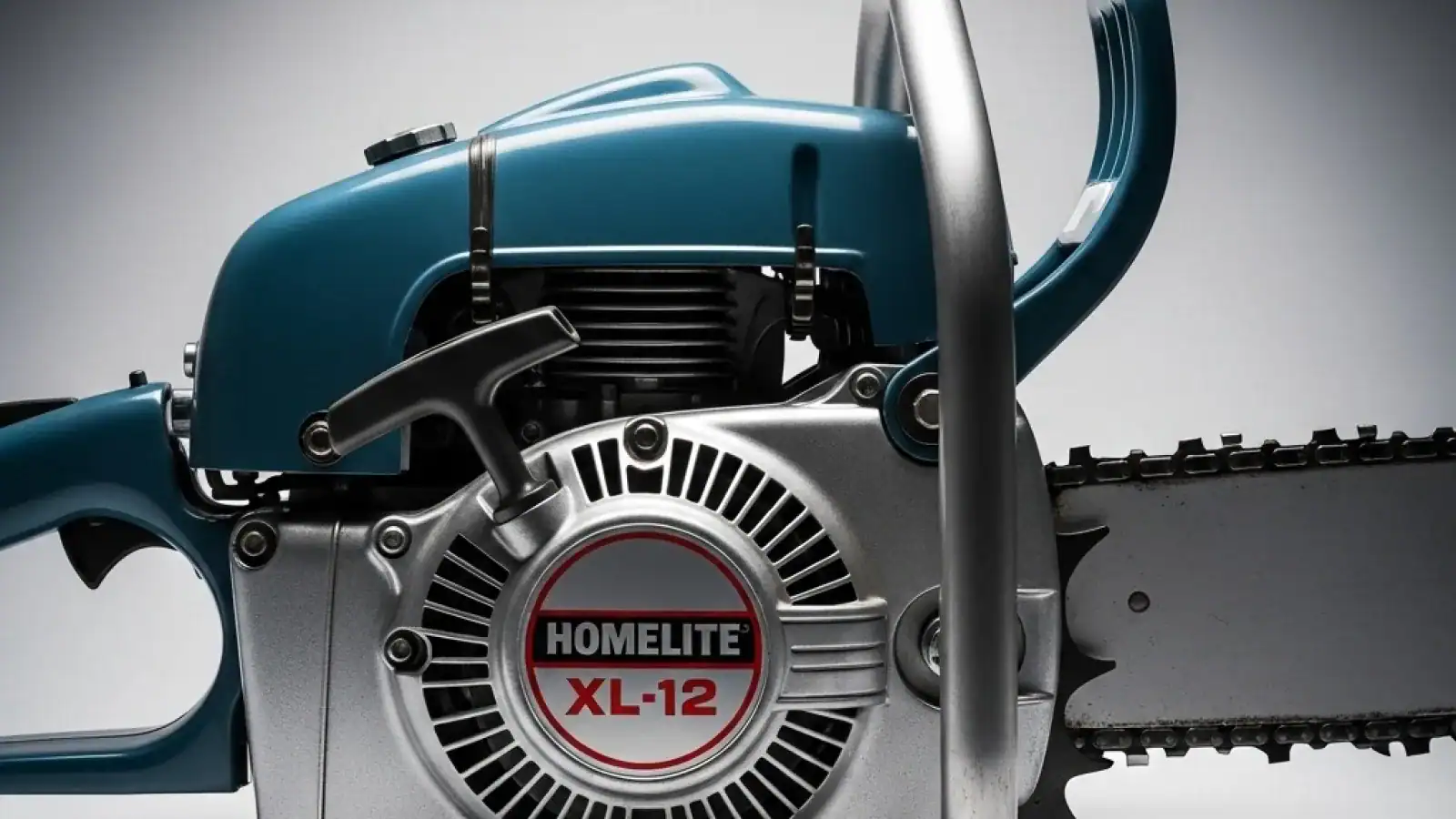

The Homelite XL-12 is more than just an antique chainsaw; it is a mechanical legend that fundamentally changed the power equipment industry. Introduced in 1963 (with production lasting through 1988), it was groundbreaking as the world’s first “lightweight” chainsaw, thanks to its revolutionary magnesium-alloy construction. The “12” in its name proudly denoted that the powerhead weighed a mere 12 pounds, a feat of engineering at the time. This saw helped transition chainsaws from heavy, professional-only tools to accessible, powerful equipment for the homeowner.
Table Of Content
- 🔬 Homelite XL 12 Specs and Power Analysis
- Engine and Performance
- Homelite XL-12 Horsepower
- 🔧 Maintenance and Repair: Parts, Carburetor, and Bar
- Homelite XL-12 Parts Availability
- Homelite XL-12 Carburetor and Fuel System
- Homelite XL-12 Bar and Chain
- 🔎 Acquisition and Authentication: Price and Serial Number Lookup
- Homelite XL 12 Price
- Homelite XL 12 Serial Number Lookup
- 📜 The Legacy
Today, the Homelite XL-12 is highly sought after by collectors and still used by those who appreciate its rugged, simple design. This article provides a deep dive into the saw’s historical specs, its enduring appeal, guidance on sourcing parts, and tips for those looking to find a Homelite XL 12 for sale.
🔬 Homelite XL 12 Specs and Power Analysis
Understanding the Homelite XL 12 specs reveals why this machine was such a success—it packed professional power into an unprecedented lightweight package.
Engine and Performance
The saw’s performance was derived from its robust two-cycle engine, built with a chrome-plated aluminum bore designed for durability.
| Specification | Homelite XL-12 (Early/Base Model) |
| Engine Displacement | 3.3 cu. in. (54.2 ccm) or 3.55 cu. in. (58.2 ccm) |
| Dry Weight (Powerhead) | 12 lbs. 12 oz. (5.8 kg) |
| Intake Method | Reed Valve |
| Carburetor | Tillotson HS-4D or Walbro SDC All-Position Diaphragm |
| Oil Pump | Manual (early models) or Automatic (Super XL Automatic) |
| Maximum Engine RPM | 6,000 RPM (under load) |
| Chain Pitch | 3/8 inch |
| Fuel Ratio | 32:1 (with Homelite mix oil) |
Homelite XL-12 Horsepower
A common question is the Homelite XL-12 horsepower. Interestingly, Homelite did not widely advertise a specific horsepower rating for the XL-12 series, focusing instead on the 12-pound weight and the saw’s phenomenal cutting speed for its size (e.g., “cuts 12-inch logs in 10 seconds”).
Based on its 54.2cc to 58.2cc displacement, loop-scavenged design, and 6,000 RPM rating, modern estimates place the effective, usable Homelite XL-12 horsepower in the range of 2.0 to 3.0 HP. This was significant power for a sub-13-pound saw in the 1960s. Choosing the Best Chainsaw Helmet for Safety and Comfort
🔧 Maintenance and Repair: Parts, Carburetor, and Bar
For enthusiasts or those performing restorations, finding Homelite XL 12 parts is the main challenge, but the simple, durable design makes repair a rewarding endeavor.
Homelite XL-12 Parts Availability
Because the XL-12 was produced for nearly 25 years and millions were sold, basic Homelite XL 12 parts are still somewhat available, primarily through three channels:
- Aftermarket/NOS (New Old Stock): Independent online retailers and specialized vintage chainsaw shops stock new old stock or modern aftermarket equivalents for consumables like starter cords, air filters, oil seals, and ignition parts.
- Salvage/Used: For major components like the magnesium casing, recoil starters, or engine housing, searching for non-working “parts saws” on auction sites is often the only route.
- Carburetor Kits: Complete rebuild kits for the common Tillotson HS-4D Homelite XL-12 carburetor are still widely manufactured by aftermarket companies, making fuel system maintenance relatively easy.
Homelite XL-12 Carburetor and Fuel System
The Tillotson all-position diaphragm carburetor was crucial to the XL-12’s performance, allowing it to cut at any angle. Maintaining this is vital. A typical repair involves:
- Replacing the old diaphragms and gaskets.
- Cleaning the fuel metering lever and needle valve.
- Checking the fuel inlet screen and filter.
Proper fuel mix (32:1 with high-quality two-stroke oil) is essential for the long-term health of the piston and cylinder due to the XL-12’s vintage metallurgy.
Homelite XL-12 Bar and Chain
The standard Homelite XL-12 bar ranged from 12 inches (the model’s namesake cut capacity) up to a maximum of 24 inches.
- Pitch/Gauge: The saw typically ran a 3/8″ pitch chain with a .050″ gauge.
- Replacement: While original Homelite XL-12 bar and chain mounts are proprietary, replacement bars are still available from aftermarket suppliers. You must ensure the new bar’s mounting pattern matches the saw’s crankcase and that the chain pitch and gauge are correct.
🔎 Acquisition and Authentication: Price and Serial Number Lookup
For those interested in owning a piece of chainsaw history, the Homelite XL 12 for sale market requires careful assessment.
Homelite XL 12 Price
The Homelite XL 12 price fluctuates wildly based on condition and originality:
- “Parts Only” or Non-Running: $50 – $120
- Runnable but Used/Rough: $120 – $250
- Fully Restored/Collector Grade: $300 – $600+
Saws in their original blue paint with the original chain brake (on later models) or flush-cut handle often command the higher end of the price spectrum.
Homelite XL 12 Serial Number Lookup
The Homelite XL 12 serial number lookup is critical for dating the saw, as the model was produced for so long. Homelite’s serial numbering conventions can be complex, often embedding the manufacture date within the first few digits:
- Early XL-12 (Pre-1972): Serial numbers are less consistent, sometimes requiring reference to specific collector guides.
- Later Models (8-Digit Serials): A common convention uses the first digit for the year of the decade (e.g., ‘2’ could mean 1972 or 1982) and the next three digits for the day of the year (e.g., ‘058’ is the 58th day).
Finding the exact manufacturing date is part of the fun for vintage chainsaw collectors and helps determine the correct parts manual to reference.
📜 The Legacy
The Homelite XL-12 remains a symbol of American power equipment innovation. Its lightweight design set the benchmark for every subsequent homeowner saw, and its legacy is sustained by a dedicated community of mechanics and enthusiasts who keep these iconic “red saws” cutting to this day.