Few sounds in outdoor power equipment are as satisfying as a two-stroke Stihl engine roaring to life on the first few pulls. However, whether you are firing up a brand-new homeowner model for weekend yard work or putting a commercial saw to work on a timber site, Stihl chainsaws use a distinct multi-position Master Control Lever that requires precise operation. Getting the sequence wrong often leads to a flooded crankcase, pulled muscles, or unnecessary wear on your starter assembly. Mastering the correct cold and warm starting routines ensures immediate ignition, prolongs equipment lifespan, and keeps your cutting tasks running on schedule.
Quick answer: To start a cold Stihl chainsaw, engage the chain brake, press the throttle lock to push the Master Control Lever down to full choke, and pull the starter cord until the engine pops (usually 2 to 4 pulls). Immediately move the lever up one notch to the half-choke position, pull the cord again until the engine fires up, then blip the throttle trigger to drop the lever into the normal idle run position.
Understanding the Stihl Master Control Lever and Cold Start Sequence
Every gas-powered Stihl chainsaw utilizes a unified Master Control Lever system that governs the ignition circuit, choke flap, and throttle latching through a single switch mechanism. To move the lever down into the full choke or starting throttle positions, you must first depress the trigger interlock on top of the rear handle while squeezing the main throttle trigger. Understanding these position settings is critical: 'Stop' (0) cuts the ignition circuit; 'Run' (I) is the standard operating position; Warm Start or Part Choke (n) opens the choke flap while holding the throttle cracked open; and Cold Start (# or full choke) completely closes the choke plate while opening the throttle slightly to draw raw fuel into the combustion chamber.
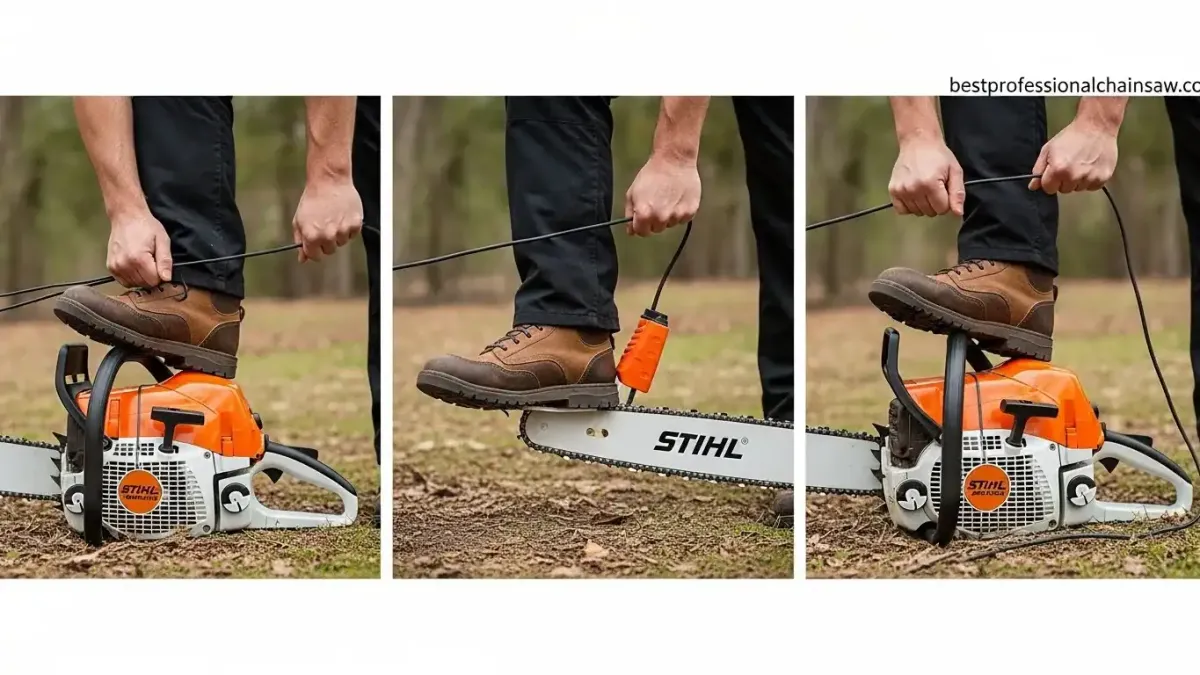
Before touching the starter rope, place the chainsaw on flat, clear ground away from dry leaves or flammable debris. Lock the chain brake by pushing the hand guard forward until it snaps firmly into place; this prevents the saw chain from spinning at fast idle when the engine catches. Thread your right boot securely into the rear handle loop, place your left hand firmly on the front handlebar, and keep your left arm straight to maintain complete physical control over the machine. Never attempt a unsafe 'drop start' by slinging the saw downward with one hand, as this swing movement creates extreme kickback risks and off-balance control losses.
If your saw comes equipped with a manual fuel primer bulb (purge pump), press it 5 to 8 times until fuel flows visibly through the clear bulb. Purging pushes trapped air out of the carburetor metering chamber and fills it with fresh two-stroke fuel, dramatically reducing the physical pulls required on cold starts. On models fitted with a spring-loaded decompression valve located on the top cylinder fins, depress the valve button before pulling the rope to reduce cylinder compression resistance and prevent excessive recoil wear.
Pull the starter grip outward slowly until you feel the starter pawls engage against the flywheel, then pull smooth and fast straight upward. Never snap the cord out to its absolute end limit, and do not let the handle snap back wildly against the starter housing. Listen closely for a quick combustion sound—often described as a 'cough' or 'pop'—which usually happens within two to four pulls. Stop pulling immediately when you hear this sound; continuing to pull on full choke will flood the engine cylinder with liquid gasoline.
Model-Specific Starting Procedures: MS 170, MS 162, and MS 250
While the fundamental cold-start routine remains consistent across the Stihl lineup, subtle mechanical variations exist between compact entry-level saws and higher-displacement mid-range saws. Small-displacement engines create distinct vacuum signals across the carburetor jets, meaning user inputs like choke management must match the machine's exact engine profile.
The standard Stihl MS 170 (30.1 cc engine displacement, generating 1.3 kW / 1.7 hp) and the updated Stihl MS 162 (30.1 cc engine displacement, 1.2 kW output) are lightweight homeowner saws designed around 14-inch to 16-inch guide bars. Neither of these entry-level units features a manual primer bulb or decompression valve. Because you rely strictly on engine vacuum to pull fuel from the fuel tank into the carburetor, cold starting these models typically requires three to five steady pulls on full choke before the initial engine pop occurs. Once you hear that brief ignition fire, move the lever to the half-choke position instantly. Attempting even one extra pull on full choke on an MS 170 will saturate the spark plug gap with unburned fuel.
Moving up to the popular Stihl MS 250 (45.4 cc engine displacement, delivering 2.3 kW / 3.1 hp) brings significantly higher compression. Designed to pull 16-inch to 18-inch guide bars equipped with standard .325-inch pitch chain, the MS 250 generates substantial recoil resistance during cold pulls. Maintaining solid boot placement in the rear handle loop is vital to prevent the powerhead from twisting sideways under high pulling force. Because the larger cylinder draws fuel far more aggressively, the MS 250 will almost always pop on its second or third pull in full choke position. Once running on half-choke, let the engine settle at high idle for 3 to 5 seconds before blipping the throttle trigger to bring it down to standard idle speed, then pull back on the hand guard to release the chain brake before entering a cut.
The table below provides key specifications and starting characteristics across common Stihl chainsaw models used by homeowners and land managers alike:
| Chainsaw Model | Displacement & Power | Standard Bar Length | Chain Pitch & Gauge | Starting Features |
|---|---|---|---|---|
| Stihl MS 162 | 30.1 cc / 1.2 kW (1.6 hp) | 12" - 16" | 3/8" LP / .043" | Master Control Lever, Standard Recoil |
| Stihl MS 170 | 30.1 cc / 1.3 kW (1.7 hp) | 14" - 16" | 3/8" LP / .050" | Master Control Lever, High-Vacuum Carburetor |
| Stihl MS 250 | 45.4 cc / 2.3 kW (3.1 hp) | 16" - 18" | .325" / .063" | High-Compression Cylinder, Master Control Lever |
| Stihl MS 271 Farm Boss | 50.2 cc / 2.6 kW (3.5 hp) | 18" - 20" | .325" / .063" | Decompression Valve, Pre-Separation Air System |
How to Avoid and Clear a Flooded Stihl Chainsaw Engine
A flooded engine is the single most common reason a Stihl chainsaw refuses to start. Flooding occurs when excessive pulls on full choke draw liquid gasoline into the crankcase and cylinder combustion chamber, drenching the spark plug electrodes and rendering ignition impossible. Users often mistake the initial engine 'pop' on full choke for a simple exhaust cough and keep pulling without switching to half-choke. Within two extra pulls, liquid fuel fills the combustion chamber, blocking electrical spark jump.
Pro tip: On real cutting jobs, if you pull a Stihl saw four times on full choke without hearing a pop, do not keep pulling. Switch the lever directly up to the half-choke position anyway. Small air pockets or high ambient temperatures often cause subtle ignition pops that are easy to miss over ear protection, and switching early prevents crankcase flooding every single time.
If you suspect your engine is flooded—evidenced by a strong smell of unburned raw gasoline or a wet starter rope—you must clear the hydraulic fuel lock before continuing. Follow this proven recovery method:
- Move the Master Control Lever to the normal 'Run' position (I) or full 'Off' position (0).
- Set the chain brake and remove the top engine shroud using your combination wrench (combipack T27 Torx socket).
- Remove the spark plug boot and unscrew the spark plug. If the plug tip is wet and black with raw gas, wipe it completely dry or burn off residual fuel using a shop rag.
- Turn the chainsaw upside down on the ground so the open spark plug hole points toward the dirt.
- Grip the starter handle with the saw inverted and pull the starter cord 10 to 15 times quickly. This ejects all pooled raw fuel out of the open cylinder hole.
- Reinstall the dry spark plug, torque it snug (approx. 20 Nm), reconnect the spark wire lead, and place the Master Control Lever into the 'Warm Start' / half-choke position. Do NOT use full choke.
- Pull the starter rope briskly while holding the saw firmly on the ground. The engine will clear its throat with a cloud of white exhaust smoke before settling into a clean idle.
Essential Pre-Start Safety and Maintenance Checks
Reliable starting depends heavily on the condition of your fuel mix, ignition system, and cutting attachment. A saw that lacks proper air intake or runs on degraded gasoline will fail to start regardless of flawless pull technique. Always mix fresh 89+ octane unleaded gasoline with high-quality 2-stroke air-cooled engine oil at a precise 50:1 ratio (2.6 fl oz of oil per gallon of gas). Ethanol blended fuel higher than E10 absorbs water over time, causing phase separation that strips lubrication from high-revving 2-stroke bearings and clogs tiny idle jets inside the carburetor.
Before pulling the cord, always check your chain tension and guide bar oiling reservoir. A properly tensioned chain sitting on a .050-inch or .063-inch gauge bar should fit snugly against the bottom bar rails while allowing you to pull the drive links smoothly around the bar nose by hand (wear heavy leather work gloves when testing chain motion). Keep the bar oil tank topped off with premium vegetable or petroleum bar and chain lubricant every time you refill the gas tank to prevent extreme friction heat and premature drive link stretching.
Personal Protective Equipment (PPE) is non-negotiable whenever you operate power equipment. Never start a saw without wearing safety glasses meeting ANSI Z87.1 standards, ear protection rated for at least 25 dB noise reduction, cut-retardant chainsaw chaps made with Kevlar or Engtex ballistic layers, steel-toe work boots, and heavy leather work gloves. Position your body so that no body part sits directly in the cutting plane of the bar, eliminating injury hazards should kickback occur unexpectedly.
Perform basic routine maintenance every 15 to 20 operating hours. Inspect the nylon or felt air filter element for fine wood dust buildup, blowing it out from the inside out using compressed air. Check the spark plug gap (standard specification is 0.020 inch / 0.5 mm) and inspect the electrode for tan-colored deposits; replace worn plugs with an approved NGK or Bosch replacement once per season to guarantee crisp spark generation across all weather conditions.
Clear Recommendation
For home users and landowners using 30cc to 45cc Stihl chainsaws, the most reliable path to effortless starting is strict adherence to the two-pull rule: never pull more than three times on full choke without moving the Master Control Lever up to half-choke, regardless of whether you heard the engine pop. If you are shopping for your first saw, opt for models featuring Stihl's Easy2Start (E) system or purge pumps if pull resistance is a concern, and always run pre-mixed ethanol-free 50:1 fuel to eliminate carburetor varnish and starting headaches entirely.
Frequently Asked Questions
Why does my Stihl chainsaw start, run for two seconds, and then die?
This behavior typically happens when you leave the Master Control Lever on full choke after the initial engine fire. The engine burns off the quick prime shot of fuel and suffocates from lack of air. Always shift the lever up to half-choke as soon as the engine pops on cold start.
Can I start my Stihl chainsaw without engaging the chain brake?
While the engine will physically start without the brake on, doing so violates basic ANSI safety standards. Starting the saw at fast idle with an un-engaged chain brake causes the saw chain to spin immediately upon ignition, creating a severe cutting hazard on startup.
What should I do if the starter rope is stuck and will not pull out?
A locked starter rope usually indicates liquid fuel hydraulic lock in the combustion chamber (extreme flooding) or physical starter recoil pawl damage. Remove the spark plug and attempt to pull the rope; if it pulls freely, the engine was fuel-locked. If it remains locked, inspect the recoil starter housing assembly for broken internal springs.
Why won't my warm Stihl chainsaw restart after taking a break?
When an engine is already hot from recent cutting, do NOT put the Master Control Lever into full choke. Putting a warm engine on full choke floods it immediately. Leave the switch in the standard 'Run' (I) position or 'Warm Start' (n) position and pull the rope.
Sources
- STIHL International - Owner's Manuals and Technical Safety Instruction Guidelines
- OSHA 1910.266 - Logging Operations Machinery and Chainsaw Safety Standards
- ANSI B175.1 - Safety Requirements for Gasoline-Powered Chainsaws