Quick answer: A carbide saw chain uses industrial tungsten carbide tiles silver-brazed onto standard steel drive chassis, allowing the cutter teeth to stay sharp up to 10 to 12 times longer than standard steel loops when cutting abrasive, dirty, mud-covered, or frozen timber. While they carry a significantly higher upfront price and require specialized diamond grinding wheels to sharpen, they eliminate frequent filing breaks on tough land-clearing and fire rescue jobs.
What Is a Carbide Saw Chain and How Is It Built?
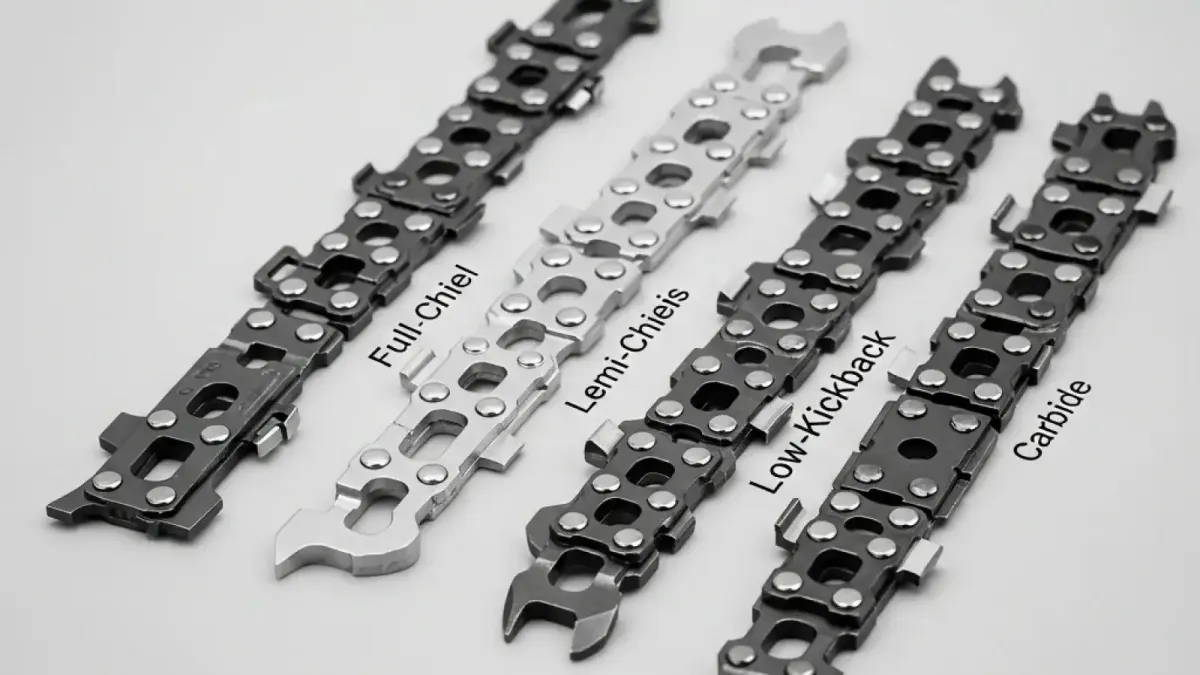
To understand why a carbide saw chain holds up against severe ground debris where standard saw loops fall apart, you have to look at the metallurgy of the cutter tooth. Traditional semi-chisel and full-chisel cutters are stamped out of high-carbon alloy steel, heat-treated for flexibility, and given a micro-thin chrome coating. On the Mohs scale of mineral hardness, hardened saw steel ranks around 5.5 to 6.0, which means common quartz particles in dirt (hardness 7.0) will instantly dull the leading edge. A carbide cutter replaces that standard steel cutting top-plate with a solid block of forged tungsten carbide silver-brazed directly onto the steel drive link chassis.
Tungsten carbide is an extremely dense compound created by joining equal parts tungsten and carbon under high-temperature powder metallurgy using a cobalt binder matrix. This engineering material registers between 8.5 and 9.0 on the Mohs hardness scale—ranking just below natural industrial diamonds. Because of this structural hardness, a carbide saw chain resists microscopic edge wear, thermal friction, and edge rolling when slicing through grit-heavy bark or dried hardwoods like osage orange, ironwood, and white oak.
Leading outdoor power equipment brands produce these specialty loops across standard pitch and gauge specifications. You can find carbide options in 3/8" Low Profile for small homeowner saws, up to full-size .325", 3/8", and .404" pitch configurations with .050" (1.3mm), .058" (1.5mm), and .063" (1.6mm) drive link gauges. These match standard 16-inch to 24-inch guide bars driven by 45cc to 70cc chainsaws, running standard 50:1 2-stroke gas oil mixture.
Key Benefits, Durability, and Real-World Uses
The single greatest advantage of mounting a carbide loop is working longevity in harsh conditions. Tree service contractors involved in stump grinding, root cutting, land clearing, or storm cleanup frequently run into logs dragged through gravel yards. Standard steel cutters hit that embedded grit and dull within three minutes of throttle time. In contrast, a tungsten carbide cutter slices right through sandy bark while preserving its original cutting geometry for hours of continuous cutting.
Winter logging operations in sub-zero climates present another scenario where carbide loops shine. Water trapped within hemlock, spruce, and pine trunks freezes into rock-hard ice structures within the grain. When standard steel full-chisel teeth impact sub-zero timber at saw chain speeds over 50 mph (80 km/h), the thin chrome plating micro-chips and loses edge keenness fast. Carbide teeth maintain consistent chip production and reduced thermal friction against guide bar rails even in deep freeze conditions.
Pro tip: While tungsten carbide offers unmatched abrasive resistance against dirt, the metal matrix is brittle under sudden shock impact. Never drop a revved carbide loop onto solid river gravel, granite boulders, or hidden steel fence wire. A high-speed impact against solid rock will shatter the carbide block or break the silver braze entirely. Always check drive link chain tension after your first ten minutes of work; a slack chain creates vibration chatter that breaks costly carbide inserts twice as fast.
Beyond forestry, municipal emergency services and structural rescue crews utilize heavy-duty carbide rescue chains on high-displacement (70cc to 90cc) saws. Built with oversized carbide blocks and reinforced tie-straps, these chains cut through composite asphalt roofing shingles, sheet metal, structural tar paper, and lightweight concrete during emergency building ventilation operations.
Carbide Saw Chain vs. Standard Steel Saw Chain
Selecting the ideal cutting chain comes down to balancing cutting speed against downtime and sharpening capabilities. Standard steel chains actually cut clean wood roughly 15% to 20% faster than carbide chains because steel can be ground into a sharper, thinner leading angle. However, the moment clean timber gives way to mud, road salt, or ground dirt, the carbide saw chain far outlasts any standard steel loop. If you are doing basic DIY timber cutting around a tidy woodpile, standard steel makes sense; if you are pulling logs out of mud pits, carbide saves hours of labor.
| Feature / Specification | Standard Steel Saw Chain | Tungsten Carbide Saw Chain |
|---|---|---|
| Hardness (Mohs Scale) | 5.5 – 6.0 | 8.5 – 9.0 |
| Sharpening Tool | Standard Round Steel File ($5) | Diamond Grinding Wheel ($80+) |
| Clean wood cutting Speed | Faster (Thinner edge geometry) | Slightly Slower (Thicker tooth profile) |
| Abrasive Dirt Resistance | Dulls in 2-5 minutes | Lasts 10x longer (Hours of run time) |
| Impact Shock Tolerance | High (Bends/rolls without shattering) | Low (Brittle under rock/metal impact) |
| Average Initial Cost | $20 – $35 | $80 – $150+ |
Sharpening and Maintenance Rules for Carbide Loops
The main reason some users hesitate to pick up a carbide saw chain is edge maintenance. You cannot dress a tungsten carbide cutter using a hand-held round steel file or standard bench grinder with an aluminum oxide wheel. The ultra-hard carbide compound will instantly rub the teeth off a steel file without sharpening the chain at all. To restore a dull or nicked carbide edge, you must use a dedicated electric bench grinder outfitted with a diamond-grit grinding wheel.
When dressing carbide cutters on a diamond grinder, take light, quick passes with gentle head pressure. Heavy grinding builds localized thermal stress, which can crack the silver braze joint bonding the carbide tile to the steel chassis. Keep coolant handy or allow ample air-cooling between grinding passes. Check your depth gauges (rakers) using a hardened steel depth gauge tool; keeping rakers set precisely to .025 inches ensures smooth feeding without snagging teeth into hard oak grain.
In addition to sharpening, keeping proper bar oil lubrication is vital. Because carbide loops are slightly heavier than standard steel chains, they generate more friction along guide bar rails. Ensure your saw’s auto-oiler is pumping clean, high-tack bar and chain oil continuously. Always adjust chain tension so the drive links pull snug against the bar belly without binding when turned by hand (wear heavy leather gloves while checking).
Is a Carbide Saw Chain Right for You?
If you are a homeowner cutting seasoned, clean firewood on a saw horse, a quality standard steel semi-chisel loop remains your most cost-effective option. However, if your work involves clearing fence lines, cutting roots near rocks, processing muddy logs, or performing storm cleanup, buying a high-durability carbide loop is one of the smartest investments you can make. Equipping a 50cc to 60cc saw with a 18-inch or 20-inch bar and a durable loop like the STIHL Rapid Duro 3 (RD3) or an equivalent Oregon carbide chain will cut your daily downtime drastically. Don't forget your safety equipment: always wear cut-retardant chainsaw chaps, heavy steel-toe boots, eye protection, and a hard hat with a face shield whenever operating power cutting equipment.
Frequently Asked Questions
Can you sharpen a carbide chainsaw chain with a regular hand file?
No. Standard steel round files are softer than tungsten carbide and will wear out immediately without sharpening the cutter tooth. Carbide cutters can only be sharpened using an electric bench grinder fitted with a specialized diamond-grit grinding wheel.
Does a carbide saw chain cut faster than a normal steel chain?
In perfectly clean wood, a traditional full-chisel steel chain actually cuts slightly faster because its teeth can be ground to a sharper, thinner leading angle. However, in dirty, icy, or bark-encrusted logs, carbide maintains its cutting speed over time while standard steel quickly dulls to a halt.
What happens if a carbide chain hits a rock or concrete?
Because tungsten carbide is hard but brittle, hitting solid rock, concrete, or metal pipes at full speed can cause the carbide tiles to chip, shatter, or break off their silver-brazed mounts entirely. They are engineered to resist dirt and sand friction, not heavy hard-object impact shock.
How long does a carbide saw chain stay sharp?
In abrasive conditions like dirty bark, frozen wood, or mud-covered logs, a carbide saw chain typically stays sharp 10 to 12 times longer than a standard carbon steel saw chain before needing resharpening on a diamond grinder.
Sources
- STIHL USA Technical Specifications & Technical Data Sheets
- OSHA Standard 1910.266 - Logging Operations Safety Standards
- Wikipedia - Tungsten Carbide Material Properties & Metallurgy