


As a chainsaw expert and outdoor power equipment specialist, I often get asked about the best type of chain for various cutting tasks. It’s a fundamental question because the chain is, quite literally, where the rubber meets the road – or rather, where the steel meets the wood! Understanding the different chainsaw chain grind types is crucial for both efficiency and safety, whether you’re a homeowner cutting firewood or a professional felling trees.
Table Of Content
- What is a Chainsaw Chain Grind?
- Understanding Full Chisel Chains
- What is Full Chisel?
- Advantages of Full Chisel Chains
- Disadvantages of Full Chisel Chains
- When to Use Full Chisel
- Understanding Semi-Chisel Chains
- What is Semi-Chisel?
- Advantages of Semi-Chisel Chains
- Disadvantages of Semi-Chisel Chains
- When to Use Semi-Chisel
- Full Chisel vs. Semi-Chisel: A Quick Comparison
- Choosing the Right Chain for Your Needs
- Sharpening Considerations
- Conclusion
Today, we’re diving deep into the two most common chainsaw chain grind types: full chisel and semi-chisel. By the end of this guide, you’ll know exactly which chain is right for your specific needs, how it impacts your cutting experience, and why it matters.
What is a Chainsaw Chain Grind?
Before we differentiate, let’s clarify what “chain grind” refers to. It’s all about the shape and angle of the cutting tooth (also called a cutter). Each tooth has a sharp edge designed to slice through wood fibers. The grind type determines how aggressive that edge is, how it performs in different wood conditions, and how durable it proves to be.
Understanding Full Chisel Chains
Imagine a sharp, square-cornered knife. That’s essentially the principle behind a full chisel chain. These chains are designed for maximum aggression and speed.
What is Full Chisel?
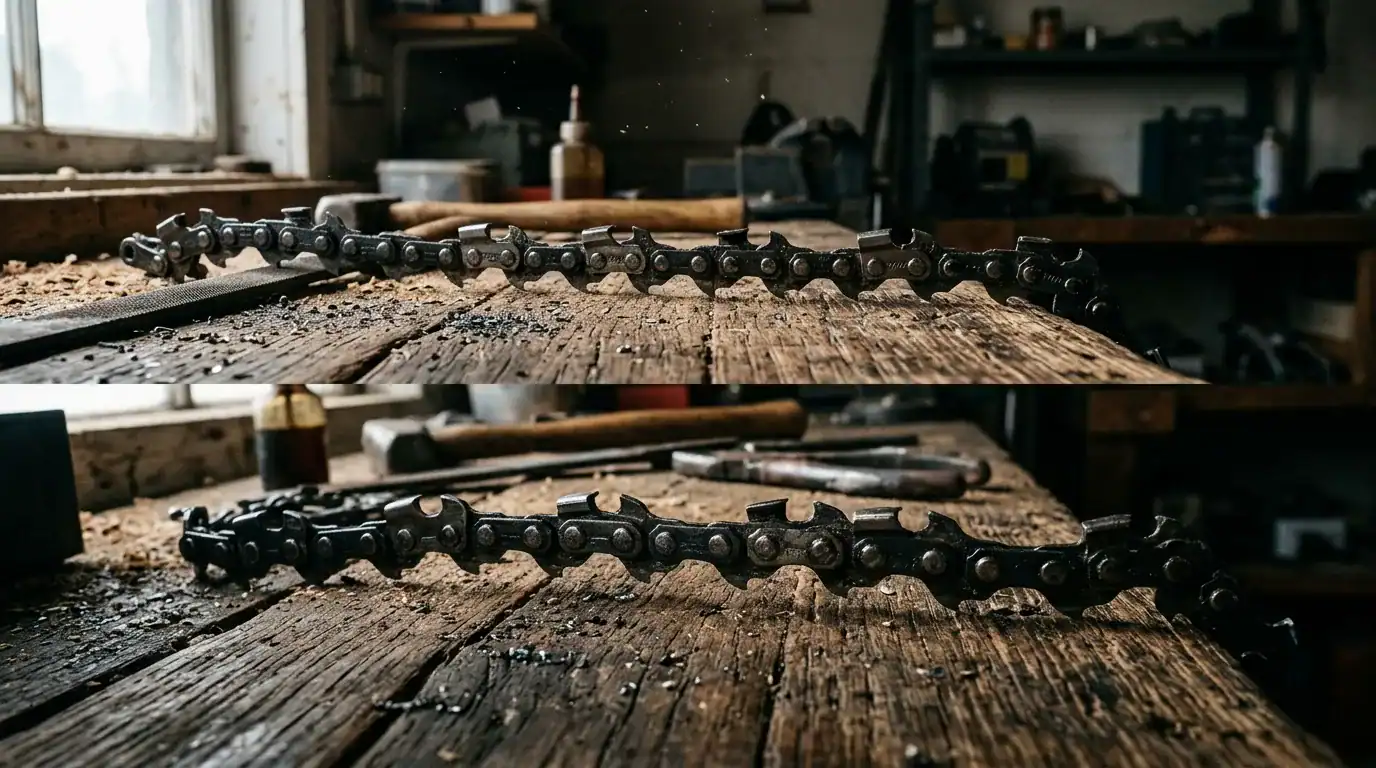
A full chisel chain features square-cornered cutters with sharp, angular side plates. This design creates a very sharp, precise edge that slices through wood fibers cleanly and quickly, much like a wood chisel. Brands often identify them with names like Stihl’s “Rapid Super (RS)” or Oregon’s “Super 70.”
Advantages of Full Chisel Chains
- Maximum Cutting Speed: They are incredibly fast in clean, green wood. If you need to fell a lot of trees or buck large logs quickly, full chisel is your go-to.
- Efficient Chip Ejection: The aggressive grind produces large, clean chips, which helps clear the kerf (the cut path) efficiently.
- Ideal for Professionals: Loggers, arborists, and experienced landowners often prefer full chisel for its superior performance in ideal conditions.
Disadvantages of Full Chisel Chains
- Higher Kickback Potential: Due to their aggressive nature, full chisel chains have a higher risk of kickback, making them less suitable for beginners.
- Dulls Quickly in Dirty Wood: They lose their edge rapidly if they encounter dirt, sand, old bark, or frozen wood.
- More Challenging to Sharpen: Maintaining the precise angles of a full chisel cutter requires more skill and a steady hand, often needing a specific round file size (e.g., 5/32″ or 7/32″ depending on chain pitch).
- Less Forgiving: Small errors in technique or hitting an obstacle can cause significant damage to the chain.
When to Use Full Chisel
Choose a full chisel chain if you are:
- An experienced chainsaw operator.
- Cutting clean, soft, or green wood.
- Felling trees or bucking large diameter logs.
- Looking for maximum cutting speed and efficiency.
Understanding Semi-Chisel Chains
Think of a more rounded, robust knife blade. That’s closer to a semi-chisel chain – designed for durability and versatility.
What is Semi-Chisel?
A semi-chisel chain features cutters with rounded working corners and side plates. This rounded profile makes the cutting edge less aggressive but significantly more forgiving. Stihl offers “Rapid Micro (RM)” and Oregon has its “S70” or “Low-Profile” chains as common examples.
Advantages of Semi-Chisel Chains
- Excellent Durability: The rounded corners are much more resistant to dulling when encountering dirt, sand, or tough wood. They hold their edge longer in adverse conditions.
- Reduced Kickback: Their less aggressive profile significantly lowers the risk of kickback, making them a safer choice for less experienced users or homeowners.
- Easier to Sharpen: The rounded cutting edge is simpler to file accurately, making maintenance less daunting for DIY users.
- Versatile: Great for a wide range of tasks and wood types, including dirty firewood, limbing, and general property maintenance.
Disadvantages of Semi-Chisel Chains
- Slower Cutting Speed: They don’t cut as fast or as aggressively as full chisel chains, especially in clean, green wood.
- Produces Smaller Chips: The rounded profile tends to create smaller chips or sawdust rather than large chips.
When to Use Semi-Chisel
Opt for a semi-chisel chain if you are:
- A homeowner, DIY user, or less experienced operator.
- Cutting dirty, frozen, hard, or seasoned wood (e.g., firewood).
- Limbing branches or performing general property maintenance.
- Prioritizing durability, safety, and ease of sharpening over raw speed.
Full Chisel vs. Semi-Chisel: A Quick Comparison
Here’s a brief breakdown to help solidify the differences:
- Cutting Speed: Full Chisel (Faster) > Semi-Chisel (Slower)
- Durability/Edge Retention: Semi-Chisel (Better in dirty wood) > Full Chisel (Dulls faster)
- Kickback Risk: Full Chisel (Higher) > Semi-Chisel (Lower)
- Ease of Sharpening: Semi-Chisel (Easier) > Full Chisel (More challenging)
- Ideal Use: Full Chisel (Clean, green wood; felling) | Semi-Chisel (Dirty, seasoned wood; limbing, general use)
Choosing the Right Chain for Your Needs
The best chain for you isn’t necessarily the fastest; it’s the one that matches your skill level, the type of wood you’re cutting, and your specific chainsaw. For instance, if you’re running a powerful professional chainsaw like a Stihl MS 362 or Husqvarna 560 XP, a full chisel chain might unlock its full potential in clean felling. However, if you’re using a smaller, homeowner-grade saw for firewood, a semi-chisel chain will be safer and more effective.
- Consider your wood: Is it fresh and clean, or old, dirty, and full of debris?
- Assess your experience: Are you comfortable managing kickback and precise sharpening?
- Match your chainsaw: Most small electric or entry-level gas chainsaws are best paired with semi-chisel chains for safety and manageability.
Sharpening Considerations
Regardless of the grind type, regular sharpening is vital for performance and safety. Full chisel chains require precise angles and a consistent stroke to maintain their aggressive edge. Semi-chisel chains are more forgiving, allowing for slightly less precise filing while still yielding good results. Always use the correct size round file for your chain’s pitch and ensure your depth gauges (rakers) are set correctly.
Conclusion
Understanding the difference between full chisel and semi-chisel chainsaw chains empowers you to make smarter choices, work more efficiently, and stay safer. For most homeowners and DIY users, the semi-chisel chain is the reliable, durable, and safer choice. For experienced professionals tackling clean wood, the full chisel chain offers unmatched speed. Always prioritize safety, wear appropriate personal protective equipment (PPE), and maintain your chains correctly. Here at Best professional chainsaw, we believe the right tool for the job, properly understood, makes all the difference.