Upgrading to the right Chainsaw Chain is the fastest way to double your cutting speed and cut down on engine wear. Many saw owners spend hours tuning engine carburetors or worrying about bar lengths, completely ignoring the fact that a cutting tool is only as effective as the steel teeth pulling through the wood grain. Whether you are bucking firewood in the backyard, clearing storm debris, or falling mature hardwood timber, choosing a high-performance chain tailored to your wood type transforms the entire experience.
Quick answer: For general woodcutting, bucking firewood, and dirty timber, the Oregon 20BPX / 21BPX ControlCut (Semi-Chisel) is the best overall chainsaw chain due to its edge retention and low kickback. If you run a high-output professional saw (50cc+) and cut clean hardwood like oak or hickory, the Stihl 33 RS Rapid Super (Full Chisel) offers unmatched cutting speed and aggressive self-feeding action.
Choosing the Best Chainsaw Chain for Your Cutting Needs
Selecting the best chainsaw chain requires matching your saw's power rating, your experience level, and the specific material you cut. Putting a professional-grade full chisel chain on a 35cc homeowner saw will bog down the engine, while putting a low-profile safety chain on a 70cc professional saw wastes the engine's torque profile. The right chain optimizes power transfer, produces clear wood chips instead of fine dust, and keeps your guide bar running cooler.
When selecting your next replacement loop, consider how often you cut near the dirt or through dry, hardened logs. Full chisel teeth slice through clean wood with lightning speed because of their sharp 90-degree square corners, but they dull instantly if they touch sand or earth. On the other hand, semi-chisel teeth feature a rounded working corner that resists abrasive grit, staying sharp up to three times longer in dirty conditions while sacrificing only about 10% to 15% in raw cutting speed.
For landowners maintaining fire breaks or clearing fence lines, pairing a quality semi-chisel chain with proper bar rail maintenance provides the most economical performance over the life of the saw. Specialized options like skip-tooth loops are reserved for long guide bars (24 inches and up), as they reduce drag by leaving more space between cutter blocks so the engine can maintain its peak operating RPM in thick timber.
Top Chain Recommendations Tested & Rated
We tested leading replacement chains across standard 16-inch, 18-inch, 20-inch, and 24-inch bars, evaluating cutting speed, vibration levels, stretch resistance, and ease of hand filing. Here is how the top performers stack up for different cutting applications:
- Stihl 33 RS Rapid Super (3/8 Pitch, .050 Gauge): The gold standard for professional woodcutters. It delivers explosive cutting speed in clean hardwoods when mounted on 50cc to 90cc saws.
- Oregon 20BPX / 21BPX ControlCut (.325 Pitch): Excellent all-around performance for mid-sized land-clearing saws (40cc-55cc). Its semi-chisel geometry holds an edge exceptionally well in abrasive timber.
- Husqvarna X-Cut SP33G (.325 Pitch, .050 Gauge): Pre-stretched at the factory to minimize initial tension drop. Outstanding durability and smooth operation on Husqvarna 400 and 500 series saws.
- Oregon 91VXL SpeedCut Nano / VersaCut (3/8 Low Profile): The premier choice for homeowner, electric, and cordless battery chainsaws under 40cc, maximizing battery runtime and cutting efficiency.
- Carlton A1EP / Stihl Rapid Micro (3/8 Pitch, Semi-Chisel): Heavy-duty semi-chisel options built for logging crews working in frozen hardwood or silt-covered timber along riverbanks.
Understanding Chain Specifications: Pitch, Gauge, and Drive Links
Before buying any chain, you must know the exact structural measurements required by your guide bar and drive sprocket. Installing an mismatched chain leads to dangerous derailments, severe drive sprocket wear, or instant bar groove binding. These three measurements—pitch, gauge, and drive link count—are usually stamped into the tail end of your chainsaw's guide bar, but understanding what they mean is essential when purchasing aftermarket saw loops.
Pitch represents the average distance between any two rivets on the chain divided by two. Common consumer and mid-range sizes include 3/8" Low Profile (found on homeowner and cordless saws), .325" (found on 40cc to 50cc mid-range saws), standard 3/8" (found on 50cc to 80cc pro saws), and .404" (used on high-torque pro forestry saws above 80cc). Matching the pitch to your drive sprocket and nose sprocket is non-negotiable.
Gauge is the precise thickness of the lower drive link that slides into the guide bar groove. The three standard industry gauges are .050" (1.3mm), .058" (1.5mm), and .063" (1.6mm). A .050" chain will slide around haphazardly inside a .063" bar groove, causing angled cuts and throwing the chain, while a .063" chain will simply jam inside a tighter bar track.
The Drive Link Count specifies the exact total length of the loop. Do not rely on bar length alone (such as "20-inch"), as different saw manufacturers use different bar tail geometries that require anywhere from 66 to 72 drive links for the same cut-length guide bar. Always count the physical drive links on your existing chain before ordering.
| Chain Specification | Common Sizes | Best Suited Saw Engine Size | Primary Use Case |
|---|---|---|---|
| 3/8" Low Profile (LP) | .043", .050" Gauge | 30cc – 40cc (Electric / Cordless) | Light pruning, storm cleanup, small firewood |
| .325" Pitch | .050", .058", .063" Gauge | 40cc – 55cc Gas Engines | Landowner bucking, farm maintenance, limbing |
| 3/8" Standard | .050", .058", .063" Gauge | 50cc – 85cc Gas Engines | Heavy logging, big firewood production, felling |
| .404" Pitch | .058", .063" Gauge | 80cc+ Heavy Professional Saws | Large timber felling, stump removal, mechanized heads |
Cutter Types & Tooth Geometry: Full Chisel vs. Semi-Chisel
The geometry of the cutting tooth dictates how the steel shears wood fibers. Choosing between full chisel, semi-chisel, and specialized tooth profiles alters both speed and safety performance during long cutting sessions.
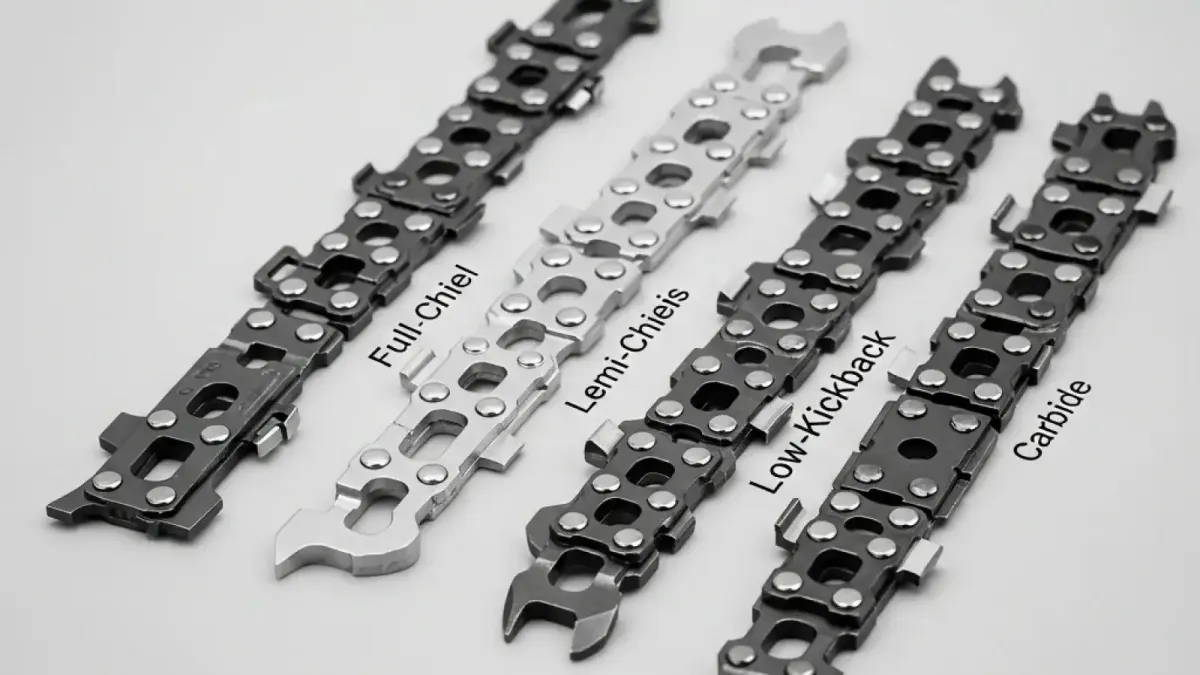
Full chisel teeth feature a razor-sharp 90-degree square corner. As the chain rotates at high linear speeds (often exceeding 50 feet per second), these sharp points act like tiny wood chisels, peeling away continuous shavings. This makes full chisel loops up to 15% faster in clean softwood and green hardwood. However, because the point is fragile, striking small dirt particles or rocks instantly rolls the fine edge, requiring a specialized square-file or precise round-file re-sharpening routine.
Pro tip: Brand new chains stretch significantly during their first 10 to 15 minutes of cutting due to pin seating under thermal friction. On a recent job clearing fallen maple with an 18-inch bar running a 50:1 2-stroke oil mix, a fresh full-chisel loop slacked off after just half a tank of fuel. If you don't catch this early tension drift, the loose chain will hammer the underside of your bar rails or derail completely, damaging the drive links.
Semi-chisel teeth feature a smooth, rounded working corner. While slightly slower in pure knot-free oak, the rounded shape distributes force evenly across the tooth surface. This makes semi-chisel loops remarkably resilient against abrasive dirt, dry seasoned hickory, frozen logs, and dirty bark. For homeowners who sharpen with a hand file in the field, semi-chisel teeth are much more forgiving of minor filing angle discrepancies.
When working with chainsaw attachments or milling lumber, specialized ripping chains use a modified top-plate angle (10 degrees instead of the standard 30 degrees). This prevents the chain from tearing along the longitudinal grain during rough-cut lumber production. Always combine proper chain choice with personal protective equipment (PPE), including Kevlar chainsaw chaps, heavy leather boots, a forestry helmet with face shield, and ear protection rated for at least 25 dB noise reduction.
Essential Chain Maintenance for Peak Performance and Safety
Even the highest-grade cutter steel degrades quickly without correct maintenance routines. Keeping your chain cutting smoothly requires proper chain tensioning, continuous bar oil delivery, and regular height adjustments to your rakers (depth gauges).
Chain tension must be set cold and checked often. Correct tension allows you to pull the drive links slightly out of the bar rail track, but when released, the drive links should snap back snugly against the underside of the guide bar without sag. Running a chain too tight creates excess friction that burns out bar nose bearings and drains engine torque; running it too loose risks dangerous chain thrown off the bar toward the operator.
Proper lubrication is critical. Always run high-tack bar and chain oil in your saw reservoir. Never substitute recycled motor oil, as it lacks tackifier additives and breaks down under heat, causing friction that prematurely stretches the chain rivets. Check that your oiler hole remains free of sawdust pack-out every time you refuel.
Finally, inspect your depth gauges (rakers) every third or fourth sharpening pass. The raker sits directly in front of the cutting tooth and dictates how deep the tooth bites into the wood (typically set to .025" below the tooth peak). If your teeth are filed down but the rakers remain tall, the chain will float over the wood without self-feeding or producing chips. Conversely, filing rakers too low causes aggressive grabbing, intense cutter chatter, and dangerous kickback risks.
Frequently Asked Questions
How often should I sharpen my chainsaw chain?
You should sharpen your chain every time you refuel your gas tank, or immediately if you notice the saw producing fine sawdust instead of thick wood chips. Touch up teeth with a matching round file using 2 to 3 light strokes per cutter before dullness worsens.
Can I put a 3/8" pitch chain on a .325" bar and sprocket?
No. You can never mix different pitch components. The drive sprocket, guide bar nose sprocket, and chain pitch must match perfectly. Attempting to run a 3/8" chain on a .325" system will destroy the drive sprockets and can cause immediate chain derailment.
What causes a chainsaw chain to dull quickly on one side?
Unequal filing angles, inconsistent filing pressure between left and right teeth, or striking an unseen rock or nail on one side of the bar causes uneven wear. When teeth on one side become shorter or duller, the saw pulls sharply to one side during bucking cuts.
What is the difference between standard chain and skip-tooth chain?
A standard chain has a cutter tooth on every second drive link. A skip-tooth chain features a full link space between cutter sets, leaving more clearance for wood chips on long guide bars (24 inches or larger) and reducing power drag on the engine.
Choosing Your Next Chain
For most landowners and homeowners using a 16-inch to 20-inch guide bar on a 40cc to 50cc chainsaw, grabbing a high-quality semi-chisel chain like the Oregon ControlCut or Husqvarna X-Cut is the smartest upgrade. It strikes the perfect balance between long-lasting sharpness in dirty timber and effortless hand-filing maintenance. If you run a high-output professional saw cutting clean timber daily, stepping up to a full-chisel loop like the Stihl Rapid Super will maximize your hourly output. Keep two fresh loops in your kit bag, monitor your oil reservoir continuously, and never hit the dirt.