Quick answer: For absolute raw cutting speed in clean softwood, the Oregon 72LPX Super Guard or Stihl 36RS Rapid Super offer the most aggressive full-chisel performance. If you need the toughest chainsaw chain to handle dirty timber, frozen hardwood, or ground-level clearing without immediate dulling, opt for a heavy-duty semi-chisel setup like the Stihl 36RM Rapid Micro or Oregon 20BPX ControlCut.
Understanding Chain Pitch, Gauge, and Drive Links
Before buying any replacement chain, you must know the three core specifications stamped on your guide bar: pitch, gauge, and drive link count. Mismatching any of these measurements causes binding, severe bar groove destruction, rapid sprocket wear, or catastrophic chain derailment. A 50cc saw spinning a chain at over 50 feet per second requires exact alignment across all drivetrain components.
Chain Pitch: Pitch defines the average distance between rivets. Calculate it by measuring the distance between any three consecutive rivets and dividing by two. The standard pitch sizes in modern forestry and tree care are:
- 1/4 inch: Found on ultra-light carving saws and pole pruners for precise, smooth cuts.
- 3/8 inch Low Profile (LP): Standard on homeowner saws from 30cc to 40cc using 12-inch to 16-inch bars.
- .325 inch: Popular on mid-sized prosumer saws (40cc to 55cc) running 16-inch to 20-inch bars, balancing fast cutting speed with low vibration.
- 3/8 inch Standard: The industry default for professional saws (50cc to 90cc) carrying 18-inch to 36-inch guide bars.
- .404 inch: Heavy-duty pitch for high-displacement professional saws (80cc+) and mechanical bucking harvesting gear.
Chain Gauge: Gauge specifies the exact width of the drive links that slide within the guide bar rail. The four universal standard gauges are .043 inch (1.1mm), .050 inch (1.3mm), .058 inch (1.5mm), and .063 inch (1.6mm). Using an .050 gauge chain inside an .058 bar groove results in loose lateral play, crooked cuts, and uneven bar rail wear.
Drive Link Count: Bar length marketing numbers (such as "18-inch bar") are generic terms. The true fitting parameter is the drive link (DL) count. An 18-inch bar for a Husqvarna .325 setup might take 72 drive links, whereas an 18-inch bar for a Stihl 3/8 setup might take 66 drive links. Always count the physical drive links on your current loop or check the tail stamping on your guide bar before ordering replacement chainsaw chains.
What Makes an Aggressive Chainsaw Chain vs. The Toughest Chainsaw Chain?
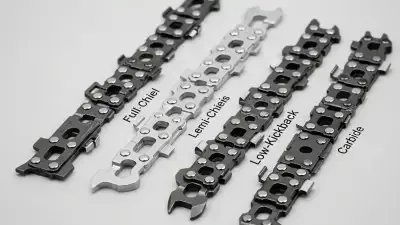
cutting efficiency comes down to cutter profile engineering. The market is split between full-chisel cutters, semi-chisel cutters, and specialized carbide-tipped links. Choosing between an aggressive chainsaw chain for race-like speed and a tough cutter built for abrasive environments dictates how often you will need to stop and file.
Full-chisel chains feature square-cornered cutters that split wood fibers abruptly. This square profile creates minimal friction, allowing the saw to pull itself through clean timber with blistering speed. However, full-chisel teeth are extremely vulnerable to damage. Hitting dirt, frozen bark, or sand instantly dulls the square corner, dropping performance dramatically.
Pro tip: Brand-new chains stretch rapidly during their first tank of fuel due to rivet seating. On new installations, stop after 5 to 10 minutes of cutting to check tension. Running a fresh chain loose will heat-warp your guide bar rails and can throw the chain off the drive sprocket, leading to damaged drive link tangs.
Semi-chisel chains feature a rounded corner profile. While roughly 10% to 15% slower in clean softwood compared to full-chisel, semi-chisel cutters hold their edge far longer when cutting hardwood like oak, hickory, or mesquite. When working near ground level where soil grit is present, semi-chisel is the toughest chainsaw chain profile for maintaining a reliable cutting edge without requiring constant field resharpening.
Top 5 Chainsaw Chains Reviewed
1. Oregon 72LPX / 72PX Super Guard (Best Overall Aggressive Chain)
The Oregon 72LPX series (3/8 pitch, .050 gauge) is widely recognized as a top-tier aggressive chainsaw chain for high-output firewood production and timber harvesting. Utilizing an advanced full-chisel cutter geometry, it bites deep into white pine, fir, and clear hardwoods, maximizing the power output of 50cc to 80cc powerheads.
Featuring low-vibration depth gauges and ramped drive links, the 72LPX meets ANSI B175.1 standards while delivering exceptional plunge-cutting performance. The offset depth gauges prevent the cutters from grabbing unevenly, providing smooth tracking through heavy bucking cuts on 20-inch and 24-inch guide bars.
2. Stihl 36RS Rapid Super (Toughest Professional Full-Chisel)
Engineered with proprietary German steel and chrome-plated cutter surfaces, Stihl's 36RS (3/8 pitch, .050 gauge) is the benchmark for durable, aggressive performance. The square cutter design maximizes cutting speed in clean timber, while the reinforced chassis resists stretch better than lower-grade alternatives.
The pre-stretched alloy rivets keep chain slop to a minimum during heavy duty cycles. For commercial arborists running 60cc to 90cc saws in thick logs, the 36RS delivers rapid chips, excellent bore-cutting response, and superb edge retention under heavy thermal stress.
3. Oregon 20BPX / 21BPX ControlCut (Best Semi-Chisel for Hardwood)
If your cutting involves downed trees covered in mud, frozen oak, or dry hardwood, the Oregon 20BPX (.325 pitch, .050 gauge) represents the perfect compromise between speed and durability. The micro-chisel profile features small-radius working corners that resist abrasive dulling far better than square chisel configurations.
This chain is specifically tuned for 38cc to 62cc saws equipped with 16-inch to 20-inch bars. Its forgiving cutter shape makes field touch-ups fast using a standard round file, requiring far less metal removal to restore a razor edge compared to damaged full-chisel teeth.
4. Husqvarna X-Cut SP33G / C85 (Best Precision & Low Stretch)
Husqvarna's in-house manufactured X-Cut series features pre-stretched steel links, golden tie-strap indicators for filing reference, and a fine-tuned semi-chisel/chisel hybrid geometry. The SP33G (.325 pitch, .050 gauge) is optimized for Husqvarna 400 and 500 series saws, reducing friction parasitic losses.
Because the chain is pre-stretched at the factory, operators experience minimal tension drift over the life of the loop. The narrow kerf design demands less power from the engine, yielding faster cut times on medium-displacement saws without sacrificing smooth handling.
5. Stihl 36RM Rapid Micro (Toughest Heavy-Duty Semi-Chisel)
When toughness is the primary requirement, the Stihl 36RM (3/8 pitch, .050 gauge) stands out as the ultimate heavy-duty semi-chisel chain. Designed with rounded cutters that hold an edge through gritty bark, dirty storm cleanup debris, and seasoned dry hardwoods, it is built to survive harsh conditions.
The semi-chisel geometry reduces kickback energy naturally while providing high tolerance against accidental ground contact. It is the premier choice for property owners clearing land or bucking mixed logs on 18-inch to 24-inch bars driven by 55cc+ engines.
Chainsaw Chain Comparison Specifications
| Chain Model | Pitch / Gauge | Cutter Type | Aggressiveness | Best Application |
|---|---|---|---|---|
| Oregon 72LPX Super Guard | 3/8" / .050" | Full-Chisel | Very High | Clean timber, fast softwood bucking |
| Stihl 36RS Rapid Super | 3/8" / .050" | Full-Chisel | Very High | Pro felling, thick log bucking |
| Oregon 20BPX ControlCut | .325" / .050" | Semi-Chisel | Moderate | Dirty hardwood, storm debris cleanup |
| Husqvarna X-Cut SP33G | .325" / .050" | Semi-Chisel Hybrid | High | Precision limbing, mid-size saws |
| Stihl 36RM Rapid Micro | 3/8" / .050" | Semi-Chisel | Moderate | Toughest dirty wood cutting, dry logs |
Buying & Maintenance Guide for Maximum Chain Life
Getting long service life from your chain requires strictly adhering to proper operational discipline. Always run fresh 2-stroke fuel mixed at a strict 50:1 ratio with synthetic two-cycle oil, and ensure your bar oil reservoir delivers continuous lubrication to the guide bar rails. Running a chain dry will destroy both the bar groove and the chain rivets within seconds.
Tension your chain so the drive link tangs remain seated inside the bar groove when pulled down firmly from the middle of the bar, but can still be rotated freely by hand with the engine off and chain brake disengaged. Check out our detailed guides on chain sharpening and maintenance to keep your cutter angles balanced at 30 degrees using correct round file diameters (typically 7/32" for 3/8 pitch and 3/16" for .325 pitch).
Safety must always come first when operating power equipment. OSHA standard 1910.266 mandates essential protective measures during logging and tree cutting. Always wear proper chainsaw safety gear, including cut-retardant chainsaw chaps, heavy leather boots, eye protection, and helmet systems with face shields to guard against high-velocity chips and potential kickback events.
For high-output cutting on clean softwood, equip a 50cc-70cc saw with an aggressive full-chisel loop like the Oregon 72LPX or Stihl 36RS; if cutting dirty, frozen, or ground-level hardwood, outfit your saw with a tough semi-chisel chain like the Stihl 36RM or Oregon 20BPX for maximum durability between filings.
Frequently Asked Questions
What is the most aggressive chainsaw chain available?
Full-chisel chains with square corner profiles, such as the Oregon 72LPX or Stihl 36RS, are the most aggressive non-carbide chains available. They slice clean wood fibers rapidly but require clean timber to maintain their sharp cutting edges.
What is the toughest chainsaw chain for dirty wood and hardwood?
Semi-chisel chains like the Stihl 36RM Rapid Micro or Oregon 20BPX ControlCut are the toughest options for dirty wood, bark with embedded grit, and seasoned hardwood. Their rounded corner design resists abrasion far better than full-chisel cutters.
Can I put a 3/8 pitch chain on a .325 bar?
No. The chain pitch must match the nose sprocket pitch of the guide bar and the drive sprocket on your saw powerhead. Running mismatched pitches will destroy the bar nose and drive sprocket immediately.
How often should I sharpen my chainsaw chain?
Touch up your chain every time you refill your gas tank, or immediately if you notice the saw producing fine dust instead of large wood chips. Taking 2 or 3 light file strokes per tooth regularly maintains peak performance and prevents excessive engine strain.
Sources
- STIHL Technical Data & Saw Chain Guide
- Oregon Tool Maintenance & Chain Selection Specifications
- OSHA 1910.266 Standard for Logging Operations
- ANSI B175.1 Chainsaw Safety Standards