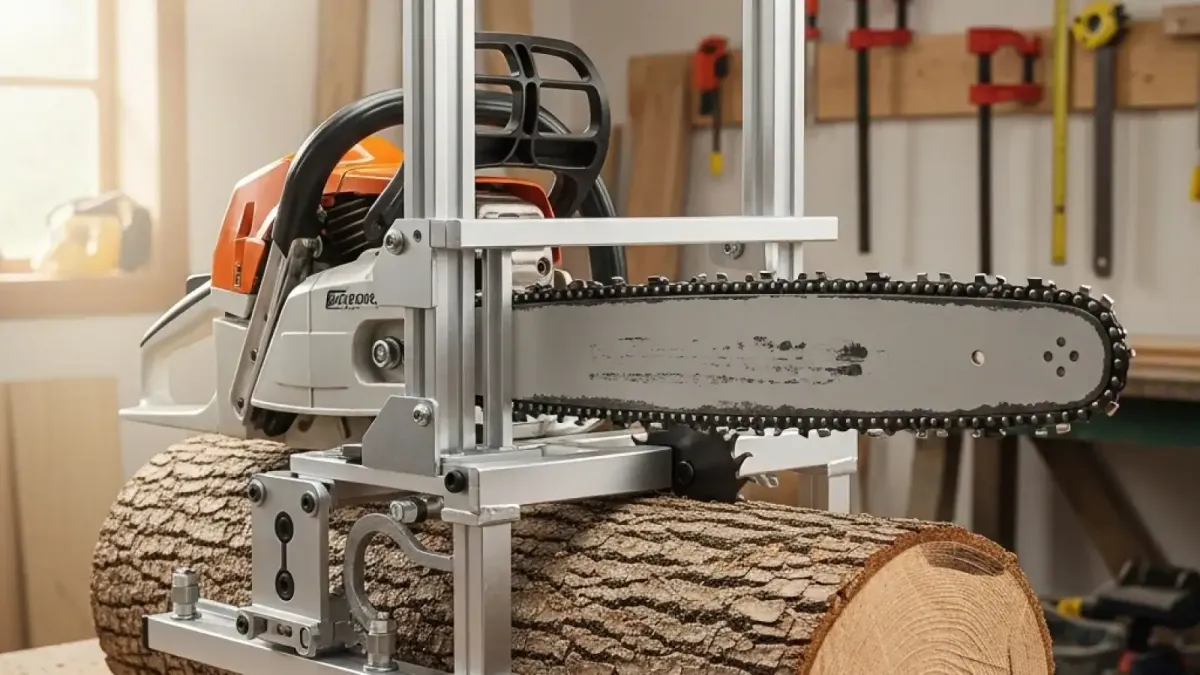
Quick answer: A chainsaw sawmill (such as a Granberg alaskan mill) attaches directly to your chainsaw's guide bar, allowing you to slice straight, uniform slabs from logs. To mill efficiently, you need a high-displacement gas saw (at least 60cc for softwoods, 70cc to 90cc+ for hardwoods), a dedicated ripping chain ground to a 10-degree top plate angle, and a sturdy first-cut rail setup.
Understanding How Chainsaw Mills Work and Why You Need Power
Unlike standard crosscutting—where the chain teeth sever wood fibers perpendicular to the grain—milling requires ripping through the wood parallel to the grain. This cutting action puts immense, continuous strain on your saw's engine, clutch, and cooling system. A standard homeowner saw built for firewood bucking will quickly overheat and burn out under the sustained load of milling lumber.
To run a milling rig effectively, high engine displacement is non-negotiable. For logs up to 18 inches in diameter, a minimum powerhead size of 60cc (around 3.5 kW / 4.7 hp) is required. If you plan to slab larger hardwoods like oak, maple, or walnut over 24 inches wide, you will want a professional-grade powerhead boasting 85cc to 120cc (such as a STIHL MS 661 C-M or MS 881, or a Husqvarna 395XP). These high-displacement engines deliver the high torque necessary to maintain chain speed without stalling under heavy cut pressure.
Beyond the engine, your cutting bar and chain choices dictate the precision of your rough-sawn boards. Standard crosscut chain uses a 30-degree or 35-degree top plate angle, which tears wood fibers during a rip cut and creates rough, uneven surfaces. A dedicated ripping chain features cutting teeth ground down to a 10-degree angle, shearing off tiny wood curls cleanly and leaving a surprisingly smooth finish that requires minimal planing.
Pro tip: Always run your 2-stroke oil mixture slightly richer during long milling sessions (e.g., a precise 50:1 mix with high-grade synthetic oil) and verify your chain oiler is maxed out. During a long continuous cut, chain stretch occurs rapidly due to thermal expansion. Check and readjust chain tension after every single pass, and never let the bar oil reservoir run completely dry before the fuel tank empties.
Top Chainsaw Sawmill Options and Styles
Chainsaw mills come in several distinct frame styles depending on the size of the timber you intend to process and how portable you need the rig to be. Choosing the right frame style depends entirely on whether you prioritize maximum board width or extreme portability in deep woods.
Frame-Style Mills (Alaskan Style)
The most popular design is the classic ladder-frame mill, often referred to globally as an alaskan mill after the pioneer brand Granberg. This rig consists of rigid tubular aluminum and steel uprights that clamp directly onto the guide bar at two points (the tip and near the powerhead). The flat underside of the frame rests on top of a guide rail or the previously cut flat face of the log, riding along as you push the saw forward to maintain an exact board thickness, adjustable from 1/2 inch up to 12 inches.
Vertical and Mini Rail Mills
Vertical milling attachments clamp to the bar near the powerhead and run along a single guide rail or 2x4 board attached to the side of the log. These compact attachments are exceptional for slabbing smaller logs, squaring up beams, or making vertical edging cuts to turn round logs into square cants before changing over to a horizontal frame mill. They weigh significantly less and are easily stowed in a backpack for remote trail work or off-grid construction.
Chainsaw Mill Comparison and Specifications
| Mill Type / Model | Optimal Bar Length | Min. Recommended Saw Size | Max Log Capacity | Best Application |
|---|---|---|---|---|
| Granberg Small Log Mill | 16" to 20" | 50cc – 60cc | 18" Diameter | Small softwoods, fence posts, DIY timber framing |
| Granberg MK IV (G778) | 24" to 36" | 70cc – 90cc | 32" Diameter | Medium hardwoods, live-edge slabs, structural lumber |
| Heavy-Duty Commercial Mill | 48" to 84"+ | 90cc – 120cc (or dual heads) | 56"+ Diameter | Massive tabletop slabs, wide hardwood logs |
| Vertical Edging Mill | 16" to 24" | 55cc – 70cc | Unlimited length | Squaring beams, trimming edges, dimensioning cants |
Essential Equipment, Chainsaw Setup, and Safety Gear
Setting up your chainsaw for milling demands meticulous attention to detail and zero compromises on safety gear. Milling generates fine wood dust and forces the operator to stand close to the bar end for extended periods, making full protective personal equipment (PPE) mandatory. You must wear heavy-duty chainsaw safety equipment including chainsaw-rated chaps or pants, steel-toe boots, heavy leather gloves, eye protection with side shields or a full mesh visor, and high-attenuation ear protection rated for over 105 dB.
When configuring your cutting head, match your drive sprocket and bar gauge carefully. Most medium-to-large milling setups utilize a 3/8" pitch chain with a .050" or .058" gauge, while extra-large setups running bars over 48 inches rely on heavy-duty .404" pitch chain with a .063" gauge to handle extreme torque without snapping drive links. Using an auxiliary bar-nose oiler kit is highly recommended for bars 36 inches and longer to ensure adequate lubrication reaches the nose sprocket under constant friction.
Securing the log before taking your first pass is critical for both safety and cut accuracy. Logs must be firmly chocked or elevated on cross-bunks using log dogs to prevent rolling or shifting while you are pushing the mill. Never attempt to mill a log resting unstable on uneven ground, as any log shift midway through a pass will pinch the bar, stalling the chain instantly and potentially triggering dangerous binding forces.
| Feature | Stihl Chainsaw Sawmill | Alaskan Chainsaw Sawmill | Granberg Chainsaw Mill |
|---|---|---|---|
| Durability | Excellent | Very Good | Excellent |
| Portability | Moderate | High | High |
| Ease of Use | High | Moderate | High |
| Price Range | Mid to High | Mid | Mid to High |
| Best For | Heavy-duty users | Remote milling | Precision cutting |
Step-by-Step Practical Milling Guide
Achieving clean, flat lumber starts with a perfect initial reference pass. Because raw logs are tapered and uneven, your mill frame cannot ride directly on round bark for the first cut. You must establish a perfectly flat reference plane using a set of aluminum ladder rails or a straight metal framework screwed firmly into both ends of the log.
- Set the Guide Rails: Center your guide rail system on top of the log, using wooden shims underneath to eliminate twists or sags along the length. Fasten the rails down securely using heavy wood screws through mounting brackets.
- Adjust Cutting Depth: Set your mill frame height on the upright posts to clear the highest knot on top of the log while leaving enough wood underneath for a solid opening cut.
- Make the First Cut: Start your saw, let it reach full operating temperature, set the throttle wide open, and slowly feed the mill frame into the log, letting the flat base plate ride smoothly on your guide rails. Maintain steady, moderate forward pressure—let the saw engine and sharp ripping chain do the work without bogging down the RPMs.
- Remove Rails and Continue Slabbing: Once the top slab (slabs/bark) is cut away, lift off the guide rails. You now have a perfectly flat wood face exposed. Set your mill frame to your desired board thickness (e.g., 5/4" for finish boards or 8/4" for workbench tops) and make subsequent passes with the frame riding directly on the freshly sawn wood surface.
To master proper operation and timber handling, review our guides on chainsaw cutting techniques to refine your setup and maintain straight lines through challenging grain knots.
Maintaining Equipment for Optimal Milling Performance
Milling is the single hardest task you can ask a chainsaw to perform. A routine maintenance schedule is critical to protect your investment in high-end powerheads and cutting attachments. After every tank of fuel, inspect the air filter for fine sawdust buildup. Fine milling dust clogs standard pleated paper filters rapidly; consider switching to a heavy-duty mesh or oil-impregnated fleece filter if operating in dry hardwoods.
Bar maintenance is equally important. Rotate your guide bar 180 degrees after every milling session to ensure equal wear on top and bottom rails. Use a bar rail dresser tool or flat file to remove any wire burrs that form along the edges of the bar channel, and clean out packed sawdust from the oil inlet holes and bar groove using a scraper tool before refilling fluids.
Frequently Asked Questions
Can I use a normal crosscut chain on my chainsaw mill?
While a standard crosscut chain will technically cut wood lengthwise, it produces extreme vibration, leaves a rough, gouged surface, and places excessive strain on the saw engine. Using a dedicated ripping chain with a 10-degree top plate filing angle results in significantly faster cuts, smoother lumber faces, and reduced stress on your equipment.
How much power (cc) do I really need for a chainsaw mill?
For small softwoods and narrow logs under 16 inches, a 50cc to 60cc saw can suffice for occasional light projects. However, for serious slabbing, continuous work, or milling hardwoods like oak and hickory, you need a saw with at least 70cc to 90cc+ displacement to prevent overheating and premature engine failure.
How much thickness do I lose to kerf during milling?
Chainsaw mills produce a wider kerf (cut width) than thin-kerf band sawmills. Standard 3/8" ripping chain produces a kerf of approximately 1/4 inch to 5/16 inch per cut. When planning your board yields from a log, always factor in losing about 1/4 inch of wood thickness for every board sliced.
Choosing Your Path in Chainsaw Milling
If you are a beginner looking to process small fallen timber or pine logs under 18 inches on your property, start by pairing a reliable 60cc-class saw with a 24-inch frame mill and a quality 10-degree ripping chain. If your goal is to harvest wide live-edge slabs from mature hardwoods for furniture making, invest immediately in a professional 85cc+ powerhead paired with a heavy-duty 36-inch or 48-inch Granberg Alaskan mill system to ensure you have the power, rigidity, and oiling capacity required for long-term success.
Sources
- STIHL Technical Data & Product Specifications
- OSHA Standard 1910.266 - Logging Operations
- ANSI B175.1 Safety Requirements for Chainsaws