

Precision vs. Power: Crafting the Perfect Edge with Manual and Electric Chainsaw Sharpeners

The Unseen Hero of Every Cut: Why Your Chainsaw’s Edge Matters Most
As someone who’s spent decades with sawdust on my boots and the hum of a chainsaw in my ears, I can tell you one thing with absolute certainty: the sharpest tool makes the safest and most efficient work. Think about it. You’ve got a powerful engine, a robust guide bar, but it all comes down to those tiny, razor-sharp teeth on your chain. When they’re keen, your saw slices through timber like butter, leaving clean, defined chips in its wake. The engine hums effortlessly, you apply minimal pressure, and the job gets done quickly, reducing fatigue and kickback risk.
Table Of Content
- The Unseen Hero of Every Cut: Why Your Chainsaw’s Edge Matters Most
- Mastering the Hand File: The Art of On-Demand Precision
- The Essential Toolkit for Manual Sharpening
- The Manual Filing Technique: A Step-by-Step Approach
- Why Choose Manual Sharpening?
- The Power Play: Leveraging Electric Sharpeners for Speed and Consistency
- Types of Electric Sharpeners
- When to Power Up: The Advantages of Electric Sharpening
- Considerations for Electric Sharpeners
- The Hybrid Approach: Integrating Both Methods for Peak Performance
- Scenario-Based Sharpening: When to Choose Which
- Making Your Decision: Beyond Just “Manual vs. Electric”
But when that critical edge dulls – perhaps from hitting a stubborn knot, a stray pebble, or simply extended use – everything changes. The saw snags, bucks, and vibrates excessively. Instead of neat chips, you get fine, powdery sawdust, indicating the chain is scraping, not cutting. This isn’t just frustrating; it’s genuinely detrimental. A dull chain forces your engine to work harder, accelerating wear on clutch, bar, and engine components, and drastically increasing the likelihood of dangerous kickback. It’s also far more physically taxing on you, the operator.
Sharpening isn’t an optional chore; it’s a fundamental aspect of chainsaw ownership and operation. It directly impacts your safety, the efficiency of your work, and the longevity of your valuable equipment. Today, we’re not just comparing manual files to electric grinders; we’re exploring the philosophy behind each method, understanding their unique strengths, and ultimately, guiding you to build a comprehensive sharpening strategy that ensures your chain is always ready to bite.
Mastering the Hand File: The Art of On-Demand Precision
For many, manual filing is where the journey of chainsaw sharpening begins, and for good reason. It’s the most traditional, portable, and arguably the most intuitive method once you grasp the fundamentals. It offers a level of tactile feedback and control that no machine can replicate, allowing you to truly “feel” the edge forming. This method is indispensable for field touch-ups and for those who appreciate a hands-on approach to maintaining their tools.
The Essential Toolkit for Manual Sharpening
To embark on manual sharpening, you’ll need a few specific, yet affordable, tools:
- Round File: This is the heart of manual sharpening. The size is critical and must match your chain’s pitch. For common homeowner chains with a .325-inch pitch, a 5/32-inch (4.0mm) file is standard. For larger 3/8-inch standard pitch chains, you’ll typically use a 7/32-inch (5.5mm) file. Always check your chainsaw’s manual or the stamped numbers on your guide bar for the correct pitch. Using the wrong file size will either under-file the cutter (too small) or damage it (too large).
- Flat File: Used for lowering depth gauges (rakers).
- Filing Guide / File Holder: These handy tools ensure you maintain the correct filing angle (usually 30 or 35 degrees, specified by the chain manufacturer) and depth. Some simply clip onto the file, while others are more elaborate, sitting directly on the chain.
- Depth Gauge Tool: Crucial for checking and adjusting the height of your depth gauges.
- Stump Vise or Bench Vise: Securing your chainsaw is paramount for safety and consistency. A stump vise is invaluable for working in the field, while a sturdy bench vise is perfect for the workshop.
The Manual Filing Technique: A Step-by-Step Approach
Once you have your tools, the technique involves precision and consistency:
- Secure the Chainsaw: Clamp the guide bar firmly in a vise. Engage the chain brake for added safety.
- Identify the Shortest Cutter: Start with the shortest cutter tooth – this will be your reference for all other teeth on that side. This ensures all teeth are filed to the same length for balanced cutting.
- Position the File: Place the round file into the gullet of the cutter tooth, ensuring it rests on both the top plate and the side plate. The filing guide will help you achieve the correct angle.
- File with Purpose: Use smooth, even strokes, pushing the file away from you. Apply gentle, consistent pressure. Lift the file on the return stroke to avoid dulling its teeth. Count your strokes for each tooth (e.g., 3-5 strokes) to promote consistency. File until a small burr appears on the back edge of the cutter.
- Alternate Sides: File all the teeth facing one direction, then rotate the saw or move to the other side to sharpen the teeth facing the opposite direction.
- Check and Adjust Depth Gauges (Rakers): After sharpening all cutter teeth, use your depth gauge tool. Place it over the top of the chain. Any raker protruding above the tool needs to be filed down with a flat file. This ensures the cutters can bite effectively into the wood. Too high, and the saw won’t cut; too low, and it becomes aggressive and prone to kickback. This step is often overlooked by beginners but is critical for optimal performance and safety.
Why Choose Manual Sharpening?
- Unrivaled Portability: A file and guide fit in any pocket, making them ideal for quick touch-ups mid-job, deep in the woods, or wherever electricity isn’t available.
- Cost-Effective Entry: The initial investment is minimal, making it accessible for all users.
- Preserves Chain Life: Manual filing removes less material per sharpening, potentially extending the overall life of your chain.
- Develops Skill & Understanding: It teaches you the mechanics of your chain, the importance of angles, and builds a tactile understanding of sharpness.
- Precision for Minor Damage: Excellent for touching up minor dullness or a slightly bent tooth without over-grinding.
The Power Play: Leveraging Electric Sharpeners for Speed and Consistency
While manual filing is an art, electric sharpeners offer a compelling solution for speed, consistency, and restoring heavily damaged chains. These tools remove the guesswork of maintaining angles and can bring a severely dull or damaged chain back to life much faster than hand filing. They are a significant advantage for users who sharpen frequently or manage multiple chains.
Types of Electric Sharpeners
Electric sharpeners come in a few primary forms, each with its own benefits:
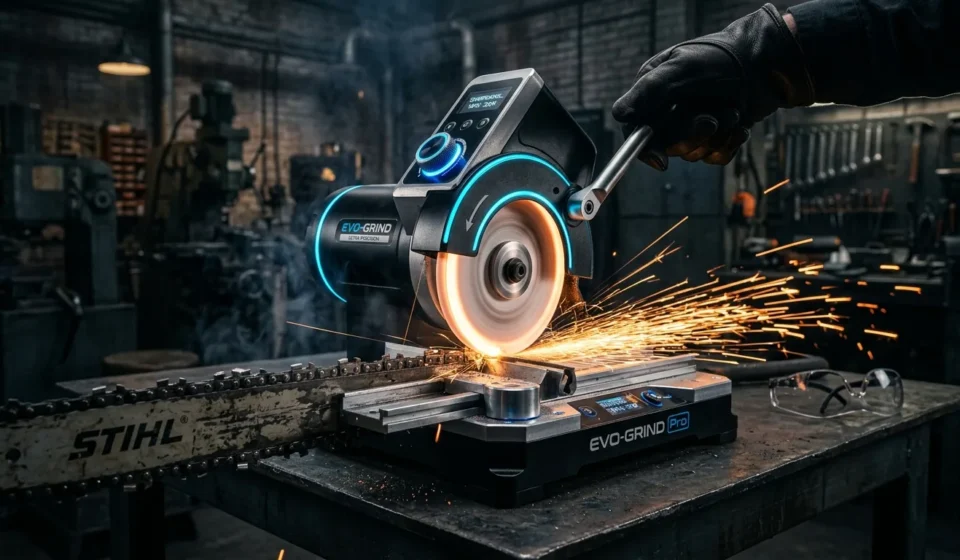
- Bench-Mounted Grinders: These are the workhorses of electric sharpening, typically featuring a small, high-speed grinding wheel and a precise chain clamping system. Models like the Oregon 410-120 or Stihl USG are designed for accuracy, allowing you to set precise angles (top plate, side plate, and depth gauge adjustments) and grind each tooth uniformly. They are excellent for achieving consistent results across an entire chain, even when dealing with significant damage or discrepancies between teeth.
- Handheld Rotary Tools with Attachments: Brands like Dremel offer kits with specialized grinding stones and guides. These are more versatile and portable than bench grinders but require a steadier hand and more practice to achieve consistent angles than a dedicated bench sharpener. They are a good step up from purely manual filing for quick in-situ sharpening.
- Bar-Mounted Electric Sharpeners: These compact units attach directly to your chainsaw’s guide bar, offering a more portable electric option. They are generally simpler to operate than handheld rotary tools and can provide decent consistency for field use, though typically less precise than bench grinders.
When to Power Up: The Advantages of Electric Sharpening
- Speed and Efficiency: Electric sharpeners are significantly faster, especially for a full chain. A bench grinder can sharpen a 20-inch chain in just a few minutes, a huge advantage for professional users or those with many chains.
- Unwavering Consistency: Once the angles are set, an electric grinder applies the same angle and depth to every tooth, ensuring uniform cutting performance across the entire chain. This is particularly beneficial for beginners struggling with manual consistency.
- Restoring Damaged Chains: When teeth are chipped, heavily rounded, or have hit foreign objects (like rocks or dirt), an electric grinder can quickly remove enough material to restore a sharp edge, which would be extremely tedious or impossible with a hand file.
- Perfect for Multiple Chains: If you rotate several chains, an electric sharpener streamlines the maintenance process, ensuring all your spare chains are always ready.
Considerations for Electric Sharpeners
- Higher Initial Cost: Dedicated bench grinders can be a significant investment compared to files.
- Removes More Material: Electric grinding often removes more material per pass than manual filing, which can slightly reduce the overall lifespan of a chain if not used judiciously.
- Requires Power Source: Not ideal for remote field sharpening unless battery-powered options are used.
- Learning Curve for Setup: While operation is straightforward, correctly setting up the angles on a bench grinder (grinding angle, tilt angle, depth stop) requires careful attention to detail.
The Hybrid Approach: Integrating Both Methods for Peak Performance
Here’s where we move beyond the “either/or” mentality and embrace a strategy that truly elevates your chainsaw maintenance: combining the strengths of both manual and electric sharpening. This hybrid approach ensures you always have the right tool for the job, maximizing efficiency, chain life, and cutting performance.
Scenario-Based Sharpening: When to Choose Which
- In-Field Touch-Ups (Manual): You’re felling trees deep in the woods, and after a few hours of cutting, you notice a slight dullness. Instead of stopping work and returning to the workshop, a quick 5-minute touch-up with your round file and guide (carried in your pocket) restores enough edge to finish the task. This is where manual portability shines.
- Post-Impact Damage (Electric): You accidentally nicked a piece of rebar hidden in a log, severely damaging several teeth. Trying to restore these with a hand file would be arduous and likely inconsistent. This is the perfect job for an electric bench grinder, which can quickly and uniformly remove the damaged material, reshape the cutters, and bring the chain back to factory-sharp condition.
- Routine Maintenance & Workshop Sharpening (Electric/Manual): At the end of a long day or week, when your chains are generally dull but not severely damaged, an electric bench grinder offers efficiency and consistency for a full sharpening. However, if you have only one or two chains and enjoy the meditative process, or want to fine-tune specific teeth, manual filing is still a perfectly valid choice.
- Depth Gauge Management (Manual or Electric): While some electric sharpeners have dedicated depth gauge attachments, many users prefer to lower their depth gauges manually with a flat file. This allows for precise control, preventing them from being lowered too aggressively, which can lead to increased kickback risk.
By adopting a hybrid approach, you’re not limited by the weaknesses of one method. You gain the agility and precision of manual filing for minor adjustments and the speed and restorative power of electric grinding for more substantial work. Many experienced chainsaw users will have a basic set of files in their gear bag and a dedicated electric grinder in their workshop.
Making Your Decision: Beyond Just “Manual vs. Electric”
Choosing the right sharpening strategy isn’t just about the tools themselves; it’s about your specific needs, environment, and commitment. Consider these factors when building your ultimate sharpening regimen:
- Your Skill Level & Patience: Are you a beginner willing to invest time in learning the nuances of filing angles and depth gauges? Or do you prefer a more automated system that minimizes the learning curve? Manual sharpening has a steeper initial learning curve but offers greater mastery. Electric sharpeners are easier to get consistent results quickly, but proper setup still requires attention.
- Frequency of Use: Do you run your chainsaw occasionally for firewood, or are you a landowner clearing acreage weekly? Occasional users might find manual filing perfectly adequate. High-volume users will greatly benefit from the speed and consistency of an electric grinder to keep multiple chains sharp.
- Type of Work: Are you primarily felling and bucking clean timber, or are you often cutting through dirty wood, old fence lines, or storm debris where chain damage is more likely? If heavy damage is a frequent occurrence, an electric sharpener becomes almost a necessity.
- Budget & Space: Manual tools are very inexpensive and take up no space. A quality electric bench grinder requires a larger investment and dedicated bench space in a workshop.
- Desired Finish & Chain Life: Manual filing, when done correctly, often leaves a very fine, sharp edge by removing minimal material. Electric grinders, while fast, can sometimes be more aggressive. Over-grinding on an electric sharpener can shorten chain life faster than careful manual filing.
Ultimately, there’s no single “best” sharpening method for everyone. The true professional, or even the dedicated homeowner, understands that the optimal approach often involves leveraging the unique strengths of both manual and electric sharpeners. Invest in quality tools for whichever method you choose, practice your technique, and always prioritize a razor-sharp, properly maintained chain. Your chainsaw, your timber, and most importantly, your safety, will thank you for it.