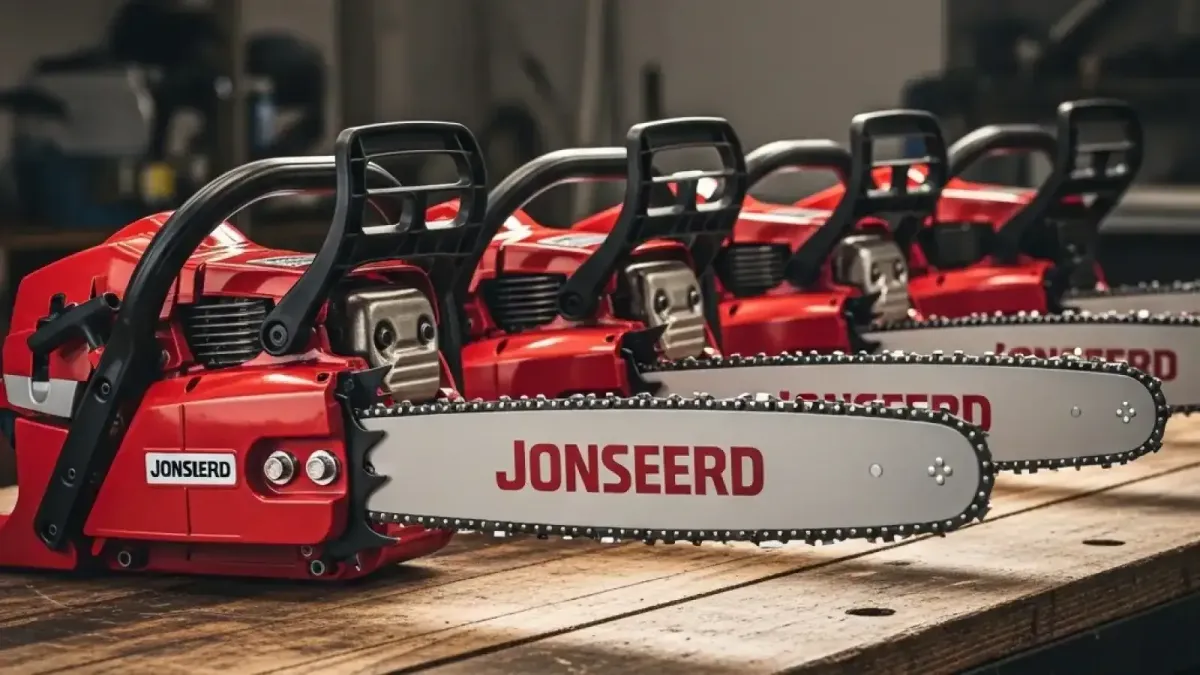
Quick answer: Jonsered chainsaws were high-performance Swedish saws manufactured under the Husqvarna Group, famous for pioneering lightweight designs and straight-handle ergonomics. Although Husqvarna officially discontinued the Jonsered line in late 2022 to consolidate its product offerings, existing owners can still easily source mechanical replacement parts through standard Husqvarna dealer channels.
The Evolution of Jonsered: Pioneer of Modern Forestry
The story of Jonsereds Fabrikers AB dates back to 1833, but its true revolution in power equipment began in 1954 with the launch of the 'Racket'—one of the earliest commercially successful lightweight one-man chainsaws. Before this breakthrough, mechanical timber cutting required bulky two-man rigs or agonizingly heavy single-operator units. Jonsered transformed logging by prioritizing power-to-weight ratios and operator comfort long before these became standard industry benchmarks.
Engineers at Jonsered introduced critical safety and functional innovations that define contemporary cutting. They were early adopters of chain brake systems, anti-vibration rubber mounts, and heated handles for sub-zero Scandinavian winters. When Electrolux acquired Jonsered in 1978—subsequently spinning off its outdoor power equipment division into the Husqvarna Group—a dual-brand strategy was formed. Husqvarna and Jonsered shared core mechanical platforms while retaining distinct styling, throttle dynamics, and ergonomic handle shapes.
In late 2022, Husqvarna Group formally phased out the Jonsered line to streamline global manufacturing and concentrate sales around the primary Husqvarna badge. Despite the sunsetting of the brand, thousands of these red saws remain active on job sites and farms. Because post-1980s Jonsered saws are mechanically identical to specific Husqvarna chassis, routine engine overhauls and chain setups remain straightforward today.
Head-to-Head: Jonsered vs. Stihl and Husqvarna
During the peak logging era of the late 20th century, timber crews were divided into passionate camps. Comparing a Jonsered to a Stihl or Husqvarna was more than evaluating horsepower; it was a matter of regional pride and personal ergonomic feel. Stihl championed a chunkier body styling with upright engine geometry, whereas Jonsered and Husqvarna focused on sleek, low-profile crankcases that made limbing faster and reduced wrist strain.
Pro tip: When working on older Jonsered professional models, always double-check the handlebar angle during felling cuts. Unlike traditional bent top-handles found on Stihl saws, Jonsered favored a straight handlebar orientation on many pro units (such as the 2171). This gives fallers an extremely accurate horizontal sightline directly across the log, but it can feel unfamiliar if you are accustomed to standard curved wrap handles.
When comparing Jonsered to its sister brand, Husqvarna, the differences were primarily tactical. A Jonsered 2153 and a Husqvarna 346XP shared the exact same 50.1 cc engine block delivering 3.7 hp (2.7 kW), running a .325" pitch chain at up to 14,000 RPM. However, the Jonsered featured a unique angular body cover, a distinct throttle interlock setup, and occasionally different clutch cover valance options. Both lines relied on a precise 50:1 two-stroke fuel-to-oil mix ratio and heavy-duty bar oil to keep chain temperatures under control during sustained cutting.
| Jonsered Model | Husqvarna Equivalent | Displacement / Power | Recommended Bar Length | Primary Target Application |
|---|---|---|---|---|
| CS 2238 | Husqvarna 236 | 38.2 cc / 1.9 hp (1.4 kW) | 14" - 16" | Light pruning, yard cleanup |
| CS 2250 S | Husqvarna 450e | 50.2 cc / 3.2 hp (2.4 kW) | 16" - 18" | Firewood cutting, landowner use |
| 2153 WH | Husqvarna 346XP | 50.1 cc / 3.7 hp (2.7 kW) | 16" - 18" | Professional limbing & felling |
| 2172 Turbo | Husqvarna 372XP | 70.7 cc / 5.3 hp (3.9 kW) | 20" - 28" | Heavy timber logging & big wood |
| Feature | Jonsered/Husqvarna Philosophy | Stihl Philosophy |
| Ergonomics/Balance | Often known for a "Torque-Heavy" feel and a more compact chassis, especially in mid-range pro saws. | Traditionally known for a more "Revvy" engine and excellent vibration damping, favoring lightness and balance. |
| Felling Sights | Jonsered models historically featured a straight top handle bar, which many loggers favored as a straight-edge reference for felling cuts. | Stihl typically used a rounded top handle. |
| Design | Often featured a snap-lock cylinder cover for easier access to the air filter and spark plug (e.g., Jonsered 2150). | Often required screws or clips to remove covers. |
| Performance | Both brands delivered top-tier power, but Jonsered/Husqvarna were sometimes associated with achieving higher RPMs or having superior air filtration systems. | Both brands delivered top-tier power. |
Standout Jonsered Models on the Used Market
Because new inventory is no longer coming off factory lines, understanding the second-hand market is vital for enthusiasts searching for a reliable professional chainsaw. Certain historic models have held their market value remarkably well thanks to bulletproof build quality, forged three-piece crankshafts, and Nikasil-cylinder coatings that refuse to wear out if properly lubricated.
Professional Legendary Saws: The 2171 and 2172 Turbo
The Jonsered 2171 and its successor, the 2172, represent the high-water mark of 70 cc class chainsaw design. Outputting over 5 horsepower, these machines effortlessly pulled 24-inch or 28-inch guide bars using a 3/8" pitch, .050" or .058" gauge full-chisel chain. They incorporated centrifugal air cleaning—branded by Jonsered as 'Turbo Air Cleaning'—which separated wood dust from intake air before reaching the air filter. This allowed loggers to run full shifts without losing engine performance to a clogged filter.
Mid-Range Firewood Champions: The CS 2250 S and 2150
For landowners processing firewood each fall, the CS 2250 S remains a workhorse. Utilizing 'Clean Power' engine technology (the equivalent of Husqvarna's X-Torq), this 50 cc saw drastically reduced exhaust emissions while increasing fuel torque under load. Standard setups paired this engine with an 18-inch guide bar running .325" pitch chain, offering smooth cuts through hardwood limbs and medium oak logs with minimal vibration feedback through the handles.
Maintenance, Mechanical Repair, and Parts Sourcing
Maintaining a vintage or late-model Jonsered saw requires zero specialized magic—just solid, standard small-engine maintenance discipline. Check out our comprehensive guide on chainsaw maintenance practices to keep your power head firing cleanly on every pull. Always use fresh 89+ octane unleaded gasoline blended with a high-grade ISO-L-EGD certified two-stroke oil at a strict 50:1 ratio. Stale fuel containing more than 10% ethanol (E10) is the leading cause of scored pistons and degraded carb diaphragms in these high-revving engines.
When performing routine tune-ups, cross-referencing parts is easy once you identify your saw's Husqvarna twin chassis. Carburetor rebuild kits (typically Walbro or Zama), drive sprockets, air filters, clutch assemblies, and recoil starters are widely stocked across local power equipment dealers and online catalogs. However, cosmetic parts—such as original red top covers, vintage badges, and model-specific brake levers—are increasingly scarce, making complete donor saws valuable assets for collectors.
Safety should always be your top priority whenever operating or testing refurbished equipment. Ensure your mechanical chain brake engages crisp and clean upon sudden forward rotation. Always wear full Personal Protective Equipment (PPE), including ASTM-approved multi-layer chainsaw chaps, heavy leather boots, safety glasses, and sound-dampening ear protection rated for at least 25 dB noise reduction. Inspect guide bar rails regularly for burrs and maintain precise chain tensioning—a loose chain on a high-speed Jonsered Turbo can derail instantly, posing serious injury risks.
Choosing the Right Saw and Taking Action
If you are currently looking to purchase a chainsaw, your path depends heavily on your mechanical willingness and workload demands. For buyers seeking a turnkey tool backed by immediate factory warranty coverage, purchasing a current-generation Husqvarna or Stihl model is the practical route. However, if you encounter a well-maintained secondhand Jonsered 2152 or 2172 at a reasonable price, buy it without hesitation. Verify that compression feels tight (ideally above 140 PSI on a pressure gauge), check that the crankcase shows no signs of hairline cracks, confirm that the chain brake snaps firmly into place, and you will own an exceptional piece of Swedish engineering built to handle decades of hard work.
Frequently Asked Questions
Are Jonsered chainsaw parts still available?
Yes, mechanical spare parts are widely available. Because most Jonsered saws built after 1980 share internal platforms with Husqvarna saws, components like pistons, carburetors, ignition coils, bars, and drive sprockets can be purchased through Husqvarna dealers and aftermarket suppliers. Unique red body plastics, however, are becoming harder to find.
What is the correct oil-to-gas ratio for a Jonsered chainsaw?
Modern Jonsered two-stroke chainsaws require a 50:1 gas-to-oil mixture, which equals 2.6 fluid ounces of high-quality two-stroke engine oil per one gallon of mid-grade (89 octane or higher) ethanol-free gasoline. Older vintage models from the 1960s or 1970s may originally have specified 40:1 or 25:1 ratios depending on the oil technology of that era, but modern synthetic oils easily handle these engines at 40:1 or 50:1.
Is Jonsered completely out of business?
The Jonsered brand name was formally retired by its parent company, the Husqvarna Group, in late 2022. No new Jonsered-branded chainsaws or power equipment are being manufactured, as Husqvarna has consolidated its product lines under the main Husqvarna brand name.
Sources
- Husqvarna Group Official Corporate History & Brand Information
- Wikipedia: Jonsereds Fabrikers AB Industrial History
- OSHA Standard 1910.266 - Logging Operations & Chainsaw Safety Guidelines
- ANSI B175.1 Safety Requirements for Gasoline-Powered Chainsaws