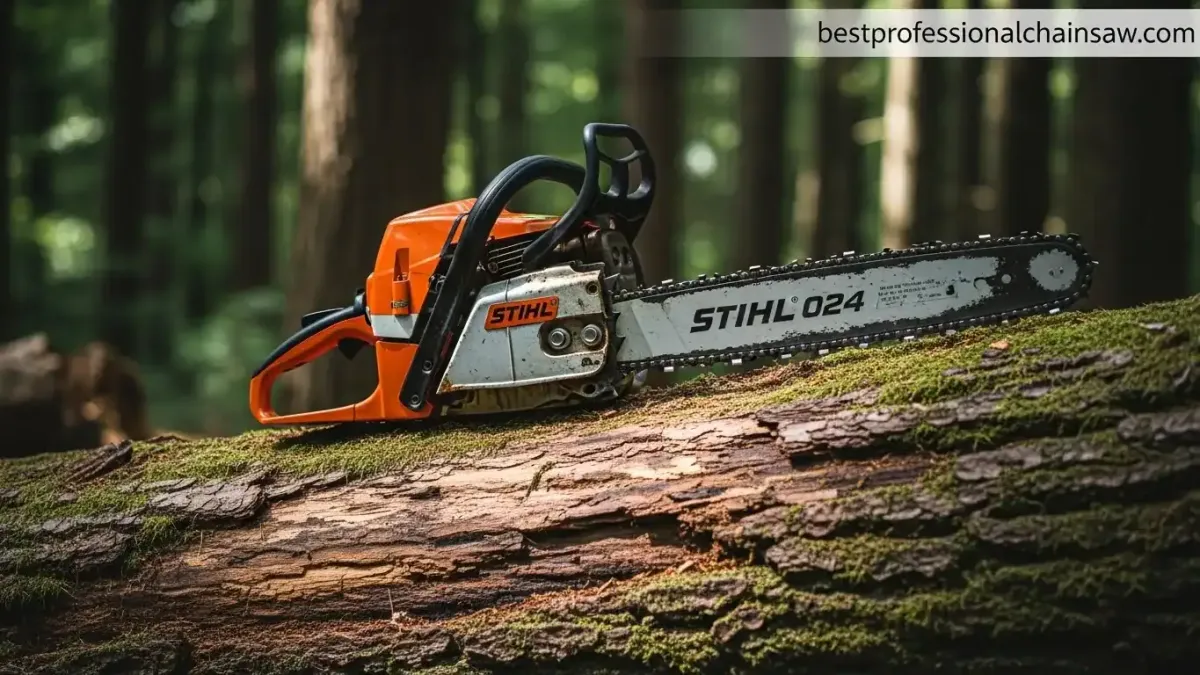
Quick answer: The Stihl 024 AV is a classic 42.0 cc, 2.8 hp (2.1 kW) mid-range chainsaw designed for firewood cutting, storm cleanup, and light limbing. Renowned for its durable magnesium construction, anti-vibration rubber mounts, and smooth power delivery, it comfortably pulls a 16-inch or 18-inch guide bar using a .325-inch pitch chain. It serves as the direct mechanical ancestor to the popular Stihl MS 260 and MS 261 series.
Stihl 024 AV Specs and Technical Engineering
The core power plant of the Stihl 024 AV revolves around a single-cylinder, two-stroke engine displacing 42.0 cubic centimeters (cc) with a cylinder bore of 42 mm and a stroke of 30 mm. Delivering approximately 2.8 horsepower (2.1 kW) at a maximum power speed of 9,500 RPM, it hits a maximum permissible engine speed of around 13,000 RPM. Power-to-weight performance remains impressive by modern standards: the powerhead weighs roughly 10.4 lbs (4.7 kg) dry, without the guide bar and chain fitted. Fuel delivery is handled by a Walbro WT or Tillotson HU diaphragm carburetor featuring fully adjustable high-speed and low-speed needle valves, allowing fine-tuning for changing altitude and ambient temperature conditions.
For cutting attachments, the 024 was engineered around a standard .325-inch pitch chain with a .063-inch gauge drive link configuration, typically paired with a 16-inch or 18-inch Rollomatic E guide bar. The engine utilizes a standard centrifugal clutch driving an interchangeable spur or rim sprocket setup. Chain oiling relies on an automatic, engine-driven oil pump that delivers bar lubricant continuously while the clutch is engaged. Fuel requirements follow the traditional Stihl standard: fresh unleaded gasoline mixed at a 50:1 gas-to-oil ratio (2.6 oz of 2-stroke air-cooled engine oil per 1 gallon of gas), combined with standard tacky bar and chain oil for friction reduction along the bar rails.
The "AV" designation in the model name highlights Stihl's integrated anti-vibration system, which decouples the engine block and cutting assembly from the front handle and rear control grip using engineered rubber buffer mounts. This drastically isolates the operator's hands from engine pulses and cutter impact vibrations. Additionally, the unit incorporates an inertia-activated or manual hand-guard chain brake, a rear hand guard for bottom chain catch safety, and a side-access or front-facing chain tensioner depending on the exact production year and sub-series variation (such as the 024 Super or 024 Wood Boss).
| Technical Specification | Stihl 024 AV Baseline Data |
|---|---|
| Engine Displacement | 42.0 cc (2.56 cu. in.) |
| Cylinder Bore / Stroke | 42 mm / 30 mm |
| Power Output | 2.8 hp (2.1 kW) @ 9,500 RPM |
| Dry Weight (Powerhead Only) | 10.4 lbs (4.7 kg) |
| Recommended Bar Lengths | 14-inch, 16-inch, to 18-inch (35 to 45 cm) |
| chain pitch & Gauge | .325" pitch / .063" gauge (standard) |
| Fuel Mix Ratio | 50:1 (Unleaded Gas + 2-Stroke Air-Cooled Engine Oil) |
| Anti-Vibration Mounts | Rubber element AV system |
Performance and Hands-On Field Experience
When running a well-tuned Stihl 024 AV on seasoned oak, maple, or pine, the power curve feels distinctly punchy compared to modern homeowner-grade plastic-crankcase saws of equal displacement. Engine response from idle to wide-open throttle is crisp, pulling smooth, steady chips with a sharp semi-chisel or full-chisel .325-inch chain. Because of its lighter crankcase design relative to heavy-duty 60cc professional felling saws, the 024 allows you to work all afternoon limbing downed treetops or bucking 10-inch to 14-inch logs into stove-length firewood without exhausting your shoulders and forearms.
Pro tip: When working with vintage saws like the 024 AV, keep a close eye on the rubber AV buffer mounts and the flexible rubber intake boot under the air filter shroud. Over decades of operation, exposure to bar oil and ethanol-blended gas causes these rubber parts to degrade or crack. A hairline crack in the intake boot causes a lean fuel condition, pushing engine RPMs dangerously high under no-load conditions and scorching the piston ring lands within minutes.
Maintaining proper chain tension is critical for safe and efficient cutting. During long cutting sessions, chain stretching is normal, especially when breaking in a brand-new loop. Always let the guide bar cool down before tightening loose chain slack; over-tightening a hot chain directly pinches the sprocket nose and leads to premature bearing wear inside the clutch drum. Always check that the chain brake fully engages when the front hand guard is thrust forward. When working in brush or felling small trees, always wear full personal protective equipment (PPE), including cut-retardant chainsaw chaps, a safety helmet with face screen, eye protection, ear defenders rated at least 25 dB NRR, and heavy leather boots.
Stihl 024 AV vs. Modern Equivalents: How Does It Compare?
Understanding how the older 024 AV lines up against modern alternatives requires looking at both historic successor models and today's professional offerings. The most famous internal comparison is between the standard 024 AV, the upgraded 024 Super, and its immediate legendary replacement, the 026 (which eventually became the MS 260 and today's MS 261 C-M). The 024 Super featured a larger 44 mm piston bore pushing displacement up to 44.3 cc, bridging the gap to the 48.7 cc output of the original 026 model.
Compared to a modern professional saw like the Stihl MS 261 C-M, the original 024 AV lacks electronically controlled fuel injection or microprocessor-managed ignition (M-Tronic). While modern units automatically tune carburetors on the fly and offer higher power-to-weight ratios (over 4.0 hp in a 10.8 lb package), the older 024 AV wins on mechanical simplicity. There are no computer chips or solenoid valves to diagnose; basic carburetor adjustments require only a small flathead screwdriver and a tachometer. However, compared to modern consumer-grade saws like the MS 250 or MS 251, the all-magnesium crankcase of the 024 AV provides far superior chassis rigidity, heat dissipation, and long-term rebuildability.
| Model | Displacement | Power Output | Weight (Powerhead) | Crankcase Construction |
|---|---|---|---|---|
| Stihl 024 AV | 42.0 cc | 2.8 hp (2.1 kW) | ||
| Stihl 024 Super | 44.3 cc | 3.1 hp (2.3 kW) | 10.4 lbs (4.7 kg) | Magnesium Alloy |
| Stihl MS 251 (Modern Farm/Home) | 45.6 cc | 3.0 hp (2.2 kW) | 10.8 lbs (4.9 kg) | Polymer / Composite |
| stihl ms 261 C-M (Modern Pro) | 50.2 cc | 4.0 hp (3.0 kW) | 10.8 lbs (4.9 kg) | Magnesium Alloy |
User Reviews and Real-World Reliability
User feedback spanning decades across online forestry forums, small-engine repair communities, and rural property owner groups remains overwhelmingly positive for the 024 AV. Owners consistently praise its light handling, easy starting procedures, and reliable mid-rpm torque. Homeowners clearing storm damage or cutting 4 to 6 cords of firewood annually report that with clean gas, proper oil mixing, and seasonal air filter maintenance, an 024 AV will reliably run for 20 to 30 years without requiring major internal overhaul.
The few negative user observations generally revolve around age-related wear rather than original design flaws. Because these saws were produced years ago, used units sold online frequently suffer from hardened oil pump diaphragms, clogged fuel tank vent valves, or clogged spark arrestor screens inside the muffler cap. Replacement OEM parts are occasionally harder to find through local dealers, though the massive aftermarket community provides compatible pistons, gaskets, and carburetor rebuild kits. Overall, woodcutters evaluate the Stihl 024 AV as one of the best 40cc-class pro-sumer saws ever produced.
Essential Maintenance and Troubleshooting Tips
Keeping an 024 AV operating at peak efficiency requires consistent attention to basic maintenance intervals. The air filter on the 024 uses a two-piece mesh or flat fleece element beneath the top shroud. Clean this filter after every 5 tanks of fuel by gently blowing compressed air from the inside out, or washing it in warm soapy water. Never reinstall a wet air filter, as liquid pulls fine dust particles directly through the filter media into the engine cylinder, accelerating piston scoring.
If your 024 AV suffers from erratic idling, stalling when tilted sideways, or difficulty restarting when warm, follow this structured troubleshooting workflow:
- Check the Spark Arrestor Screen: Remove the small retaining screw on the muffler exhaust outlet and clean carbon buildup off the wire screen using a brass brush or torch flame.
- Inspect the Fuel Line and Filter: Old rubber fuel pickup lines inside the gas tank collapse or develop pinhole leaks. Replace the line and intake felt filter annually.
- Verify Cylinder Compression: Hook up a standard automotive compression gauge. A healthy 024 AV engine should register between 135 PSI and 155 PSI. Readings below 110 PSI point to worn rings, cylinder scoring, or blown crankcase seals.
- Set Carburetor Base Settings: Gently turn both the High (H) and Low (L) needle screws clockwise until lightly seated. Back both needles out 1 full turn counter-clockwise as a baseline starting point before fine-tuning with a tachometer.
If you are looking for a nimble, durable, and easily repairable mid-sized chainsaw for cutting firewood, trimming tree branches, and maintaining rural properties, a well-maintained Stihl 024 AV paired with a 16-inch .325" bar remains a fantastic tool. If purchasing a used model, inspect the piston skirt through the exhaust port, check for cracked rubber AV mounts, replace the fuel lines, and keep the chain sharp for fast, safe cutting performance.
Frequently Asked Questions
What gas to oil ratio does the Stihl 024 AV use?
The Stihl 024 AV runs on a 50:1 gas-to-oil fuel ratio when using modern high-quality 2-stroke air-cooled engine oil mixed with 89 octane or higher unleaded gasoline (preferably ethanol-free). This equates to 2.6 fluid ounces of 2-cycle oil per 1 gallon of gasoline.
What is the maximum bar length for a Stihl 024?
While the 42 cc engine can technically power a 20-inch bar in softwoods, the optimal bar length for balance, chain speed, and engine longevity on the Stihl 024 AV is 16 inches (40 cm), with 18 inches being the practical maximum for occasional hardwood bucking.
Is the Stihl 024 the same as the MS 260?
No, but they belong to the exact same family line. The 024 (42 cc) served as the foundation for the slightly larger 026 (48.7 cc). When Stihl updated their model naming convention in the early 2000s, the 026 became the MS 260, making the 024 its direct smaller-displacement predecessor.
Why is my Stihl 024 bar oiler not pumping oil?
Common causes include a clogged oil tank pickup screen, stripped plastic worms on the oil pump drive gear under the clutch drum, or hardened oil sludge in the guide bar oiling holes. Clean the bar groove and test oil delivery with the chain removed over a sheet of cardboard at half-throttle.
Sources
- STIHL Global Official Technical Product Archives
- OSHA Standard 1910.266 - Logging Operations and Equipment Safety
- ANSI B175.1 Safety Requirements for Gasoline-Powered Chainsaws