Disclosure: As an Amazon Associate, we earn from qualifying purchases.
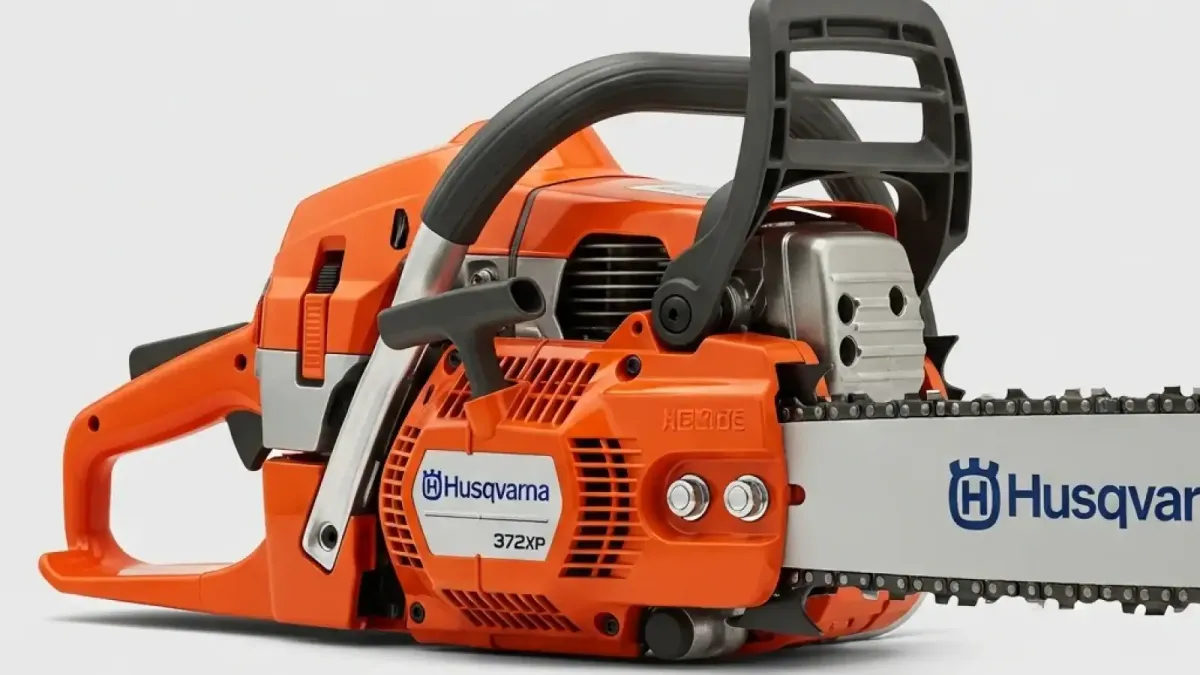
Few power tools have commanded as much respect in logging camps, commercial tree care operations, and farm woodlots as the Husqvarna 372XP. Engine designers engineered this legendary 70cc-class gas chainsaw to balance rapid acceleration, extreme durability, and high power-to-weight ratios under punishing daily schedules. Whether felling dense hardwoods with a 28-inch bar or bucking timber through endless truckloads of firewood, understanding how this saw is engineered helps operators extract maximum performance while extending powerhead life.
Quick answer: Delivering 5.3 to 5.5 horsepower (3.9 kW) from its 70.7 cc two-stroke engine, the Husqvarna 372XP operates at 9,600 RPM peak power with a top free-revving speed of 13,500 RPM. Dry powerhead weight sits at 13.9 lbs (6.3 kg) for Original Edition models and 14.6 lbs (6.6 kg) for X-Torq units, running 16 to 28-inch guide bars on a standard 3/8-inch pitch chain with a 50:1 gas-to-oil mix ratio.
Husqvarna 372XP Specs: Complete Technical Breakdown
When selecting a commercial logging saw, factory specifications reveal exactly how an engine behaves under severe cutting loads. The core of the 372XP is a single-cylinder 70.7 cc engine with a 50 mm bore and 36 mm stroke. This design yields incredible chain speed across both hard oak and soft pine, making it a benchmark in the forestry industry. The powerhead relies on an automatic, adjustable oil pump that allows loggers to dial in lubrication based on timber density and bar length.
Fuel delivery relies on a heavy-duty Walbro carburetor isolated from engine heat and chassis movement through rubber vibration dampers. Ignition spark is delivered via an electronic ignition system set to a 0.020-inch (0.5 mm) spark plug electrode gap using a standard Champion RCJ7Y or NGK BPMR7A spark plug. The 26.04 fl oz (0.77 L) fuel capacity balances fuel load with operator endurance, allowing continuous high-RPM output between fill-ups.
Over its multi-decade production run, Husqvarna produced two primary mechanical iterations of this saw: the original pre-emissions "Original Edition" (OE) and the EPA-compliant "X-Torq" edition. Understanding the exact mechanical differences between these two builds helps when sourcing replacement parts, tuning the carburetor, or purchasing used forestry gear.
| Specification Category | 372XP Original Edition (OE) | 372XP X-Torq |
|---|---|---|
| Engine Displacement | 70.7 cc / 4.31 cu. in. | 70.7 cc / 4.31 cu. in. |
| Power Output | 5.3 HP / 3.9 kW @ 9,600 RPM | 5.5 HP / 4.1 kW @ 10,200 RPM |
| Maximum Engine Speed | 13,500 RPM (Idle: 2,700 RPM) | 13,500 RPM (Idle: 2,700 RPM) |
| Powerhead Weight (Dry, no cutting gear) | 13.9 lbs / 6.3 kg | 14.6 lbs / 6.6 kg |
| Decompression Valve Location | Right side of cylinder head | Top center of cylinder shroud |
| Standard Bar Length Compatibility | 16 to 28 inches (Up to 32" skip chain) | 16 to 28 inches (Up to 32" skip chain) |
| chain pitch & Gauge | 3/8" Pitch / .050", .058", or .063" Gauge | 3/8" Pitch / .050", .058", or .063" Gauge |
| Fuel Tank Capacity | 26.04 fl oz / 0.77 Liters | 26.04 fl oz / 0.77 Liters |
| Oil Tank Capacity | 14.2 fl oz / 0.42 Liters | 14.2 fl oz / 0.42 Liters |
| Vibration Level (Front / Rear Handle) | 5.7 m/s² / 8.0 m/s² | 4.7 m/s² / 5.7 m/s² |
Key Engineering Features and Commercial Capabilities
Engine longevity in demanding timber felling environment requires far more than high horsepower. Husqvarna built the 372XP around a forged three-piece crankshaft supported by heavy-duty crankcase bearings seated in die-cast magnesium housing. Unlike plastic clamshell engine casings found in homeowner saws, this rigid metal chassis resists torsional twisting when operators leverage heavy dogs against giant logs during bucking cuts.
Clean air intake management is critical when working in dusty hardwood timber or dry pine. Husqvarna integrated its Air Injection™ centrifugal pre-cleaning design into the flywheel. As the flywheel spins, centrifugal force slings large wood chips and heavy dust particles away from the primary intake plenum before air reaches the heavy-duty nylon mesh air filter. This system drastically reduces air filter clogging, preserving horsepower during long shifts and protecting internal cylinder walls from scoring.
Operator comfort during full eight-hour shifts is addressed by the LowVib® anti-vibration technology. Husqvarna isolated the front wrap handle and rear trigger assembly from the engine block using tuned steel coil springs instead of soft rubber bushings. Steel springs maintain structural integrity and dampening properties across extreme temperature swings, shielding hands from repetitive high-frequency engine vibration that contributes to white-finger syndrome.
Pro tip: When stepping up from a 20-inch guide bar to a 24-inch or 28-inch setup in thick oak or frozen wood, always turn the slotted brass oil pump screw on the bottom of the powerhead counterclockwise to increase oil output. Running stock oiler settings on long bars starves the nose sprocket of oil, causing rapid heat expansion, drive link binding, and premature bar tail wear.
Bar and Chain Setup Guide for Peak Performance
Matching the correct bar and chain combination to your work environment unlocks the full torque potential of the 70.7 cc engine. While the 372XP can power a 16-inch bar for lightning-fast bucking, its power band truly shines when pulling standard 20-inch to 28-inch guide bars. For softwoods like fir, white pine, or cedar, experienced loggers frequently run a 32-inch bar matched with a 3/8-inch pitch full-skip chisel chain to maintain high chain RPM.
Chain selection dictates both speed and safety. Full-chisel cutters feature sharp square corners that split wood fibers cleanly, delivering the fastest cutting speeds in clean green timber. semi-chisel cutters feature rounded corners that retain their edge far longer when cutting dirty timber, skidder decks, or dead standing trees coated in mud and bark rot. Ensure your chain gauge (.050, .058, or .063 inch) matches your guide bar groove exactly to eliminate bar wobble and curved cuts.
- 20-Inch Bar Setup: Ideal all-around balance for firewood cutting, storm cleanup, and general tree work. Drives full power across dense hardwoods with a standard full-house chain.
- 24-Inch Bar Setup: The standard choice for professional loggers felling medium-diameter timber. Provides comfortable reach without sacrificing chain speed.
- 28-Inch Bar Setup: Maximum recommended bar length for full-house chain in mixed timber. Requires full chain oiler flow and precise raker height tuning.
- 32-Inch Bar Setup: Special application length. Best paired with a 3/8" full-skip chain to reduce cutter drag on the engine when working large softwood trunks.
Routine maintenance keeps the cutting system operating efficiently. Before every shift, inspect drive sprocket teeth for wear grooves, check chain brake inertia engagement, and verify that side-mounted chain tensioners hold torque. Clean the guide bar oil hole and scraper groove daily, flip the guide bar periodically to ensure even rail wear, and maintain depth gauge clearances at 0.025 inches (0.65 mm) for smooth cutting performance.
Own the Legend: Husqvarna 372 XP Professional Chainsaw

Husqvarna 372XP OE vs. 372XP X-Torq: What Buyers Need to Know
When searching for a new or used 372XP, choosing between the classic Original Edition (OE) and the modernized X-Torq model is a common dilemma. Original Edition saws built prior to 2010 utilize a traditional two-stroke intake design. These saws feature quick throttle response, high top-end RPM, lighter overall powerhead weight, and simple carburetor tuning using standard low and high jets without specialized tools.
The 372XP X-Torq introduced stratified air-head scavenging technology to comply with international EPA emissions standards. By injecting a barrier of clean air between the exhaust gas and fresh fuel charge, X-Torq models deliver up to 20% lower fuel consumption and up to 75% reduced exhaust emissions. The X-Torq powerhead delivers higher low-end torque, holding engine RPM better under heavy stalling loads, though it adds roughly 0.7 lbs of mass due to larger cylinder castings and reinforced crankcase webbing.
Selecting between them comes down to personal preference and working conditions. arborists and loggers who prioritize raw RPM snap and lighter powerhead weight often favor pristine 372XP OE units. Landowners and timber contract operators who want lower fuel costs, reduced exhaust fumes, and broader mid-range torque will find the 372XP X-Torq to be a exceptionally reliable power tool for heavy cutting jobs.
To keep any 372XP running reliably for decades, always run 89 octane or higher ethanol-free gasoline mixed at a strict 50:1 ratio with premium synthetic two-stroke air-cooled engine oil. Always equip yourself with complete personal protective equipment (PPE), including steel-toe boots, heavy leather work gloves, eye protection with side shields or a mesh helmet visor, noise-canceling hearing protection rated for 103+ dB(A), and cut-retardant chainsaw chaps compliant with ASTM standards.
Frequently Asked Questions
What fuel ratio does a Husqvarna 372XP use?
The Husqvarna 372XP requires a strict 50:1 fuel-to-oil mix ratio, which translates to 2.6 fluid ounces of high-quality synthetic two-stroke oil per one gallon of 89+ octane ethanol-free gasoline.
What is the maximum bar length for a Husqvarna 372XP?
Husqvarna officially recommends guide bar lengths between 16 and 28 inches. However, experienced operators can run a 32-inch guide bar when paired with a 3/8-inch pitch full-skip chain in softwoods.
How do I identify if my 372XP is an Original Edition (OE) or X-Torq model?
The easiest visual indicator is the decompression valve location. The original 372XP OE features the decompression button on the right side of the cylinder casing near the wrap handle, while the X-Torq version positions the button directly on top of the blue engine shroud.
What spark plug is recommended for the Husqvarna 372XP?
The factory recommends a Champion RCJ7Y or NGK BPMR7A spark plug set to an electrode gap of 0.020 inches (0.5 mm) for smooth idling and reliable ignition timing.