

As a seasoned arborist, I’ve seen countless tools come and go, but few have revolutionized large-scale tree trimming and utility line clearance quite like the hydraulic pole saw. These aren’t your average homeowner’s electric or gas-powered models; we’re talking about heavy-duty, industrial-grade systems designed for relentless professional use. When you see a utility crew meticulously clearing branches near power lines from the aerial vantage point of a bucket truck, chances are, they’re wielding a hydraulic pole saw.
Table Of Content
- The Powerhouse Advantage: Why Hydraulic Pole Saws Stand Apart
- Unpacking the Hydraulic Difference
- Key Advantages for Professional Use
- When to Choose Hydraulic
- Types of Hydraulic Pole Saws & Their Applications
- Bucket Truck-Mounted Systems: The Arborist’s Backbone
- Stand-Alone Hydraulic Pole Saws: Portability & Versatility
- Specialized Hydraulic Sawheads
- Mastering the Mount: Integrating Hydraulic Pole Saws with Bucket Trucks
- Pre-Installation Checklist & Compatibility
- Step-by-Step Mounting Process
- Optimizing Ergonomics & Storage
- Operation, Maintenance, and Safety for Peak Performance
- Safe Operating Practices
- Essential Maintenance Schedule
- Troubleshooting Common Issues
- Investing Wisely: Choosing the Right Hydraulic Pole Saw System
- Key Factors to Consider
- Where to Source Professional Equipment
- The Return on Investment
The ability to connect directly to a vehicle’s hydraulic system, typically a bucket truck, provides an unmatched combination of power, precision, and endurance that’s critical for demanding tasks. It’s about more than just cutting; it’s about safety, efficiency, and getting the job done right the first time, often in challenging environments. In this comprehensive guide, we’ll dive deep into the world of hydraulic pole saws, exploring their unique advantages, how they integrate with bucket trucks, essential operational techniques, and crucial maintenance and safety protocols. My goal is to equip you with the knowledge of a trusted professional, ensuring you understand exactly why these tools are indispensable for serious tree care.
The Powerhouse Advantage: Why Hydraulic Pole Saws Stand Apart
When it comes to tackling substantial tree trimming projects, especially those involving thick, stubborn branches or working around sensitive infrastructure, the raw power and consistent performance of a hydraulic pole saw are simply unparalleled. Unlike their gas or electric counterparts, which rely on internal combustion engines or electric motors with limited battery life, hydraulic saws harness the constant, high-pressure flow of hydraulic fluid to drive their cutting mechanism. This fundamental difference translates into a host of significant advantages for commercial arborists and utility crews who operate them daily.
Unpacking the Hydraulic Difference
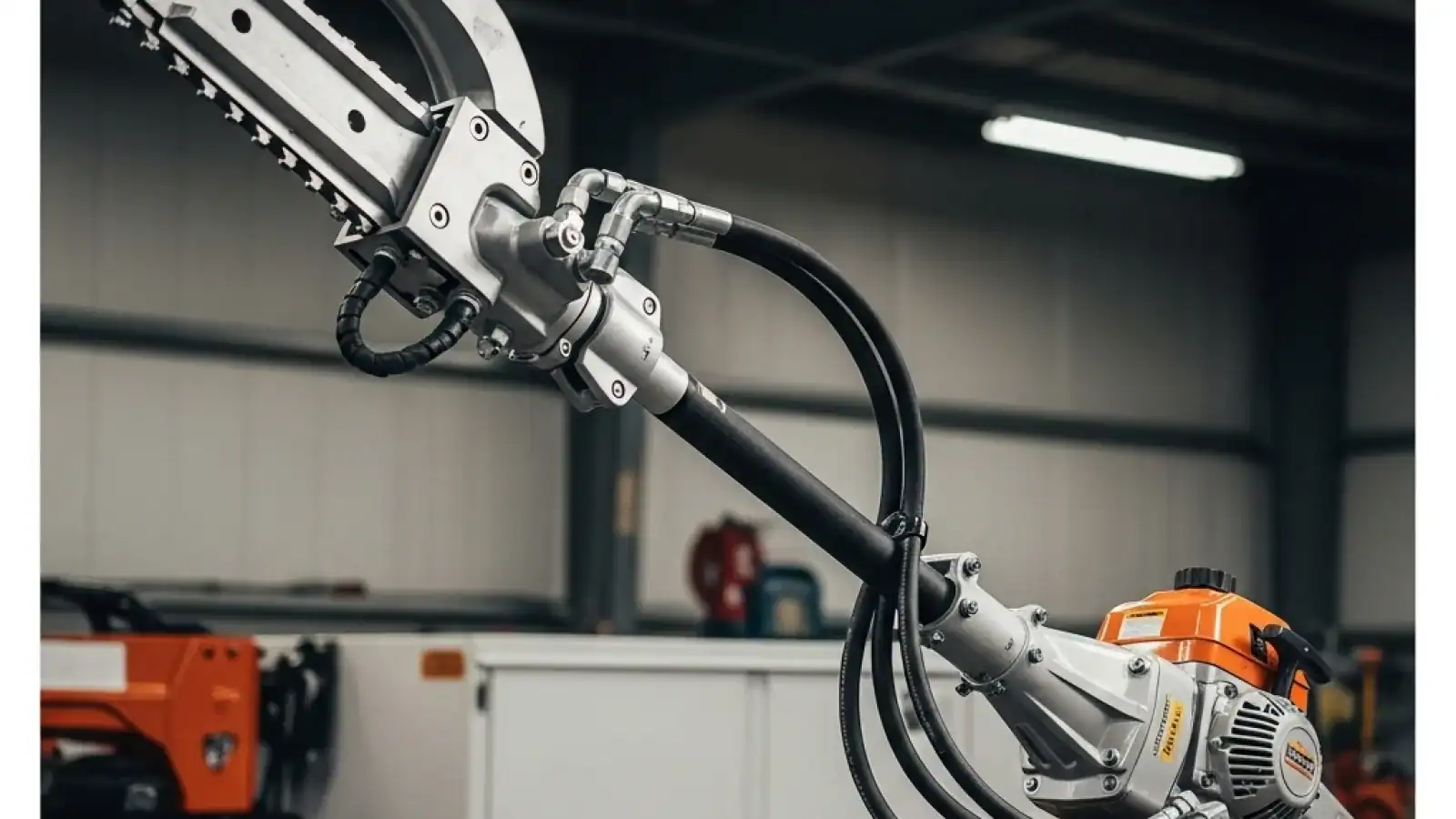
At its core, a hydraulic system operates by using an incompressible fluid to transmit force from one point to another. In the context of a pole saw, a hydraulic pump (often integrated into a bucket truck’s engine) pressurizes hydraulic fluid, which then flows through hoses to a hydraulic motor within the sawhead. This motor converts the fluid’s pressure and flow into rotational energy, spinning the saw chain with incredible force. What this means for the operator is a consistent, high-torque output that doesn’t bog down under load, even when cutting through dense hardwood. The result is a smooth, powerful cut every single time, without the peaks and valleys of a sputtering gas engine or the diminishing power of a draining battery.
This inherent design also contributes to other operational benefits. Hydraulic systems typically generate less vibration than gas engines, reducing operator fatigue over long shifts – a critical factor when you’re working 20 feet up. Furthermore, without a gas engine, there are no exhaust fumes, making them a cleaner choice, especially in urban environments or confined spaces. And because the power source is external, the sawhead itself can be lighter and more compact, enhancing maneuverability at the end of a long pole.
Key Advantages for Professional Use
The advantages of hydraulic pole saws extend far beyond just brute force. Their design offers specific benefits that are crucial for the demanding world of professional tree care. First and foremost is their unmatched cutting power. A hydraulic motor delivers consistent torque, allowing the saw to power through thick branches up to 10-12 inches in diameter with remarkable ease, often exceeding the capabilities of comparably sized gas saws. This translates directly to increased productivity on the job site.
Secondly, extended runtime is a massive benefit. When connected to a bucket truck’s hydraulic system, these saws operate as long as the truck’s engine runs. There are no batteries to recharge or fuel to mix and refill constantly, minimizing downtime and keeping crews focused on the task at hand. A recent survey from a leading arborist association highlighted that 78% of utility line clearance crews now rely on hydraulic pole saws as their primary trimming tool, largely due to their reliability and sustained performance.
Their heavy-duty construction is another critical factor. Built with industrial-grade components, hydraulic pole saws are designed to withstand the rigors of daily professional use, from extreme weather conditions to accidental impacts. This robust build contributes to a longer lifespan and fewer breakdowns compared to consumer-grade equipment. Moreover, precision control is paramount when working near power lines or delicate structures. Many hydraulic saws feature variable speed operation, allowing arborists to make careful, controlled cuts, feathering the trigger for delicate work or engaging full power for aggressive trimming. Finally, the minimal vibration of hydraulic systems means less operator fatigue and a reduced risk of hand-arm vibration syndrome, improving both comfort and safety during prolonged operations.
When to Choose Hydraulic
So, when does a hydraulic pole saw truly shine? Primarily, they are the undisputed champions for municipal tree trimming, utility line clearance, and large-scale commercial arboriculture. If your work involves routinely clearing vegetation around power lines, managing urban forests, or maintaining extensive property with mature trees, a hydraulic pole saw system is not just an option—it’s an essential investment. Their ability to deliver sustained power at height, combined with robust construction and precise control, makes them the ideal choice for environments where safety, efficiency, and reliability are non-negotiable.
Types of Hydraulic Pole Saws & Their Applications
While the core principle of hydraulic power remains consistent, hydraulic pole saws come in various configurations, each tailored to specific professional needs and operational environments. Understanding these distinctions is crucial for selecting the right tool for your crew and your typical job profile. The primary division lies in how they receive their hydraulic power: directly from a vehicle or from a dedicated power pack.
Bucket Truck-Mounted Systems: The Arborist’s Backbone
The most common and arguably most efficient professional configuration involves hydraulic pole saws designed for direct connection to a bucket truck’s hydraulic system. These systems are the workhorses of utility companies and municipal tree care departments. The truck itself becomes the power source, providing a continuous flow of hydraulic fluid at specific pressure and flow rates, typically in the range of 4-8 GPM (gallons per minute) at 1500-2500 PSI (pounds per square inch). This integration means the saw operates seamlessly as an extension of the truck’s capabilities, eliminating the need for separate engines or fuel tanks on the pole saw itself.
These saws typically feature a telescopic pole, offering impressive reach capabilities, often between 15-25 feet, allowing operators to safely trim high branches from the bucket. Common bar lengths for these professional saws range from 14 to 16 inches, providing ample cutting capacity for most utility and municipal tasks. Advanced models, such as those offered by Altec, Terex, or specialized manufacturers like ADI, often boast features like 360° rotating heads for optimal cutting angles, dual-action hydraulic cylinders for smooth and precise sawhead articulation, and sawhead tilt adjustments to navigate complex branch structures. The integration of these tools into bucket truck operations is also heavily guided by OSHA and ANSI standards, ensuring maximum safety for operators working at height and near energized lines.
Stand-Alone Hydraulic Pole Saws: Portability & Versatility
While bucket truck integration offers unparalleled convenience on large projects, there are scenarios where a truck simply isn’t feasible or accessible. This is where stand-alone hydraulic pole saws shine. These portable systems are powered by separate hydraulic power packs, which can be either gas-engine driven or, less commonly, electric. These power packs are compact units, designed to be easily transported to remote job sites, areas inaccessible by vehicles, or for smaller trimming operations where a full bucket truck setup would be overkill.
Stand-alone systems typically offer a slightly shorter reach, often in the 8-12 foot range, making them suitable for ground-based operations or when working from ladders in confined spaces. Key features include quick-connect hoses, allowing for rapid setup and disconnection, and robust power units that can be wheeled or carried. Brands like SherrillTree and Bandit offer popular models in this category, providing arborists with the flexibility of hydraulic power without being tethered to a truck. They are invaluable for tasks like clearing trails, performing selective pruning in sensitive landscapes, or accessing backyards where heavy machinery cannot enter.
Specialized Hydraulic Sawheads
Beyond the power source, the sawheads themselves can vary. Some hydraulic pole saws come with fixed heads designed for straightforward cutting, while others feature articulating or rotating heads for enhanced maneuverability and precision, particularly useful when making intricate cuts within a canopy or near obstacles. There are also specialized sawheads with different bar and chain configurations, from narrow kerf chains for delicate pruning to aggressive chains for maximum material removal. Choosing the right sawhead is as important as choosing the right power source, ensuring the tool is perfectly matched to the specific demands of the job.
Mastering the Mount: Integrating Hydraulic Pole Saws with Bucket Trucks
Successfully integrating a hydraulic pole saw with a bucket truck is more than just plugging in a hose; it’s a careful process that demands attention to detail, adherence to safety standards, and a thorough understanding of hydraulic systems. Improper mounting or incompatible components can lead to equipment failure, reduced performance, and, most critically, serious safety hazards. As an experienced professional, I can’t stress enough the importance of getting this right from the outset.
Pre-Installation Checklist & Compatibility
Before you even think about connecting hoses, the first step is to verify the hydraulic compatibility between your pole saw and your bucket truck’s auxiliary hydraulic circuit. Every truck’s hydraulic system is designed to deliver specific flow rates (GPM) and pressure levels (PSI). Your hydraulic pole saw will have clearly stated requirements, for example, needing 6 GPM at 2000 PSI. Exceeding these specifications can damage the saw, while insufficient flow or pressure will result in poor performance. You must consult both the pole saw’s and the truck’s manuals.
Additionally, assess your truck’s hydraulic reservoir capacity and filtration system. A pole saw adds to the overall hydraulic load, and ensuring adequate fluid volume and clean fluid is vital for system longevity. If your truck’s hydraulic system doesn’t have an integrated relief valve set appropriately for the pole saw’s maximum pressure, installing one is a non-negotiable safety measure to prevent over-pressurization. Finally, consider the type of hydraulic fluid required; most utility trucks use specific fluids like AW 46, and it’s imperative that the pole saw system is compatible to avoid fluid contamination and component damage.
Step-by-Step Mounting Process
- Secure the Mounting Bracket: The pole saw’s storage and operating bracket must be securely mounted to the bucket truck’s boom or basket. This isn’t just about convenience; it’s a critical safety point. Use only reinforced, truck-approved mounting points and hardware specified by the truck manufacturer. Ensure the bracket provides 360° clearance for the pole saw’s operation, allowing for full articulation without obstruction or interference with other controls or safety mechanisms.
- Connect Hydraulic Lines: This step requires precision. Use only high-pressure hydraulic hoses specifically rated for the maximum operating pressure of your system (typically 3000 PSI or higher). Install quick-disconnect fittings – flush-face couplers are highly recommended as they minimize fluid loss and prevent dirt and debris from entering the hydraulic system during connection and disconnection. Always ensure the fittings are clean before connecting to prevent contamination. Connect the pressure line (usually marked) to the saw’s inlet and the return line to the saw’s outlet.
- Bleed the System: Once connected, it’s crucial to bleed any air out of the hydraulic lines. Air in the system can cause erratic operation, cavitation (which damages pumps), and reduced power. This process typically involves cycling the saw’s functions slowly without a load, often with the sawhead pointed downwards to help trapped air rise and exit the system. Consult your saw’s manual for the exact bleeding procedure.
- Test Operation Thoroughly: With the system bled, perform a comprehensive test. Start the truck’s engine and engage the hydraulic tool circuit. Carefully activate the pole saw, checking for smooth extension and retraction, proper chain engagement and rotation, and most importantly, any signs of leaks at the hose connections. Listen for unusual noises, which could indicate air in the system or other issues. Never operate the saw under load until you are certain it is functioning perfectly and leak-free.
Optimizing Ergonomics & Storage
Beyond the technical installation, consider the ergonomics. The pole saw should be positioned for easy access and comfortable handling by the operator in the bucket. Secure storage on the truck is also vital. When not in use, the saw should be locked down to prevent movement during transport, which could damage the saw or pose a hazard to other equipment or personnel. Many trucks have dedicated scabbards or holders to protect the bar and chain and keep the tool secure.
Operation, Maintenance, and Safety for Peak Performance
A hydraulic pole saw is a powerful and efficient tool, but like any piece of professional equipment, its effectiveness and longevity are directly tied to proper operation, rigorous maintenance, and an unwavering commitment to safety. Neglecting any of these aspects can lead to costly repairs, reduced productivity, and, most critically, severe accidents. My advice here comes from years of hands-on experience; these practices aren’t just recommendations, they are essential for anyone using these formidable tools.
Safe Operating Practices
Safety around hydraulic pole saws, especially when working from a bucket truck, begins long before the first cut. Personal Protective Equipment (PPE) is non-negotiable: a hard hat (ANSI Z89.1 approved), eye protection (ANSI Z87.1 approved), hearing protection, cut-resistant gloves, and chainsaw protective pants or chaps are the absolute minimum. When working aloft, a full body harness and appropriate fall arrest system are mandatory.
The most critical safety consideration for bucket truck operators is maintaining Minimum Approach Distances (MAD) to power lines. OSHA and utility-specific regulations dictate these distances, which can be 10 feet for unqualified personnel and often closer for qualified utility workers with specialized training. Always assume lines are energized. A designated spotter on the ground is crucial, particularly when cutting near roads, structures, or other hazards, to manage traffic, watch for falling debris, and monitor the operator. Clear communication between the operator and spotter is paramount.
Proper cutting techniques are also vital for safety and efficiency. Understand the principles of kickback and how to avoid it by always cutting with the bottom of the bar (pulling chain) when possible, or using the top of the bar (pushing chain) only with extreme caution and proper technique. Plan your cuts, establish clear escape routes, and always make cuts that allow the branch to fall safely without striking the bucket or other parts of the truck. Mastering techniques like three-cut method (undercut, top cut, final cut) to prevent bark tearing and understanding branch collar cutting for tree health are fundamental. Never exceed the manufacturer’s rated pressure for the saw, as this can lead to catastrophic failure.
Essential Maintenance Schedule
A consistent maintenance schedule is the lifeblood of your hydraulic pole saw. Neglecting it is a recipe for premature wear and costly downtime. Think of it as preventative medicine for your equipment:
- Daily: Before each shift, check the hydraulic fluid level in the truck’s reservoir. Inspect all hydraulic hoses for kinks, cuts, abrasions, or leaks – even small leaks can quickly become major problems. Verify saw chain tension and sharpness; a dull chain works harder, heats up, and can lead to kickback. Ensure the chain oiling system is functioning correctly and the reservoir is full.
- Weekly: Perform a more thorough inspection. Check all quick-connect fittings for wear and ensure they are clean and sealing properly. Inspect the saw’s filters (hydraulic filter on the truck, and any inline filters for the saw itself). Clean the bar groove to ensure proper chain lubrication and remove debris. Check all fasteners on the sawhead and pole for tightness.
- Monthly/Quarterly: Depending on usage, consider flushing the hydraulic system and replacing filters. This helps remove contaminants that can degrade fluid and damage components. Inspect all seals and O-rings for signs of cracking or hardening. Check the structural integrity of the pole itself for any signs of damage, cracks, or excessive wear.
- Annually/Bi-Annually: Schedule a professional inspection by a qualified technician. This is when major components like hydraulic cylinders might be rebuilt, and comprehensive diagnostic checks are performed. Replace the hydraulic fluid entirely as recommended by the manufacturer, ensuring you use the correct type and viscosity (e.g., AW 46 or specialized biodegradeable hydraulic fluids).
Using the correct hydraulic fluid is critical. Never mix different types of hydraulic fluid, and always ensure the fluid meets the manufacturer’s specifications. High-quality replacement parts, especially for filters and hoses, will also significantly extend the life of your equipment.
Troubleshooting Common Issues
Even with meticulous maintenance, issues can arise. If you experience a loss of power, check the hydraulic fluid level, ensure the filter isn’t clogged, and inspect hoses for kinks or damage. Leaks usually point to worn seals, loose fittings, or damaged hoses – address them immediately. Erratic operation might indicate air in the system (requiring bleeding) or issues with the saw’s internal hydraulic motor. Always consult your operator’s manual for specific troubleshooting steps and never attempt repairs beyond your skill level, especially on hydraulic systems under pressure.
Investing Wisely: Choosing the Right Hydraulic Pole Saw System
The decision to invest in a hydraulic pole saw system for your professional operation is a significant one, but it’s an investment that pays dividends in productivity, safety, and operational efficiency. Choosing the right system, however, requires careful consideration of several key factors to ensure it perfectly matches your specific needs and existing equipment. As your trusted chainsaw expert, I’ll guide you through making an informed choice.
Key Factors to Consider
When evaluating hydraulic pole saws, don’t just look at the price tag. Consider the following:
- Reach and Bar Length: What are your typical job requirements? Do you need to trim branches 25 feet up, or are most of your tasks within a 15-foot range? Most professional models offer telescopic poles reaching 15-25 feet. Common bar lengths are 14-inch or 16-inch, offering a good balance of cutting capacity and maneuverability. Match these to the average diameter of branches you’ll be cutting.
- Flow and Pressure Requirements: This is paramount for bucket truck compatibility. Verify your truck’s hydraulic system output (GPM and PSI) and ensure the pole saw’s requirements fall within that range. Some saws are more versatile, capable of operating efficiently across a broader range of hydraulic flows.
- Weight and Balance: Even though hydraulic saws often have lighter sawheads than gas models, the overall weight of the pole and sawhead, especially at full extension, can contribute to operator fatigue. A well-balanced saw will be more comfortable and safer to operate over long periods. Consider the “dry weight” of the sawhead and pole itself.
- Durability and Construction: Look for industrial-grade materials – robust aluminum or fiberglass poles, heavy-duty hydraulic motors, and strong sawhead components. These tools are subjected to harsh conditions, so build quality directly impacts lifespan and reliability.
- Features: Do you need a 360° rotating head for maximum versatility in tight spaces? Is a variable speed trigger important for precision work? How effective is the automatic chain oiling system? These features can significantly impact efficiency and ease of use.
- Brand Reputation & Support: Brands like ADI, SherrillTree, and Bandit are well-known in the arborist community for their quality hydraulic tools. Beyond these, major utility equipment manufacturers like Altec and Terex often offer integrated hydraulic tool systems that are designed to work seamlessly with their trucks. Research their customer support, availability of parts, and warranty.
Where to Source Professional Equipment
For professional-grade hydraulic pole saws, you’ll want to turn to specialized suppliers. Reputable arborist equipment suppliers like TreeStuff, SherrillTree, and Wesspur are excellent starting points. They offer a range of hydraulic pole saws, components, and accessories tailored for tree care professionals. For those integrating with specific utility vehicles, utility equipment specialists such as Altec, Terex, and Versalift are often the direct source for compatible tools designed to work with their truck systems.
Attending industry trade shows and demonstrations can also provide invaluable hands-on experience and direct interaction with manufacturers, helping you compare different models and ask specific questions.
The Return on Investment
While the initial cost of a quality hydraulic pole saw system might be higher than a gas or electric alternative, the return on investment for professional operations is substantial. Increased productivity due to consistent power and extended runtime means more work accomplished in less time. Reduced operator fatigue leads to safer work practices and fewer errors. The sheer durability of these systems means fewer breakdowns and lower long-term maintenance costs compared to constantly repairing or replacing less robust equipment. Ultimately, investing in a top-tier hydraulic pole saw system is an investment in the safety, efficiency, and reputation of your professional tree care business.
The journey from a beginner to an expert arborist involves mastering your tools, and hydraulic pole saws are certainly among the most powerful allies in a professional’s arsenal. Approach their selection, mounting, operation, and maintenance with the respect and diligence they deserve, and they will serve you reliably for years to come. Remember, safety always comes first, and a well-maintained tool is a safe tool.