



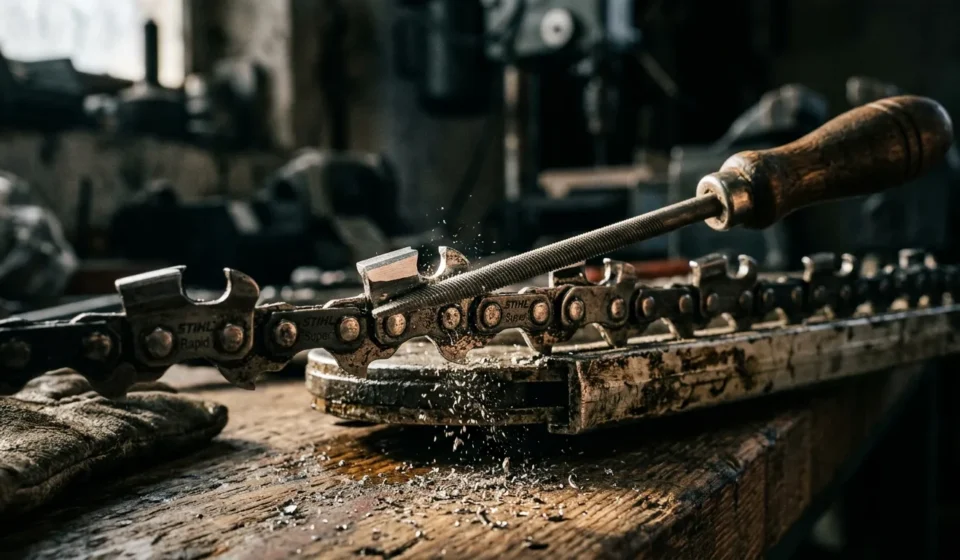

There are few things more frustrating in the world of outdoor power equipment than wrestling with a dull chainsaw chain. Not only does it make your work harder and slower, but it also puts unnecessary strain on both you and your saw. A sharp chain, on the other hand, slices through wood like butter, making your tasks safer, faster, and much more enjoyable. So, let’s turn that frustrating grind into a smooth, efficient cut by mastering the art of chainsaw sharpening.
Table Of Content
- Why a Sharp Chain Is Non-Negotiable for Every Chainsaw User
- Decoding Your Chain: Understanding the Anatomy of a Cutting Tooth
- Essential Tools for Precision Chainsaw Sharpening
- The Step-by-Step Process: Mastering the Art of Hand Sharpening
- Step 1: Safety First, Always!
- Step 2: Clean the Chain and Identify the Shortest Cutter
- Step 3: Secure Your Chainsaw
- Step 4: Choose the Correct File and Angle
- Step 5: Sharpening the Cutters (One Direction Only)
- Step 6: Adjusting the Depth Gauge (Raker)
- Step 7: Inspect and Test
- Pro Tips and What to Watch Out For
- Common Chainsaw Sharpening Mistakes to Avoid
- Frequently Asked Questions
- How often should I sharpen my chainsaw chain?
- What is the correct filing angle for my chain?
- Can I sharpen a chain with a Dremel or grinder?
Why a Sharp Chain Is Non-Negotiable for Every Chainsaw User
Honestly, what’s worse than wrestling a chainsaw that just won’t cut? You’re pushing, straining, the engine is screaming, and all you’re getting is a thin whisper of sawdust instead of satisfying chips. This isn’t just inefficient; it’s downright dangerous. A dull chain is more prone to kickback, which is when the tip of the guide bar hits an object and causes the saw to suddenly jump back towards the operator. That’s a scenario no one wants to experience, and it can lead to serious injury.
Beyond safety, a sharp chain dramatically improves your cutting efficiency. It reduces the physical effort required, allowing the saw to do the work it was designed for. This means less fatigue for you, quicker job completion, and less wear and tear on your chainsaw’s engine. A dull chain forces your engine to work harder, consume more fuel, and generate excessive heat, all of which shorten the lifespan of your valuable equipment. Imagine this situation: you’ve got a whole cord of firewood to cut, and after just a few logs, your saw starts to smoke, the cuts are ragged, and you’re sweating buckets trying to push it through. That’s a clear sign your chain is screaming for some attention, and addressing it promptly will save you a lot of headache and potential repair costs down the line.
Recognizing a dull chainsaw chain is relatively easy. Instead of producing chunky, uniform wood chips, a dull chain will typically produce fine, powdery sawdust. The saw will also require more pressure to cut, tend to jump or bounce on the wood, and might even pull to one side. If you see smoke, even in softwoods, it’s a definite indicator that friction is too high, and your chain is losing its edge. Regular chainsaw maintenance, including sharpening, is the secret to a happy saw and a safe, productive cutting experience.
Decoding Your Chain: Understanding the Anatomy of a Cutting Tooth
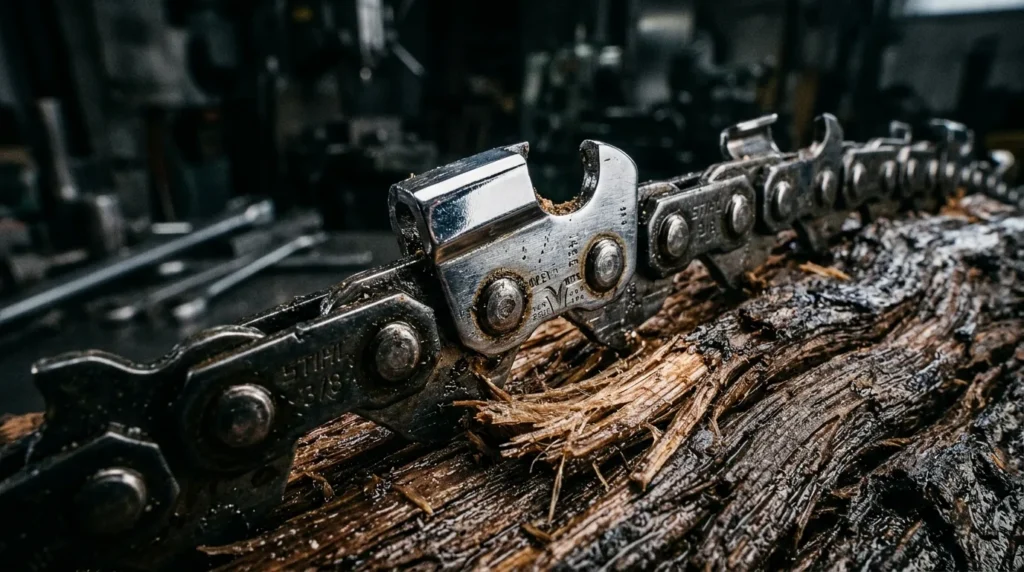
Before we pick up a file, it’s crucial to understand what we’re actually sharpening. A chainsaw chain isn’t just a simple loop of metal; it’s a complex assembly of specialized links, each with a specific job. The most important part for cutting is, naturally, the cutter. Each cutter has two main parts: the top plate and the side plate. These meet at the working corner, which is the actual cutting edge that shaves wood fibers.
Behind each cutter, you’ll find the depth gauge, often called the raker. This small, protruding metal hump determines the depth of the cut. Think of it like a tiny ski; it limits how deep the cutter can dig into the wood, ensuring consistent chip thickness. If the depth gauge is too high, the cutter won’t engage the wood effectively, leading to shallow cuts and slow progress. If it’s too low, the cutter will take too big a bite, causing excessive vibration, bogging down the engine, and significantly increasing the risk of dangerous kickback. Maintaining the correct relationship between the cutter’s edge and the depth gauge is paramount for optimal performance and chainsaw safety.
There are also different types of chains, primarily full chisel and semi-chisel. Full chisel chains have sharp, square-cornered cutters for aggressive, fast cutting, especially in clean wood. Semi-chisel chains have rounded working corners, making them more forgiving, less prone to dulling in dirty wood, and generally better for homeowners and all-around use. While the basic sharpening process is similar, the precise filing angles might vary slightly, so always consult your chainsaw’s manual or the chain manufacturer’s specifications. Understanding these components is your first step to a truly effective sharpening process. Without this knowledge, you’re just grinding metal without purpose.
Essential Tools for Precision Chainsaw Sharpening
To get a razor-sharp edge, you need the right tools. Skimping here will only lead to frustration and a sub-par result. Here’s what you’ll need to have on hand before you start:
- Round File: This is the star of the show. It must be the correct size for your chain’s pitch. Using the wrong size will ruin your cutting edge.
- File Guide/Holder: This handy tool clamps onto your round file and helps maintain the correct filing angle and depth. Absolutely essential for beginners and a great aid for experienced users.
- Flat File: Used for lowering the depth gauge (raker).
- Depth Gauge Tool: This small metal template sits over your chain and indicates how much of the depth gauge needs to be filed down.
- Chain Vise or Stump Vise: Securing your saw is critical for safe and accurate sharpening. A bench-mounted chain vise or a portable stump vise works perfectly.
- Work Gloves: Protect your hands from sharp edges and metal slivers.
- Safety Glasses: Non-negotiable! Metal shavings can fly.
- Bar Groove Cleaner: Not directly for sharpening, but good practice to clean the guide bar groove while you’re at it.
Choosing the correct chainsaw file size is paramount. If you use a file that’s too small, it won’t properly shape the cutter. If it’s too large, it will hit the depth gauge and won’t sharpen the working corner correctly. You can find your chain’s pitch (e.g., .325″, 3/8″, .404″) stamped on the guide bar or in your chainsaw’s manual. Here’s a general guide:
| Chain Pitch | Recommended Round File Size |
|---|---|
| 1/4 inch | 5/32 inch (4.0 mm) |
| .325 inch | 3/16 inch (4.8 mm) |
| 3/8 inch (low profile) | 5/32 inch (4.0 mm) |
| 3/8 inch (standard) | 13/64 inch (5.2 mm) or 7/32 inch (5.5 mm) |
| .404 inch | 7/32 inch (5.5 mm) |
Always double-check your chain manufacturer’s recommendation, as there can be slight variations. Having these tools ready means you won’t be scrambling mid-sharpening, allowing you to focus purely on technique.
The Step-by-Step Process: Mastering the Art of Hand Sharpening
Now that you’re geared up and understand your chain, let’s get down to business. This is where patience and practice pay off.
Step 1: Safety First, Always!
Before you even touch a file to the chain, make sure your chainsaw is off and the chain brake is engaged. This prevents any accidental movement. Put on your heavy-duty work gloves and, importantly, your safety glasses. I’ve seen too many close calls with metal filings flying around. Don’t skip these crucial chainsaw safety steps; your eyesight and fingers are worth it.
Step 2: Clean the Chain and Identify the Shortest Cutter
Use a brush to remove any sawdust, resin, or debris from the chain. A clean chain allows for better visibility and more accurate filing. Once clean, visually inspect all the cutters. Look for any damage, chips, or unusually worn teeth. Find the shortest (most worn) cutter and mark it with a permanent marker. This will be your reference point; you’ll sharpen all other cutters to match its length, ensuring a balanced chain.
Step 3: Secure Your Chainsaw
This step is non-negotiable for effective sharpening. Clamp the guide bar firmly in a vise, a stump vise, or a specialized bar clamp designed for sharpening. The chain needs to be stable and unable to move or wobble. Trying to sharpen a wobbly chain is like trying to draw a straight line on a trampoline – it’s just not going to happen, and you’ll end up with inconsistent angles and a poorly sharpened chain.
Step 4: Choose the Correct File and Angle
Insert the correct size round file into its guide/holder. This guide is key to maintaining the correct filing angles chainsaw. Most chains require a filing angle of 25 to 35 degrees, with 30 degrees being very common. Your chain’s top plate will usually have a guide mark to indicate the correct angle. The file holder will typically have markings to help you align with this angle. When you place the file into the cutter, about 1/5th to 1/4th of the file’s diameter should be above the top plate of the cutter. This ensures you’re filing both the top plate and the side plate correctly.
Step 5: Sharpening the Cutters (One Direction Only)
Start with your marked shortest cutter. Place the file in the gullet (the space between the cutter and the depth gauge). File from the inside of the cutter towards the outside, using smooth, even strokes. Apply pressure only on the forward stroke and lift the file slightly on the return stroke. Never file in both directions; this dulls the file quickly and creates a jagged edge. Count the number of strokes you use on that first cutter (e.g., 3-5 strokes) until it’s sharp and the damaged portion is gone. Repeat this exact number of strokes for all other cutters on that same side of the chain. For example, if your saw has an odd number of cutters facing left, sharpen all of those. Once all the cutters facing one direction are done, you’ll need to either reposition the saw in the vise or walk around to the other side of your workbench to access the cutters facing the opposite direction. But what if you’ve sharpened one side and can’t easily access the other? Simply flip the saw in the vise, or if using a stump vise, rotate the entire saw to get a comfortable position for the remaining cutters. Consistency in angle and number of strokes is absolutely crucial for a balanced chain that cuts straight.
Step 6: Adjusting the Depth Gauge (Raker)
After you’ve sharpened all the cutters, it’s time to check and adjust the depth gauge setting. Place the depth gauge tool over the chain so that the raker protrudes through the slot. Use your flat file to gently file down the protruding raker until it’s flush with the top of the depth gauge tool. Then, with a couple of light strokes, round off the front edge of the raker slightly. This prevents it from catching and causing kickback. Remember, a little goes a long way here; taking too much off the depth gauge can make your saw overly aggressive and dangerous. Do this for every depth gauge on the chain.
Step 7: Inspect and Test
Once you’ve finished filing all the cutters and adjusting all the depth gauges, remove the saw from the vise. Run your gloved finger carefully along the cutting edge of a tooth – it should feel very sharp, almost like a knife edge, with no visible burrs or flat spots. Ensure the chain moves freely on the bar. Re-tension the chain if necessary, start your saw (safely!), and make a test cut. You should immediately notice the difference: smooth, fast cutting with chunky, consistent wood chips. If it still pulls to one side or feels sluggish, re-inspect your angles and depth gauges.
Pro Tips and What to Watch Out For
Regular maintenance is the backbone of safe and efficient chainsaw operation. Chainsaw sharpening isn’t a “once-a-year” task; it’s something you’ll do frequently. I recommend a few light strokes with the file every time you refuel, or at least every few hours of cutting. It’s much easier to maintain a sharp edge with a few quick passes than to try to restore a severely dull chain. In my opinion, this frequent, light sharpening is one of the most effective habits you can adopt.
Always keep your files clean. Wood resin and metal particles can clog the file teeth, making them ineffective. Use a wire brush to clean them regularly. Also, remember that files wear out over time. If your file isn’t biting effectively, it might be time for a new one. To be fair, a fresh, sharp file makes the job significantly easier and more accurate.
Pay attention to the wear indicators on your chain. Many chains have small witness marks on the top plate. When you’ve filed past these marks, the chain has reached the end of its useful life and should be replaced. Trying to squeeze a few more cuts out of a severely worn chain is not only ineffective but also dangerous. A chain with multiple broken links, stretched links, or extreme wear should be discarded immediately. Also, keep the chain well-lubricated with bar and chain oil; this reduces friction and helps keep the cutting edge cooler, extending its sharpness.
Common Chainsaw Sharpening Mistakes to Avoid
Even seasoned users can sometimes fall into bad habits. Here are the most common pitfalls to sidestep:
- Using the Wrong File Size: As we discussed, this is a fundamental error. It leads to improper tooth geometry and an ineffective cutting edge.
- Inconsistent Angles: Filing at different angles for different teeth will make your chain cut crookedly, strain the saw, and wear unevenly. Use a file guide!
- Filing in Both Directions: This rapidly dulls your file and creates a poor, feathered edge on the cutter. Always file in one direction: away from you, from the inside out.
- Ignoring the Depth Gauge: Neglecting the raker will either prevent the chain from cutting effectively (too high) or cause it to bite too aggressively, leading to kickback (too low).
- Not Securing the Saw: A wobbly saw means inconsistent pressure and angles, leading to a poorly sharpened chain and increased risk.
- Waiting Too Long: Trying to sharpen a severely dull chainsaw chain takes more effort, removes more material, and shortens the chain’s life. Sharpen little and often!
- Applying Too Much Pressure: Excessive force doesn’t make the file work better; it can damage the cutter, wear out your file faster, and make it harder to maintain a consistent angle. Let the file do the work.
Frequently Asked Questions
How often should I sharpen my chainsaw chain?
As a general rule, sharpen your chain every time you refuel your saw or after about 1-2 hours of cutting, especially if cutting hardwoods or dirty wood. If you hit dirt or rock, stop immediately and sharpen.
What is the correct filing angle for my chain?
Most chainsaw chains use a 25 to 35-degree filing angle for the top plate, with 30 degrees being the most common. Always check your chain’s manufacturer specifications or the markings on the top plate of the cutter for the precise angle.
Can I sharpen a chain with a Dremel or grinder?
While technically possible, using a Dremel or bench grinder freehand is generally not recommended for hand sharpening, especially for beginners. It’s very difficult to maintain consistent angles and prevent overheating, which can damage the chain’s temper. Stick to dedicated round files and file guides for best results and chain longevity.
Mastering chainsaw sharpening is one of the most empowering skills any chainsaw owner can acquire. It’s a bit like learning to ride a bike – challenging at first, but incredibly rewarding once you get the hang of it. Not only will you save money on professional sharpening services and replacement chains, but you’ll also gain a deeper understanding of your equipment, leading to safer and more efficient cutting every time you fire up your saw. So grab your tools, take your time, and enjoy the satisfaction of a truly sharp chain and perfectly cut wood. Your chainsaw, and your back, will thank you for it!