Disclosure: As an Amazon Associate, we earn from qualifying purchases.
A 16-inch guide bar and chain assembly represents the absolute sweet spot for versatile cutting performance on homeowner, landowner, and light commercial chainsaws. Mounting a 16-inch bar to a mid-sized engine keeps the chainsaw nimble during limbing operations while preserving enough bar length to cut logs up to 28 inches in diameter using dual-pass techniques. Choosing the proper cutting attachment requires understanding how pitch, gauge, and drive link counts interact with your chainsaw's engine displacement. When your bar and chain are perfectly matched to your powerhead, the engine stays in its optimal RPM power band, reducing strain on the clutch drum, crankcase bearings, and drive sprocket.Quick answer: A 16-inch Husqvarna bar paired with a matching chain provides optimal balance for 35cc to 50cc gas engines, delivering high chain speed and low vibration. Select a 3/8-inch Low Profile pitch with 56 drive links for lightweight saws (35cc–40cc), or a .325-inch pitch with 66 drive links for medium-duty land management (40cc–50cc). Matching drive link counts, pitch, and gauge (.050" or .058") prevents premature rail wear and severe thermal overload.
Understanding Husqvarna 16-Inch Bar Specifications and Mounts
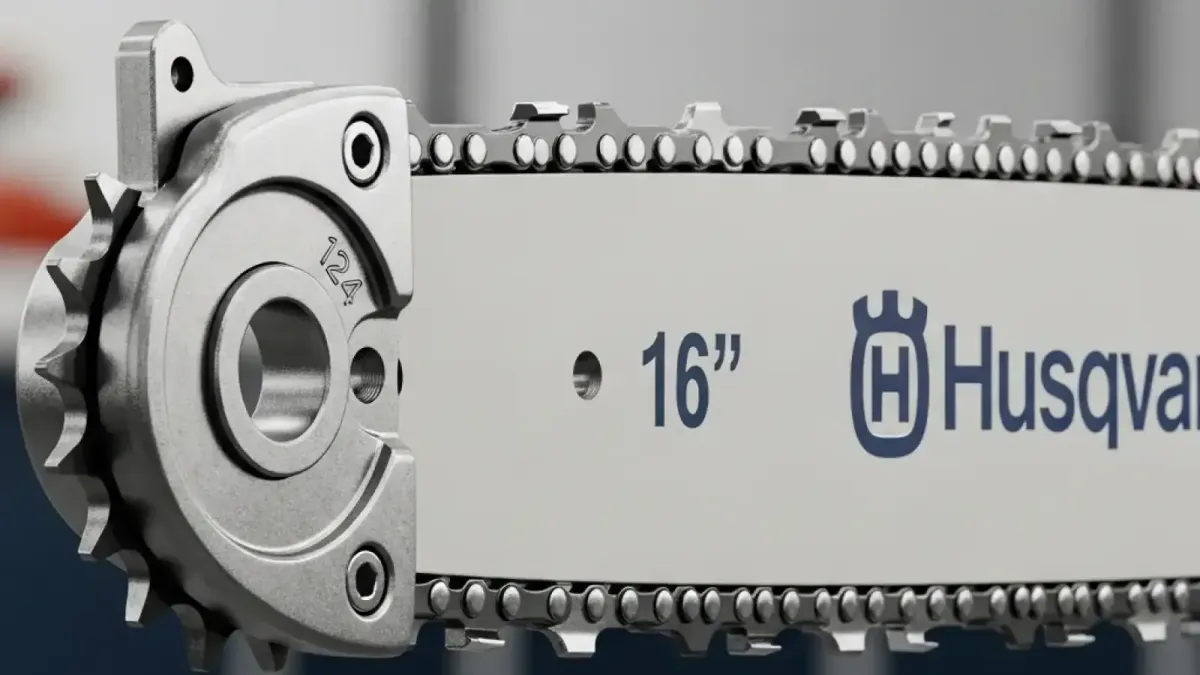
Navigating the technical specifications stamped onto the tail end of a Husqvarna guide bar is essential before purchasing replacement parts. Every Husqvarna bar displays three primary dimensions: pitch, gauge, and drive link (DL) count. The pitch represents the average distance between any three consecutive rivets divided by two, commonly measuring 3/8-inch Low Profile (LP) or .325-inch on 16-inch setups. Drive link gauge refers to the precise thickness of the lower drive tangs that track inside the guide rail groove, standardizing at either .050 inches (1.3 mm) or .058 inches (1.5 mm) for Husqvarna equipment. Inserting a chain with the wrong gauge will either cause immediate binding or result in sloppy, crooked cuts that destroy the bar rails.
Guide bar mounting geometry, often referred to as the tail mount pattern, determines physical fitment onto the chainsaw studs and oil outlet ports. Husqvarna heavily utilizes small bar mounts (often labeled as A041 or K095 tail mounts in industry catalogs) across their popular 100, 400, and 500 series powerheads. For instance, entry-level consumer models like the Husqvarna 120 Mark II and 135 Mark II utilize an A041 mount running 3/8-inch LP chain with 56 drive links. Moving up to mid-range homeowner and semi-professional saws such as the 435, 440, 445, 543 XP, and 545 Mark II requires the K095 small mount running a .325-inch pitch system with 66 drive links. Matching the oil passages on the bar tail to your saw's crankcase oil discharge port ensures consistent rail lubrication during high-load cutting.
Modern Husqvarna guide bars incorporate advanced metallurgy and structural design improvements to shave weight and increase durability. The Husqvarna X-Force bar series features an optimized center plate geometry, sealed internal bearings, and a robust nose sprocket assembly. Traditional laminated bars required operators to manually pack grease into the nose sprocket grease hole at every refueling stop. In contrast, X-Force bars utilize a sealed bearing system that eliminates manual nose greasing entirely, protecting the internal roller bearings from ambient wood dust, fine shavings, and abrasive grit. This sealed design drastically reduces downtime while extending overall bar life during demanding clearing operations.
Choosing the Right Chain Pitch, Gauge, and Tooth Geometry
Matching your 16-inch bar with the correct saw chain tooth profile dictates cutting speed, vibration levels, and dulling resistance. Chainsaw chains are categorized by cutter architecture, primarily full-chisel, semi-chisel, and specialized narrow-kerf variants. Full-chisel cutters feature square-cornered teeth that slice cleanly through clean timber fibers at maximum speed. However, full-chisel chains dull rapidly upon contact with dirty bark, sandy soil, or frozen timber. Semi-chisel cutters possess rounded corner radiuses that retain razor sharpness much longer in harsh environments, making them the preferred choice for firewood gathering and storm damage cleanup.
Husqvarna's factory-developed X-Cut chain line, including popular models like the SP33G (.325" pitch, .050" gauge) and S93G (3/8" LP pitch, .050" gauge), offers pre-stretched manufacturing directly from the assembly plant. Standard aftermarket chains undergo substantial initial stretch during their first thermal expansion cycles, requiring frequent adjustments to prevent off-track throwing. X-Cut chains minimize initial stretch, featuring golden tie-links that provide a visible reference point when sharpening teeth with a round file. Furthermore, narrow-kerf options (frequently designated as Pixel technology) remove a thinner kerf of wood during each pass. This reduced cutting resistance allows smaller displacement engines to maintain peak RPM under heavy cutting loads without stalling.
Engine displacement directly dictates which chain system your chainsaw can drive effectively. Running a heavy standard 3/8-inch full-chisel chain on a 40cc engine will overload the centrifugal clutch assembly, resulting in belt slip, clutch drum overheating, and premature engine wear. The chart below illustrates the ideal technical specifications for 16-inch Husqvarna setups across different engine classes and application types.
Factory-Engineered K095 Match: Husqvarna 16-Inch Bar & X-CUT Chain Combo

| Engine Size (cc) | Bar Length & Mount | Pitch & Gauge | Drive Links | Chain Type & Primary Use |
|---|---|---|---|---|
| 35cc – 40cc (e.g., 120, 135 Mark II) | 16" Small Mount (A041) | 3/8" Low Profile / .050" | 56 DL | Husqvarna X-Cut S93G semi-chisel; light pruning, yard cleanup |
| 40cc – 45cc (e.g., 435, 440 Mark II) | 16" X-Force (K095) | .325" Narrow Kerf / .050" | 66 DL | Husqvarna X-Cut SP33G semi-chisel; general firewood processing |
| 45cc – 50cc (e.g., 445, 450, 545 II) | 16" X-Force Laminated | .325" / .050" or .058" | 66 DL | Husqvarna X-Cut SP33G or full-chisel; felling small timber, bucking |
| 50cc – 55cc (e.g., 550 XP Mark II) | 16" Professional Solid/X-Force | .325" / .058" | 66 DL | Full-chisel high-speed chain; rapid pro limbing and timber cutting |
Performance Comparison: 16-Inch vs. Extended Bar Lengths
Choosing a 16-inch bar instead of an 18-inch or 20-inch setup provides distinct mechanical and operational advantages on mid-sized powerheads. In chainsaw operation, every additional inch of guide bar adds friction as drive links drag through the bar groove. A 16-inch setup requires less torque to pull the chain through dense wood fibers compared to an 18-inch bar. On a standard 45cc engine like the Husqvarna 445, switching from an 18-inch bar down to a 16-inch bar increases overall cutting speed and chain velocity while lowering operational engine temperatures.
Weight distribution and ergonomic balance improve dramatically with a 16-inch bar setup. When working on extended brush clearing or overhead limbing tasks, a nose-heavy chainsaw increases operator wrist fatigue and muscle strain. A 16-inch X-Force bar keeps the saw's center of gravity close to the front handle, allowing precise control when making technical undercut and bypass cuts. Furthermore, shorter bars reduce kickback hazards by decreasing the total surface area of the bar nose kickback zone.
For landowners processing mixed hardwoods like oak, maple, and hickory, a 16-inch bar handles logs up to 14 inches in a single pass. When encountering trees slightly larger than the bar length, applying proper bucking techniques allows clean cuts on logs up to 28 inches in diameter. By making an initial cut on one side and completing the cut from the opposite side, operators maximize the utility of a lighter, faster-revving 16-inch setup without carrying the extra weight of a larger 60cc or 70cc chainsaw.
Essential Bar Maintenance, Sharpening, and Tensioning Techniques
Maintaining proper chain tension is the single most important factor for maximizing bar life and operational safety. A loose chain can derail from the bar track at high speed, damaging the drive links, crankcase guard, and operator protective clothing. Conversely, an overly tight chain exerts extreme radial loads on the drive sprocket, clutch drum bearings, and bar nose sprocket. When properly tensioned, the tie-links on the underside of the bar should firmly contact the bottom rail, but you should still be able to pull the chain freely around the bar by hand with the chain brake disengaged.
Pro tip: Never tension a chain while the bar is blistering hot immediately after heavy cutting. Metal contracts as it cools down overnight; tightening a hot chain flush against the bar rails will cause extreme tension buildup as it cools, which can warp your crankshaft, strain the clutch side bearings, or snap the bar nose sprocket. Always perform tension checks during warm-up stops or allow the cutting system to reach ambient air temperature before setting final tension.
Preventative guide bar maintenance must be performed regularly alongside routine chain sharpening. Every time you sharpen or replace your chain, remove the guide bar and perform these essential maintenance steps:
90-Degree Rail Edge Precision: Oregon Bar Rail Dresser Tool

- Clean the Bar Groove: Use a groove cleaner or thin putty knife to scrape out packed sawdust, resin, and dirty oil residue from the entire length of the bar channel.
- Clear the Oil Passages: Verify that the small oil inlet holes near the bar tail mount are completely clear of debris so automatic oil pumps can deliver fresh bar oil to the rails.
- Dress the Bar Rails: Inspect the outer edges of the bar rails for flat wire burrs caused by friction. File burrs flat using a flat dressing file held at a strict 90-degree angle.
- Flip the Guide Bar: Rotate the bar top-to-bottom every time you reinstall it. Symmetrical Husqvarna bars are designed to run in either orientation, and flipping them regularly ensures even wear across both top and bottom rails.
Proper engine fueling and chain lubrication are equally critical to thermal management. Always mix fresh gas with high-quality two-stroke oil at a precise 50:1 ratio (2.6 oz of oil per gallon of gas). Ensure your automatic chain oiler is functioning correctly by pointing the bar tip toward a clean piece of wood or stump and revving the engine slightly; a fine line of flung oil should appear on the wood surface within a few seconds, confirming proper oil flow along the rails.
Always adhere to personal protective equipment (PPE) standards whenever operating power equipment. Wear cut-resistant chainsaw chaps or trousers matching ASTM F1897 standards, along with heavy-duty leather gloves, steel-toe boots, safety glasses, and hearing protection rated for at least 25 dB noise reduction. Maintaining safety equipment and proper working stance ensures long-term safety across all timber cutting tasks.
When selecting your ideal replacement setup, pair your engine size directly to the manufacturer's spec: select a 16-inch 3/8-inch LP setup with 56 drive links for lightweight saws under 40cc, or step up to a .325-inch pitch X-Force bar with 66 drive links and X-Cut SP33G chain for 40cc to 50cc models. Always verify the stamped markings on your original bar tail before ordering replacement loops to guarantee seamless compatibility and smooth cutting performance.
Frequently Asked Questions
How many drive links are on a 16-inch Husqvarna chainsaw chain?
The drive link count depends on the chain pitch. For 16-inch Husqvarna bars with a 3/8-inch Low Profile pitch, the standard count is 56 drive links. For 16-inch bars with a .325-inch pitch, the standard count is 66 drive links. Always check the stamping on your bar tail to confirm.
Can I put a 16-inch bar on a Husqvarna chainsaw that came with an 18-inch bar?
Yes, as long as the replacement bar matches your saw's tail mount pattern (such as K095 small mount) and drive sprocket pitch. Downsizing from an 18-inch to a 16-inch bar on saws like the Husqvarna 445 or 450 often increases chain speed and improves saw balance.
Rigid Field Sharpening Anchor: Chainsaw Filing Stump Vise

What is the difference between .050 and .058 gauge on Husqvarna bars?
Gauge refers to the thickness of the chain's drive links that fit into the bar channel (.050 inches vs .058 inches). You must match the chain gauge exactly to the bar gauge; running a .050 chain in a .058 bar causes dangerous chatter and uneven cuts, while forcing a .058 chain into a .050 groove binds the chain.
Do Husqvarna X-Force 16-inch bars require manual nose sprocket greasing?
No, genuine Husqvarna X-Force guide bars feature a sealed internal bearing system at the nose sprocket that eliminates the need for manual greasing. Bar and chain oil supplied by the engine's automatic oiler provides all necessary lubrication during operation.
Sources
- Husqvarna Official Guide Bar and Chain Specifications
- ANSI B175.1 Safety Requirements for Gasoline-Powered Chainsaws
- OSHA 1910.266 Logging Operations Regulations
| Bar Size | Best For | Ease of Use | Cutting Capacity |
|---|---|---|---|
| 16 inch | Homeowners, light tasks | Effortless | Medium logs |
| 18 inch | Versatile use | Easy | Medium-large logs |
| 20 inch | Professionals, larger tasks | Moderate | Large logs |
| 24 inch | Forestry, heavy-duty | Challenging | Extra-large logs |
Looking for the Right Gear?
Check out our verified Top Professional Chainsaws & Safety Gear Essentials on Amazon.
As an Amazon Associate, we earn from qualifying purchases.