


Understanding Your Chainsaw’s Carburetor
Few things are more frustrating than pulling the starter cord on your chainsaw, only for it to sputter, refuse to start, or die mid-cut. Often, the culprit lies within the heart of its fuel system: the carburetor. As your trusted chainsaw professional, I’m here to demystify this crucial component and guide you through diagnosing and fixing common carburetor issues. You’ll be back to cutting wood in no time!
Table Of Content
- Understanding Your Chainsaw’s Carburetor
- What Does a chainsaw carburetor Do?
- Common Chainsaw Carburetor Problem Symptoms
- Step-by-Step Diagnosing and Simple Fixes
- 1. Check Your Fuel Quality and Supply
- 2. Inspect the Air Filter
- 3. Check the Primer Bulb and Choke
- 4. Adjust Carburetor Screws (With Caution!)
- 5. Address Clogged Fuel Jets and Passages
- 6. Inspect for Leaks and Damage
- When to Rebuild vs. Replace
- Prevention is Your Best Friend
What Does a chainsaw carburetor Do?
Simply put, a chainsaw carburetor’s job is to precisely mix air and fuel in the correct ratio before it enters the engine’s combustion chamber. It’s like the engine’s lungs and mouth working together – too much or too little of either, and your engine won’t run efficiently, if at all. Modern chainsaw carburetors are typically diaphragm-type, designed to work in any orientation.
Common Chainsaw Carburetor Problem Symptoms
Before we dive into fixes, let’s identify the tell-tale signs of a carburetor problem. Your chainsaw might be experiencing one or more of these:
- Chainsaw Won’t Start: The most obvious symptom, even with fresh fuel and a good spark plug.
- Starts Then Stalls: It fires up, runs for a few seconds, then dies, often requiring repeated attempts.
- Runs Rough or Erratically: The engine RPMs fluctuate wildly, or it sounds like it’s “coughing.”
- Lacks Power During Cutting: The saw bogs down easily under load, even with a sharp chain.
- Idles Poorly or Not At All: It won’t hold a steady idle, or completely dies when you release the throttle.
- Excessive Smoke: Especially black smoke, indicating a rich fuel mixture.
- Fuel Leaks: Visible fuel dripping from the carburetor area.
Step-by-Step Diagnosing and Simple Fixes
Safety First: Always ensure your chainsaw is off, and disconnect the spark plug wire before performing any maintenance or inspection. Wear appropriate personal protective equipment (PPE) like gloves and eye protection.
1. Check Your Fuel Quality and Supply
This is often overlooked but is the easiest fix!
- Stale Fuel: Fuel, especially with ethanol, can degrade in as little as 30 days, causing gum and varnish to build up in the carburetor.
- Fix: Drain all old fuel from the tank and fuel lines. Refill with fresh, high-quality, ethanol-free gasoline mixed with the correct two-stroke oil ratio (e.g., 50:1 or 40:1, check your saw’s manual). Consider using a fuel stabilizer for long-term storage.
- Clogged Fuel Filter: Located inside the fuel tank, the filter prevents debris from reaching the carburetor.
- Fix: Use a bent coat hanger or fuel line pliers to carefully pull the fuel line and filter out of the tank. Inspect the small filter for clogs. If it’s dirty, replace it. These are inexpensive and vital.
- Kinked or Cracked Fuel Lines: Old fuel lines can become brittle, crack, or get pinched.
- Fix: Visually inspect all fuel lines leading to and from the carburetor. Replace any lines that are cracked, hardened, or visibly kinked.
2. Inspect the Air Filter
A restricted air filter can starve the engine of air, making it run rich and causing poor performance.
- Clogged Air Filter: Sawdust and debris can quickly clog foam, felt, or nylon air filters.
- Fix: Remove the air filter cover. Take out the air filter. If it’s foam or nylon, clean it with warm, soapy water, rinse thoroughly, let it dry completely, and apply a light coat of air filter oil (if recommended by the manufacturer). If it’s a felt or paper filter, tap out loose debris or replace it if heavily soiled.
3. Check the Primer Bulb and Choke
These aid in cold starting.
- Cracked Primer Bulb: A cracked bulb won’t create the necessary vacuum to draw fuel.
- Fix: Press the primer bulb. If it feels soft, doesn’t spring back, or you see cracks, replace it.
- Choke Function: Ensure the choke lever moves freely and fully engages/disengages.
- Fix: Clean any debris around the choke mechanism. Ensure it’s not stuck halfway.
4. Adjust Carburetor Screws (With Caution!)
Most chainsaws have three adjustment screws: L (low speed), H (high speed), and T (idle speed). These fine-tune the fuel-air mixture.
Important: Adjusting these incorrectly can damage your engine. If you’re unsure, mark the original positions before turning, and only make small adjustments (quarter-turns at a time).
- L (Low Speed) Screw: Affects idle and acceleration from idle.
- Symptom: Poor idle, hesitation on acceleration.
- Fix: With the engine warmed up, turn the L screw slowly clockwise until the engine smooths out, then back it out counter-clockwise about 1/4 turn. You want the highest, smoothest idle without the chain moving.
- H (High Speed) Screw: Controls fuel mixture at full throttle.
- Symptom: Lacks power at full throttle, excessive smoking, or engine “screaming” (too lean).
- Fix: Run the saw at full throttle in a cut. Turn the H screw counter-clockwise until the engine sounds like it’s “four-stroking” (a slightly rough, rich sound), then slowly turn it clockwise until it smooths out but isn’t screaming. Never run the engine too lean (too far clockwise) at full throttle, as this can cause severe engine damage.
- T (Idle Speed) Screw: Adjusts the engine’s idle RPM.
- Symptom: Chainsaw dies at idle or chain spins when idling.
- Fix: After adjusting the L screw, turn the T screw clockwise to increase idle speed or counter-clockwise to decrease it, until the engine idles smoothly without the chain moving.
5. Address Clogged Fuel Jets and Passages
This is where ethanol fuel truly causes problems, leaving behind gum and varnish in tiny passages.
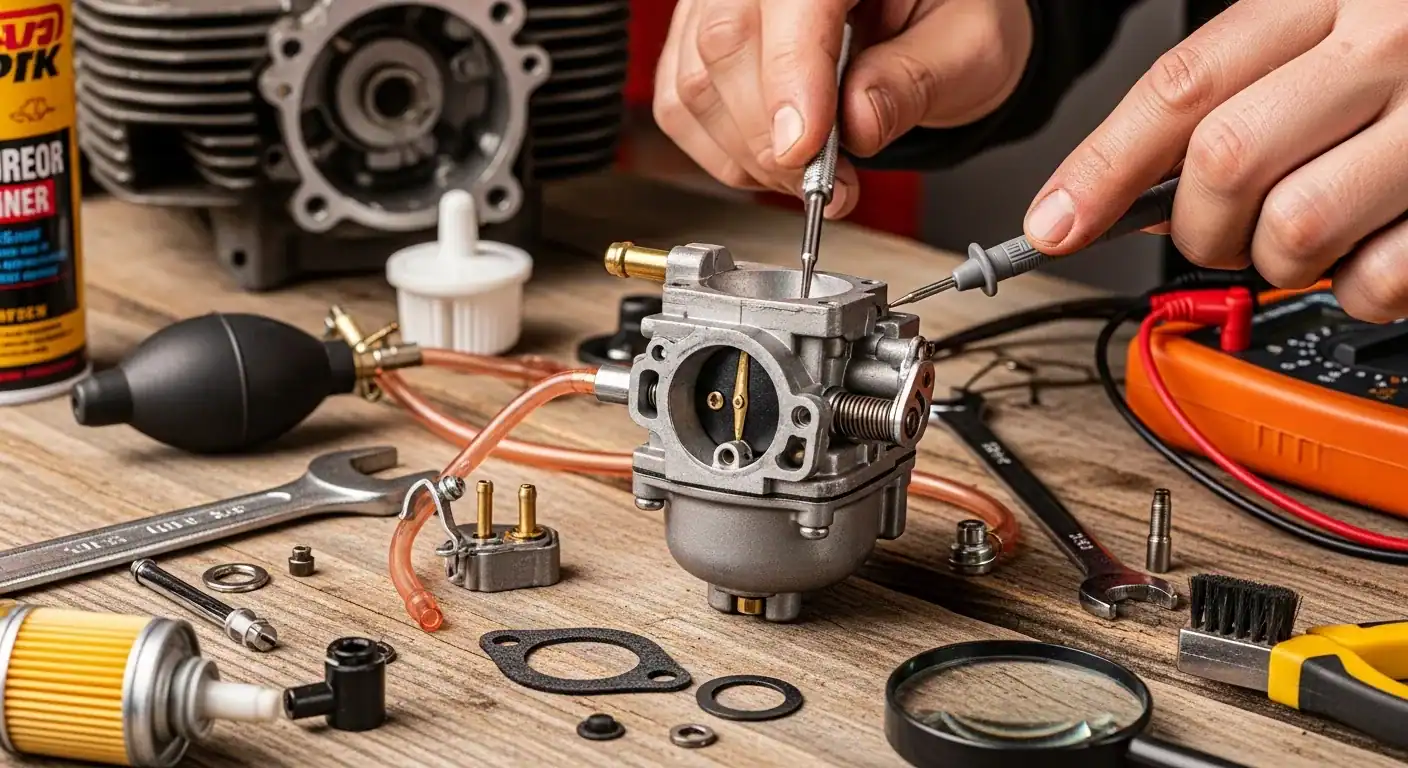
- Disassembly: Carefully remove the carburetor from the chainsaw. Take photos as you go to remember the assembly order.
- Carburetor Cleaner: With the carburetor disassembled (remove covers, diaphragms, and jets), generously spray all internal passages and jets with a non-chlorinated carburetor cleaner. Use the straw attachment to direct the spray into every tiny hole.
- Air Compressor: Blow compressed air (low pressure) through all passages to clear loosened debris.
- Thin Wire: For stubborn clogs, a very thin strand of wire (from a twist tie or guitar string) can gently probe and clear jets. Be extremely careful not to enlarge or damage the small orifices.
- Rebuild Kit: If diaphragms are stiff, cracked, or the problem persists, a carburetor rebuild kit is often the next step. These kits include new diaphragms, gaskets, and sometimes new needle valves and springs. Follow the kit’s instructions for replacement.
6. Inspect for Leaks and Damage
Look for any visible cracks in the carburetor body or torn gaskets that could lead to air or fuel leaks, disrupting the air/fuel ratio.
When to Rebuild vs. Replace
For most common issues like clogged jets or hardened diaphragms, a carburetor rebuild kit is a cost-effective solution (typically $15-$30). However, if the carburetor body is physically damaged, warped, or you’ve tried a rebuild without success, a full carburetor replacement might be necessary. A new carburetor (often $30-$80 for many homeowner models) ensures all internal components are fresh and correctly calibrated.
Prevention is Your Best Friend
The easiest way to avoid carburetor problems is proactive maintenance:
- Always use fresh, high-octane, ethanol-free fuel mixed with quality two-stroke oil.
- Add a reputable fuel stabilizer to your fuel mix, especially if you won’t use the chainsaw frequently.
- Clean or replace your air filter regularly.
- Before storing your chainsaw for more than a few weeks, run the carburetor dry by letting the engine run until it starves itself of fuel. Alternatively, use a fuel stabilizer and ensure the tank is full to minimize air exposure.
Diagnosing and fixing chainsaw carburetor problems might seem daunting, but with these practical steps, you can often get your saw running smoothly again. Remember, patience and attention to detail are key. If you ever feel out of your depth, don’t hesitate to consult a qualified small engine mechanic.