

As a seasoned arborist and outdoor power equipment specialist, I’ve seen firsthand how often people overlook the single most important component for a chainsaw’s performance: the chain itself. It’s easy to get caught up in engine size or bar length, but the truth is, a dull or incorrect chain can turn the most powerful saw into a frustrating, dangerous, and inefficient tool. Conversely, the right chain can make even a modest chainsaw feel like a precision cutting machine.
Table Of Content
- Understanding Chainsaw Chain Anatomy and Types
- Key Components of a Chainsaw Chain
- Cutter Tooth Types: Full Chisel vs. Semi-Chisel vs. Low-Profile
- Chain Gauges and Pitches Explained
- Matching the Right Chain to Your Chainsaw and Task
- Consider Your Chainsaw’s Power and Bar Length
- The Wood You’re Cutting: Clean vs. Dirty, Green vs. Seasoned
- Safety Features: Low Kickback Chains
- Top Picks and Recommendations for 2026
- For General Homeowner Use & Versatility
- For Aggressive Cutting & Professional Felling
- For Dirty Wood, Storm Cleanup & Durability
- For Battery-Powered Chainsaws
- Chain Maintenance for Longevity and Performance
- Proper Sharpening Techniques
- Raker (Depth Gauge) Adjustment
- Lubrication and Tension
- Cleaning and Inspection
- Final Thoughts: Your Chain, Your Performance
Think of it like this: you wouldn’t put racing tires on a tractor, nor would you use off-road tires for a drag race. The same principle applies to chainsaw chains. The best chain isn’t just the sharpest; it’s the one that’s perfectly matched to your saw, the type of wood you’re cutting, and your skill level. This comprehensive 2026 guide is designed to cut through the jargon and equip you with the knowledge to choose chains that not only cut faster but also last longer, ensuring every pass is productive and safe.
Understanding Chainsaw Chain Anatomy and Types
Before we dive into recommendations, let’s break down what makes a chainsaw chain tick. Understanding its basic components and the different types of cutters is foundational to making an informed choice. Neglecting these details is like trying to diagnose an engine problem without knowing what a piston does – you’re just guessing.
Key Components of a Chainsaw Chain
Every chain, no matter its type, consists of a series of interconnected links, each playing a crucial role:
- Cutter Tooth: This is the business end, the part that actually shaves wood fibers away. Each cutter has a top plate, a side plate, and a cutting corner. The shape and angle of these elements determine its cutting characteristics.
- Raker (Depth Gauge): Located just in front of each cutter, the raker controls the depth of the cut, preventing the cutter from biting too deeply into the wood. Properly filed rakers are critical for smooth, efficient cutting and minimizing kickback.
- Drive Link: These inverted V-shaped links fit into the groove of your guide bar and engage with the saw’s drive sprocket. Their thickness (gauge) is vital for a snug fit.
- Tie Strap: These links connect the cutters and drive links, holding the chain together.
- Rivet: Small metal pins that join all the links together, allowing the chain to flex and move around the bar and sprocket.
Cutter Tooth Types: Full Chisel vs. Semi-Chisel vs. Low-Profile
The type of cutter tooth is perhaps the most significant factor in how a chain performs. Each design has its strengths and weaknesses, making it suitable for different tasks and users.
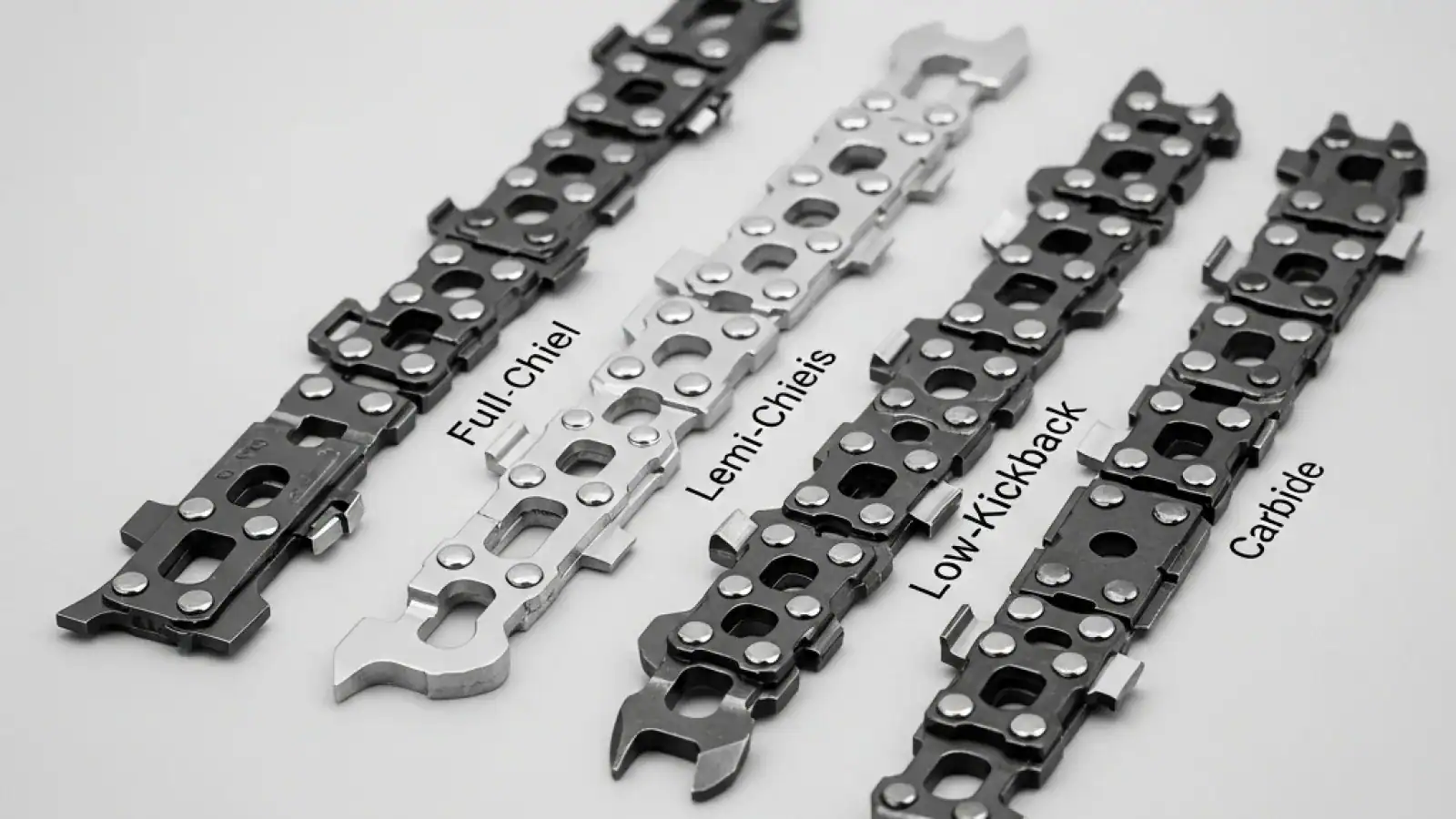
- Full Chisel Chain: This chain features square-cornered cutters that look like a carpenter’s chisel. They are the most aggressive and fastest-cutting chains, designed to slice clean wood fibers with maximum efficiency. If you’re felling large, clean timber with a powerful saw, a full chisel chain is your go-to. However, their sharp corners are prone to dulling quickly in dirty wood or if they encounter foreign objects, and they require a higher level of sharpening skill. They also have a slightly higher kickback potential, making them better suited for experienced operators.
- Semi-Chisel Chain: Sporting rounder working corners, semi-chisel chains are a fantastic all-around choice. They’re less aggressive than full chisel chains but hold their edge much longer, especially when cutting dirty, frozen, or seasoned wood. The rounded profile is more forgiving and easier to sharpen, making them ideal for homeowners, landowners, and those doing general cleanup or bucking tasks. They offer a great balance of speed, durability, and reduced kickback. Many professionals even prefer semi-chisel for limbing due to their consistent performance.
- Low-Profile (or Chipper) Chain: Characterized by a very rounded working corner and often a smaller cutter size, low-profile chains are designed with safety in mind. They produce smaller chips and have significantly reduced kickback, making them perfect for smaller chainsaws, electric models, and beginners. While not as fast as full or semi-chisel, they are very easy to sharpen and highly forgiving, providing a safer introduction to chainsaw operation for occasional users.
Chain Gauges and Pitches Explained
Beyond the cutter type, two critical measurements define a chainsaw chain: pitch and gauge. These must precisely match your chainsaw’s guide bar and drive sprocket, or your chain won’t fit or function correctly.
- Pitch: This is the distance between three consecutive rivets divided by two. Common pitches include 1/4″, .325″, 3/8″ (standard), and .404″. The pitch must match the drive sprocket on your chainsaw and the nose sprocket on your guide bar. Using the wrong pitch can lead to rapid wear, chain derailment, or even damage to your saw. You can usually find the pitch stamped on your guide bar, or it will be in your chainsaw’s manual.
- Gauge: This refers to the thickness of the drive links, which must precisely fit into the groove of your guide bar. Common gauges are .050″ (1.3mm), .058″ (1.5mm), and .063″ (1.6mm). If the gauge is too thin, the chain will wobble, leading to poor cuts and rapid wear. If it’s too thick, it won’t fit at all. Like pitch, the gauge is typically stamped on your guide bar.
Finally, the drive link count is simply the number of drive links on the chain. This number, along with the pitch, determines the overall length of the chain and must match your guide bar’s length. Always check your current chain’s specifications or your saw’s manual before purchasing a replacement.
Matching the Right Chain to Your Chainsaw and Task
Choosing the “best” chain isn’t about finding the most expensive or aggressive one; it’s about finding the one that perfectly balances performance, safety, and durability for your specific needs. As a professional, I’ve learned that a mismatched chain is a recipe for frustration and potential danger.
Consider Your Chainsaw’s Power and Bar Length
Your chainsaw’s engine size (measured in cubic centimeters, or cc) and the length of its guide bar are primary indicators of what chain it can effectively run. Overpowering a small saw with an aggressive chain or underpowering a large saw with a weak chain will lead to poor results.
- Small Electric/Battery/Gas Saws (e.g., 10-16 inch bars, <40cc): These saws are typically designed for light-duty tasks like limbing, small felling, or pruning. They benefit most from low-profile or semi-chisel chains. Chains like the Oregon S52 AdvanceCut or Stihl Picco Micro Mini 3 (PMM3) are excellent choices. Their reduced weight and lower kickback characteristics make them safe and efficient for smaller powerplants, maximizing battery life or fuel economy while still providing clean cuts.
- Mid-Range Gas Saws (e.g., 16-20 inch bars, 40-60cc): This category includes many popular homeowner and landowner chainsaws, capable of felling medium trees and extensive bucking. A high-quality semi-chisel chain like the Stihl Picco Super 3 (PS3) or Oregon 72VPX is often the ideal choice here. They provide excellent cutting speed and maintain their sharpness well through varied wood types. For more experienced users tackling clean, larger diameter wood, a full chisel chain can unlock extra performance, but be mindful of the increased kickback risk.
- Professional/Large Gas Saws (e.g., 20+ inch bars, >60cc): These are the workhorses of professional loggers and arborists, designed for heavy felling, bucking, and milling. Full chisel chains, such as the Oregon 72LGX or Stihl Rapid Super (RS), truly shine here. Their aggressive bite allows for rapid material removal, crucial when you’re dealing with large volumes of wood. These saws have the power to drive these chains effectively, and experienced operators can manage the increased aggression and kickback potential.
The Wood You’re Cutting: Clean vs. Dirty, Green vs. Seasoned
The type of wood you’re processing significantly impacts chain choice. Different woods present different challenges to a cutting edge.
- Clean, Green Wood: This is where full chisel chains excel. Their sharp, square corners slice through fresh wood fibers effortlessly, making fast, efficient cuts for felling and bucking. If your work primarily involves healthy, standing timber, a full chisel will deliver maximum productivity.
- Dirty, Seasoned, or Frozen Wood: When working with storm-damaged trees, firewood from old logs, or timber that’s been on the ground, you’ll encounter grit, bark inclusions, and hardened fibers. This is where semi-chisel chains prove their worth. Their rounded corners are much more resistant to dulling from abrasive materials, holding an edge longer than full chisel chains. They might not be as fast in pristine conditions, but their consistent performance in challenging wood often saves time by reducing sharpening frequency.
- Abrasive or Extreme Conditions: For truly abusive tasks, like cutting through stumps embedded with dirt, or salvaged timber, specialized carbide-tipped chains exist. While very expensive and difficult to sharpen (often requiring diamond grinders), they offer unparalleled durability against abrasive materials. They are a niche product but invaluable in specific, demanding scenarios.
Safety Features: Low Kickback Chains
For homeowners and less experienced users, prioritizing safety is paramount. Many chains are designed to reduce the risk of kickback, a violent upward and backward thrust of the chainsaw that can occur when the upper quadrant of the guide bar tip strikes an object.
Low kickback chains incorporate features like ramped depth gauges, guard links, or bumper ties to minimize the chance of the chain biting too aggressively. Look for chains that meet ANSI B175.1 standards for low kickback. While no chain can eliminate kickback entirely, these designs significantly reduce the risk, making them an excellent choice for anyone who isn’t a seasoned professional. They might cut slightly slower, but the added safety is well worth the trade-off for most users.
Top Picks and Recommendations for 2026
With a solid understanding of chain types and how to match them to your saw and task, let’s explore some general recommendations. Remember, brand loyalty often stems from positive experiences, but the underlying principles of pitch, gauge, and cutter type remain universal. We’re looking at categories of chains and characteristics that define their performance for the years to come.
For General Homeowner Use & Versatility
For the average homeowner or landowner who tackles a variety of tasks – from pruning and limbing to cutting firewood and occasional storm cleanup – versatility and ease of maintenance are key. You need a chain that performs reliably without needing constant sharpening.
Recommendation: High-Quality Semi-Chisel Chain. Brands like Oregon (e.g., Oregon AdvanceCut series) and Stihl (e.g., Picco Super 3 – PS3 for smaller saws or their standard Rapid Micro – RM for larger) offer excellent semi-chisel options. These chains strike an ideal balance: they cut efficiently, hold an edge well in varied wood conditions, and are relatively forgiving to sharpen. They’re also often designed with low-kickback features, enhancing safety for intermittent users. For instance, the Oregon S52, a common chain for 14-inch bars, is a fantastic example of a low-profile semi-chisel that delivers consistent results for DIY projects.
For Aggressive Cutting & Professional Felling
When speed is paramount and you’re working with powerful saws in clean, large-diameter timber, you need a chain that can devour wood. This is the domain of the full chisel chain, favored by loggers and arborists for maximum productivity.
Recommendation: Premium Full Chisel Chain. Look for models like the Oregon 72LGX (or its modern equivalent) or Stihl Rapid Super (RS). These chains are engineered for aggressive cutting, providing unparalleled speed in softwoods and hardwoods. They require powerful saws (typically 50cc and up) to run efficiently and demand a skilled hand both in operation and sharpening. The sharp, square corners bite deep, clearing chips rapidly. While they can be unforgiving if mishandled, in the right hands, they are unmatched for sheer cutting power and efficiency.
For Dirty Wood, Storm Cleanup & Durability
Sometimes, you’re not cutting pristine logs; you’re clearing storm debris, cutting firewood from questionable sources, or dealing with abrasive materials. In these scenarios, edge retention and durability are more important than outright speed.
Recommendation: Robust Semi-Chisel or Specialized Durability Chains. Again, a good quality semi-chisel chain will outperform a full chisel in dirty conditions. Brands like Forester offer durable semi-chisel options that stand up well to abuse. For extreme cases, consider chains with advanced coatings or even carbide inserts, though these are much harder to sharpen and more expensive. Some manufacturers also offer “full skip” or “semi-skip” chains, which have fewer cutters, reducing friction and power demand, making them suitable for very long bars or underpowered saws in dirty wood, though at the cost of cutting speed and smoothness.
For Battery-Powered Chainsaws
The rise of battery-powered chainsaws demands chains optimized for efficiency to maximize run-time and cutting performance without excessive power draw.
Recommendation: Thin Kerf, Low-Vibration, and Efficient Chains. Many manufacturers now produce chains specifically for battery saws. These often feature a thinner kerf (the width of the cut) to reduce the amount of wood removed, thus requiring less power. Look for chains designed for lower vibration and smooth operation, such as the Oregon AdvanceCut or Stihl’s Picco Micro 3 (PM3) and Picco Micro Mini 3 (PMM3) series. These chains ensure your battery lasts longer while still providing impressive cutting capability for the tasks battery saws are typically used for.
Chain Maintenance for Longevity and Performance
Even the best chain will perform poorly and wear out quickly without proper care. Maintenance isn’t just about extending the life of your chain; it’s about ensuring safety and consistent cutting performance. As an old timer once told me, “A sharp chain is a safe chain, and a maintained saw is a happy saw.”
Proper Sharpening Techniques
A sharp chain cuts fast, efficiently, and safely. A dull chain forces you to push harder, increasing fatigue, kickback risk, and wear on your saw’s engine. How often should you sharpen? A good rule of thumb is every time you refuel, or whenever you notice the saw producing dust instead of chips, burning the wood, or pulling to one side. Here’s how to do it right:
- File Size and Angle: Always use the correct round file size for your chain’s pitch (e.g., 5/32″ for .325″ pitch, 3/16″ for 3/8″ low profile, 7/32″ for standard 3/8″). Maintain the correct top plate filing angle, typically 30 or 35 degrees, and the correct side plate angle, which is built into the cutter. Use a sharpening guide or filing kit to ensure consistency.
- Consistent Strokes: File each cutter with firm, consistent strokes, always pushing away from you. Count the strokes on each cutter and apply the same number to all cutters on that side, then switch to the other side. This ensures uniform sharpness and maintains balance.
- Check for Damage: While sharpening, inspect for any chipped or broken cutters, which indicate a need for replacement.
Raker (Depth Gauge) Adjustment
The raker determines how deep each cutter bites into the wood. If it’s too high, the chain won’t cut effectively. If it’s too low, the chain will cut too aggressively, increasing kickback risk and putting undue strain on your saw. Adjusting rakers is crucial for maintaining optimal performance.
Use a depth gauge tool (often included in sharpening kits) to check and file down your rakers. File them gently with a flat file, rounding off the front edge after filing. A common mistake is filing them too low, which can make the saw grab and increase vibration. Only adjust them after sharpening, as sharpening reduces the cutter height.
Lubrication and Tension
These two factors are fundamental to chain longevity and safe operation.
- Chain Lubrication: Your chainsaw’s bar oil system is critical. Always ensure your oil tank is filled with quality bar and chain oil. This oil reduces friction between the chain and guide bar, preventing premature wear, overheating, and extending both chain and bar life. A properly oiled chain will sling a fine mist of oil when running at full throttle – a simple visual check.
- Chain Tension: A properly tensioned chain should be snug against the guide bar, but still able to be pulled freely by hand. There should be no sag on the underside of the bar, but you should be able to lift the drive links slightly out of the bar groove in the middle of the bar. Too tight, and it causes excessive wear on the chain, bar, and sprocket, and can even damage your saw. Too loose, and it can derail from the bar, posing a serious safety hazard and potentially damaging the chain and bar. Check tension frequently, especially when the chain is new or after it heats up during use.
Cleaning and Inspection
Regular cleaning and inspection prevent problems before they become serious.
- Clean Regularly: After each significant use, clean the guide bar groove, the sprocket cover area, and the chain itself. Sawdust and pitch buildup can impede chain movement and oil flow. Use a bar groove cleaner tool to clear debris.
- Inspect for Wear: Look for stretched links, cracks in the cutters or drive links, and burrs on the guide bar rails. A worn guide bar will often have noticeable burrs on the edges, which should be filed smooth to prevent uneven chain wear. Regularly flip your guide bar to ensure even wear on both sides.
By diligently following these maintenance practices, you’re not just ensuring your chains cut faster and last longer; you’re also significantly improving your safety and the overall lifespan of your chainsaw. It’s a small investment of time that pays huge dividends in performance and peace of mind.
Final Thoughts: Your Chain, Your Performance
Choosing the best chain for your chainsaw isn’t a one-size-fits-all decision. It’s an informed choice based on your specific saw, the tasks you undertake, and the type of wood you’re cutting. Whether you’re a homeowner felling a small tree or a professional logging giant timber, understanding the nuances of chain types, pitch, gauge, and proper maintenance will dramatically enhance your cutting experience.
I hope this guide has demystified the world of chainsaw chains, empowering you to make smarter choices. Remember, a sharp, well-maintained, and correctly chosen chain isn’t just about cutting faster; it’s about working safer, reducing fatigue, and getting the most out of your valuable equipment. Take the time to understand your chain, and you’ll find that your chainsaw performs at its peak, job after job, for years to come.