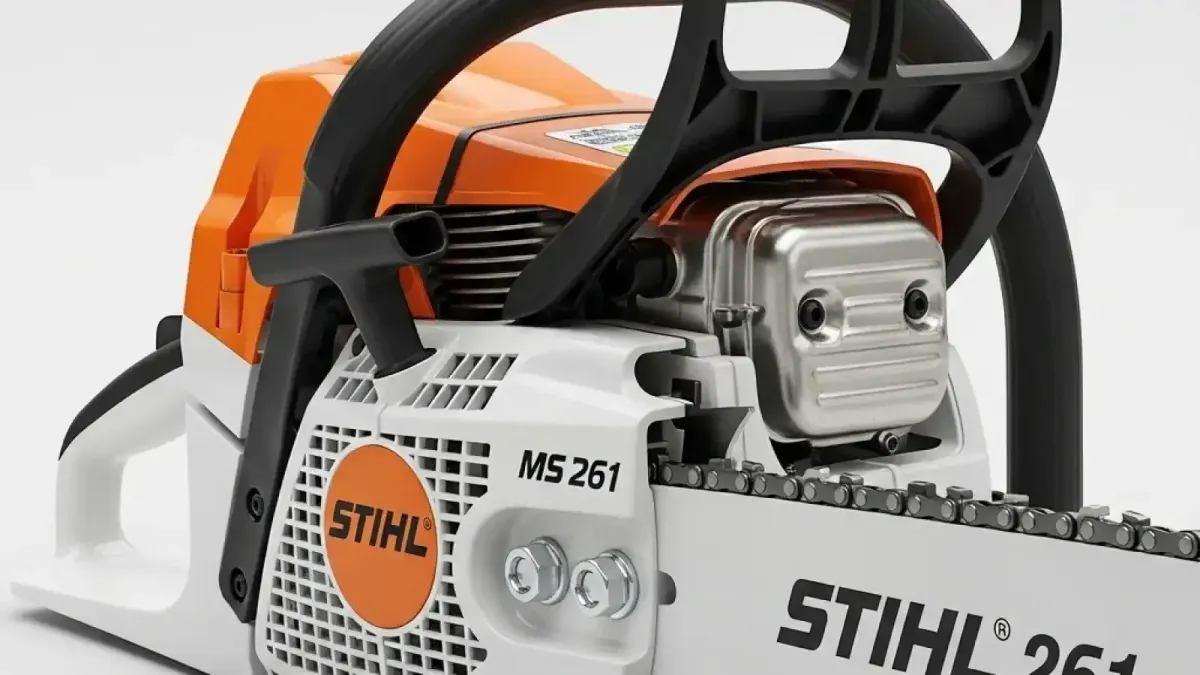
Quick answer: The Stihl MS 261 is a professional-grade 50.2 cc chainsaw delivering 4.0 horsepower (3.0 kW) at a dry powerhead weight of just 10.8 lbs (4.9 kg). It handles 16-inch to 20-inch guide bars effortlessly, making it the premier choice for firewood cutters, landowners, and forestry pros looking for maximum cutting speed with minimal operator fatigue.
Stihl MS 261 Technical Specifications and Engine Engineering
At the heart of the Stihl MS 261 lies a high-revving 50.2 cc stratified scavenging two-stroke engine. This design pulls a layer of fresh air between the burned exhaust charge and the incoming fuel-air mixture, boosting fuel efficiency by up to 20% while cutting exhaust emissions drastically compared to older two-stroke designs. The powerhead puts out an impressive 4.0 bhp, giving it a power-to-weight ratio that rivals much larger saws in the gas chainsaw category.
Stihl engineered the MS 261 powerhead with a lightened magnesium crankcase and a redesigned cylinder head to drop every unnecessary ounce. The saw features an advanced anti-vibration system utilizing precisely tuned buffer elements that keep handle vibration down to a remarkably low 3.5 m/s². This means far less hand numbness and arm fatigue during all-day cutting sessions. Additionally, the pre-separation air filtration system uses centrifugal force to eject heavy sawdust particles before they ever reach the washable HD2 air filter, extending filter life up to five times longer than traditional systems.
| Specification Parameter | Stihl MS 261 C-M Details |
|---|---|
| Engine Displacement | 50.2 cc (3.07 cu. in.) |
| Power Output | 4.0 bhp (3.0 kW) |
| Powerhead Weight (Dry) | 10.8 lbs (4.9 kg) |
| Recommended Bar Lengths | 16", 18", or 20" (Rollomatic E or Light) |
| Chain Pitch & Gauge | .325" Pitch / .063" (1.6 mm) Gauge standard |
| Fuel Tank Capacity | 16.9 oz (0.50 L) — 50:1 Pre-mix ratio |
| Chain Oil Capacity | 9.1 oz (0.27 L) |
Performance Review: Real-World Cutting and Handling
In actual cutting tests across dense red oak, sugar maple, and damp pine, the Stihl MS 261 cuts noticeably faster than entry-level homeowner units like the MS 250 or MS 271 Farm Boss. The engine picks up RPM almost instantly thanks to its lightweight flywheel and electronic engine management system (M-Tronic). M-Tronic constantly adjusts ignition timing and fuel metering based on altitude, air filter cleanliness, and ambient temperature, eliminating the need for manual carburetor screw adjustments.
The ergonomic handling of the MS 261 is where the saw truly shines during extended forestry work. Captive bar nuts built directly into the sprocket cover mean you will never lose a nut in deep autumn leaves or snow when changing a chain in the field. The side-access chain tensioner makes quick adjustments straightforward, while the transparent fuel tank lets you monitor mixed gas levels at a quick glance without opening the cap.
Pro tip: Brand-new chains stretch rapidly during their first two tanks of fuel due to thermal expansion and rivet seating. When running a fresh chain on the MS 261, check and reset your chain tension after every 15 minutes of heavy bucking. Allowing a loose chain to run slung on a high-RPM professional saw risks throwing the chain, damaging your drive links, or chewing up the chain catcher.
Selecting the Correct Bar, Chain, and Sizing Chart
Choosing the right bar and chain setup determines how effectively your MS 261 transfers its 4.0 horsepower into wood fiber. While the saw can pull a 20-inch guide bar in softwoods, its absolute sweet spot for speed and balance is an 18-inch Rollomatic E Light bar paired with a .325" pitch chain. Running a .325" narrow-kerf chain maximizes cutting velocity because the engine removes less wood width per pass compared to full 3/8" pitch chains.
Proper chain selection also requires matching the exact gauge (groove width) of your guide bar. Most Stihl MS 261 configurations sold in North America run a .063" (1.6 mm) gauge, whereas European or specific light-bar builds may utilize a .050" (1.3 mm) gauge. Always check the stamped markings on the tail of your guide bar before ordering replacement saw chain.
| Bar Length | Pitch | Gauge | Drive Links |
|---|---|---|---|
| 16 inch | 0.325 | 0.063 | ~67 links |
| 18 inch | 0.325 | 0.063 | ~74 links |
| 20 inch | 0.325 | 0.063 | ~81 links |
- 16-Inch Bar Setup: Ideal for rapid limbing, thinning small timber, and lightning-fast chain speeds. (67 Drive Links, .325" Pitch)
- 18-Inch Bar Setup: The standard all-around balance for general firewood cutting, felling up to 30-inch diameter trunks, and comfortable topping. (74 Drive Links, .325" Pitch)
- 20-Inch Bar Setup: Best for big log bucking and reducing stooping, though chain speed drops slightly in dense green hardwoods. (81 Drive Links, .325" Pitch)
Essential Maintenance, Fueling, and Essential Gear
To ensure your Stihl MS 261 delivers decades of dependable service, proper fuel mixing and maintenance schedules are non-negotiable. Always run premium 91+ octane unleaded gasoline blended strictly with high-quality two-stroke engine oil at a precise 50:1 ratio (2.6 oz of oil per 1 gallon of gas). Ethanol content must stay below 10%, though using ethanol-free canned fuel like Stihl MotoMix is the ultimate protection against fuel line degradation and carburetor corrosion during winter storage.
Proper safety practices are just as vital as maintenance when operating a high-performance pro saw. Always wear heavy-duty chainsaw chaps meeting ASTM standards, an approved forestry helmet equipped with a wire mesh face screen and ear muffs (rated for at least 25 dB NRR), non-slip steel-toe boots, and cut-resistant gloves. Understanding kickback zones and maintaining firm two-handed grip wrapping your left thumb under the front handlebar will prevent dangerous reactive force events.
Which Saw Should You Buy?
If you chop two cords of soft firewood a year, a mid-range farm-and-ranch model will suit your budget fine. However, if you clear forested property, fell mature hardwoods, demand immediate throttle response, or simply want a lightweight professional machine built to last 15 to 20 years, the Stihl MS 261 C-M outfitted with an 18-inch bar is the undisputed gold standard in the 50cc market.
Frequently Asked Questions
What is the difference between the Stihl MS 261 and MS 261 C-M?
The standard MS 261 features a traditional manually adjustable carburetor, whereas the MS 261 C-M comes equipped with Stihl's M-Tronic microprocessor engine management. M-Tronic electronically regulates fuel flow and ignition timing automatically in all conditions, making manual carb adjustments completely unnecessary.
Can you run a 3/8" pitch chain on a Stihl MS 261?
Yes, you can convert an MS 261 to run 3/8" pitch chain by swapping the drive sprocket, bar, and chain. However, because 3/8" chain takes a wider kerf bite, most operators prefer sticking with .325" pitch to maintain maximum chain speed and engine RPM in hardwoods.
How often should I clean the air filter on the MS 261?
Thanks to the HD2 filter and pre-separation system, the MS 261 requires far less frequent cleaning than standard saws. Inspect the filter every month or roughly every 10–15 tanks of gas; wash it in warm soapy water or warm water with Stihl Special Cleaner whenever fine wood dust builds up on the pleated surface.
Sources
- STIHL Incorporated Official Product Documentation & Technical Specifications
- OSHA Standard 1910.266 - Logging Operations Safety Guidelines
- American National Standards Institute (ANSI) B175.1 Safety Requirements for Gasoline Chainsaws