Disclosure: As an Amazon Associate, we earn from qualifying purchases.
Poulan gas-powered chainsaws are legendary workhorses across yards and woodlots, but modern ethanol-blended gasoline takes a heavy toll on their flexible fuel lines over time. Standard pump gas containing 10% ethanol (E10) causes small polyurethane and rubber hoses to harden, turn brittle, split, or turn into a soft, gummy mess inside the fuel tank. When these lines crack or lose air-tight sealing, your chainsaw starves for fuel, pulls air instead of gas, refuses to prime, or simply won't start under load. Understanding how a purge-bulb fuel system is routed is the single most important key to getting your small engine screaming through logs once again.Quick answer: Poulan two-stroke chainsaws use a closed-loop 3-line fuel system where gas is drawn from the tank through a weighted filter into the lower carburetor fitting, pulled out of the carburetor's upper fitting into the primer bulb's short nipple, and pushed from the bulb's long nipple straight back to the tank.
Understanding the Poulan Two-Stroke Fuel System Layout
Unlike old-school gravity-fed engines on lawnmowers or standard small tractors, a handheld 2-stroke chainsaw engine utilizes a sealed impulse-driven carburetor coupled with a purge bulb (commonly called a primer bulb). The purge bulb does not actually squirt fuel directly into the engine intake throat during cold starts. Instead, it creates a localized vacuum that pulls fresh fuel from the bottom of the fuel tank, fills the internal metering chamber of the Zama or Walbro carburetor, and purges trapped air pockets back into the tank. If you route a single hose backward, this vacuum seal breaks instantly, leaving you with a dry carburetor and an engine that won't pop.
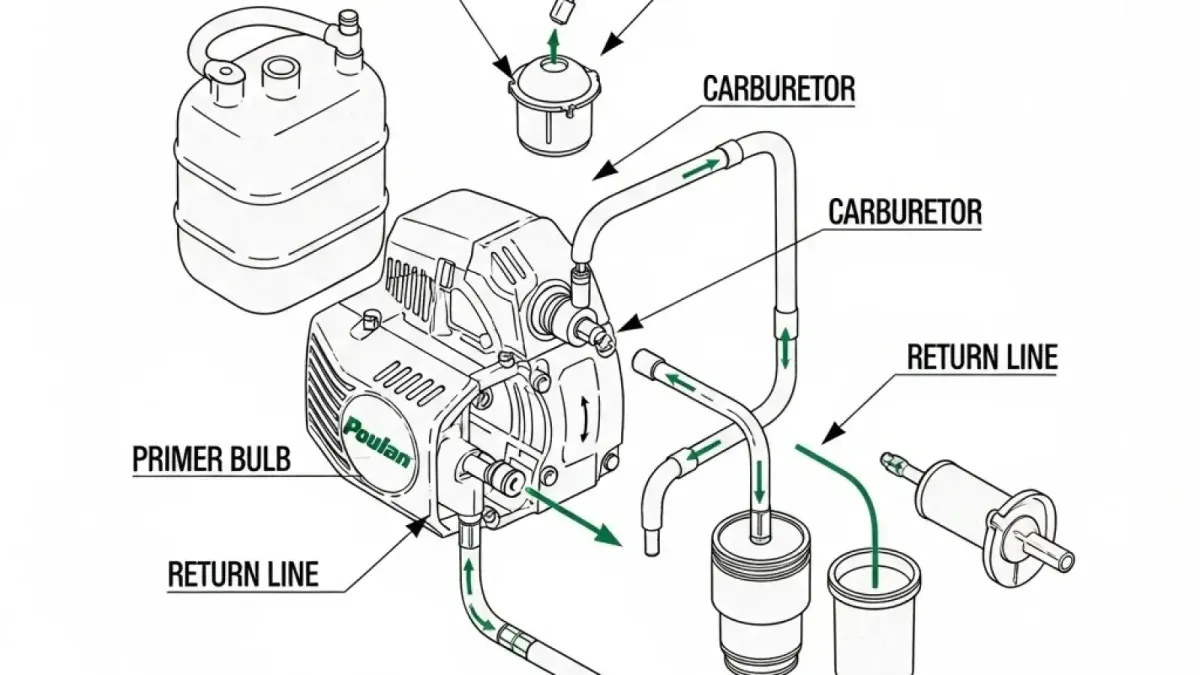
To successfully trace or rebuild your fuel system, you need to understand the precise job performed by each of the three lines present on almost every modern Poulan engine. Misidentifying ports on the carburetor body or reversing connections on the primer bulb housing is the primary cause of post-repair starting problems. Take a close look at the component map before touching your pliers.
| Component | Function in the System |
| Fuel Tank Grommet | The rubber piece where the fuel lines pass through the tank wall. |
| Fuel Filter | Located inside the fuel tank, this is attached to the main fuel line (intake). |
| Carburetor | The component that mixes fuel and air. It typically has two nipples for the fuel lines (an inlet and an outlet/return). |
| Primer Bulb (Purge Bulb) | The plastic bulb you push to circulate fuel and prime the carburetor. It also has two nipples (an intake and a return). |
Key Components and Fuel Flow Sequence
Every standard Poulan chainsaw equipped with a purge bulb follows an identical hydraulic sequence from the fuel reservoir to the return port. Tracing this path step-by-step ensures your repair goes smoothly without guessing line destinations:
- Main Intake (Filter) Line: Connects from the weighted brass/felt fuel filter resting at the bottom of the fuel tank, passes through the tank wall, and attaches directly to the primary fuel inlet port on the carburetor (typically the larger brass barb on the lower carb body).
- Carburetor to Primer Line: Runs from the carburetor's fuel outlet port (usually a upper straight barb) directly to the short nipple on the back of the primer bulb assembly.
- Primer Return Line: Connects from the long nipple on the back of the primer bulb assembly, passes through the tank wall, and terminates inside the tank without a filter, allowing excess fuel and air bubbles to drop back into the reservoir.
Pro Tip: Get The Complete Repair Kit
Don't just replace the fuel line—if the line has rotted, the fuel filter and primer bulb are likely next. Save yourself time and future headaches by grabbing a complete, inexpensive Poulan Fuel Line Replacement Kit. It includes everything you need to get your chainsaw running like new in under 10 minutes.

Model-Specific Fuel Line Routing Diagrams
While the internal physics remain constant across two-stroke engines, physical layouts, grommet configurations, and port orientations shift across various generations of Poulan saws. Below are the specific routing guides for the most common models in circulation among homeowners and woodcutters.
Poulan 2150 and Wild Thing (Model 2375 Series)
The 36cc to 42cc chassis platform—which includes the legendary Poulan 2150, Wild Thing (Model 2375), Woodshark, and 2050 series—uses two separate tank hole penetrations or a dual-hole rubber grommet. On these models, line sizing and strict routing are essential due to tight clearance beneath the air filter housing. The fuel supply line carrying the filter must enter the right side of the tank floor and attach to the lower carburetor inlet nipple. The middle line runs from the top carb port straight up to the shorter plastic stem on the primer bulb. Finally, the return line mounts to the longer primer stem and pushes roughly one inch down into the tank cavity.
Poulan P3314, P3416, and P3816 Series
The newer P-series homeowner saws (ranging from 33cc to 38cc engine displacement driving 14-inch to 16-inch guide bars) utilize a slightly altered carburetor chamber housing. On the Poulan P3314 fuel line diagram, the lines pass through rubber grommets that seal tightly against thin aluminum chassis walls. Pay careful attention to line diameter here; using oversized tubing will prevent the line from sealing against the tank, resulting in fuel leaks whenever the saw is turned on its side during felling or bucking cuts.
Choosing the Right Fuel Line Sizes and Materials
One of the most frustrating parts of DIY fuel system repairs is buying a standard "universal" hose kit that ends up fitting too loose or pinching shut inside the tank wall. Small engine fuel lines are measured by inside diameter (I.D.) and outside diameter (O.D.). Because these hoses rely on a compression seal against the drilled plastic hole in the fuel tank, the outside diameter must match factory tolerances down to thousandths of an inch.
Never replace chainsaw lines with cheap PVC vinyl tubing, clear fish tank air hose, or automotive rubber vacuum lines. Always opt for genuine yellow Tygon (polyurethane) fuel tubing. Tygon remains flexible down to sub-zero temperatures, resists cracking when exposed to ethanol-blend pump fuel, and retains its elasticity under heavy engine vibration.
| Line Type | Function | Typical Inner Diameter (ID) | Typical Outer Diameter (OD) | OEM/Replacement Code |
| Large/Thick Line | Main Intake (Tank to Carburetor) | 3/32" or 1/8" ID | 3/16" or 7/32" OD | Often yellow Tygon line |
| Small/Thin Line | Return (Primer Bulb to Tank) | 0.080" ID | 0.140" OD | Often clear Tygon line |
| Fuel Line Function | Inside Diameter (I.D.) | Outside Diameter (O.D.) | Common Application / Location |
|---|---|---|---|
| Main Fuel Intake (Small Line) | 3/32 inch (0.094" / 2.4mm) | 3/16 inch (0.187" / 4.8mm) | Tank Filter to Carburetor Main Inlet |
| Primer Return / Feed (Large Line) | 1/8 inch (0.125" / 3.1mm) | 3/16 inch (0.187" / 4.8mm) or 1/4 inch | Carburetor to Primer & Primer to Tank Return |
| Pulse / Impulse Line (If equipped) | 1/16 inch (0.062" / 1.6mm) | 1/8 inch (0.125" / 3.1mm) | Engine Crankcase to Carburetor Impulse Port |
Step-by-Step Poulan Fuel Line Replacement
Replacing fuel lines on a small chainsaw requires patience and basic hand tools. Before starting, work in a well-ventilated space away from open flames, and empty all remaining gas into an approved fuel container.
Tools Required
- Replacement Tygon fuel line (3/32" x 3/16" and 1/8" x 3/16")
- New in-tank fuel filter and fresh primer bulb diaphragm
- Long needle-nose pliers or curved hemostats
- Utility knife or sharp razor blade
- T25 Torx screwdriver/driver bit
- A drop of 2-stroke engine oil or liquid soap (for lubrication)
Pro tip: When pulling new Tygon hose through tight fuel tank holes, slice the working end of the hose at a long 45-degree taper (about 1.5 inches long) to form a thin point. Thread that narrow point through the hole from the outside, grip it from inside the gas tank filler neck using hemostats, and pull it through until full diameter hose seals the opening. Then cut the tapered point off square before attaching your filter.
1. Disassembly and Removal
Remove the top cylinder cover and air filter assembly using your T25 Torx wrench. Carefully unhook the throttle linkage wire from the carburetor throttle arm. Unbolt the two carburetor mounting studs and slide the carburetor off its mounting pad, taking care not to tear the intake gasket. Disconnect any remaining brittle fuel lines from the carburetor barbs and primer bulb stems using long pliers.
Unscrew the gas cap and use a bent wire hook or long hemostats to grab the old fuel filter from inside the tank. Pull it out and pull the main supply line through the tank floor. If the old lines have hardened completely, cut them flush outside the tank and push the remaining plastic stubs down into the tank cavity to shake them out through the fuel cap opening.
2. Installing the New Lines
Cut a 12-inch section of 3/32" x 3/16" Tygon tubing. Create your tapered pull-point, coat it lightly with 2-stroke oil, and push it through the main supply hole into the tank. Reach through the filler neck with hemostats, grab the tapered tip, and pull roughly 4 to 6 inches of line out through the fuel cap hole. Cut the tip off square, slip your new brass/felt fuel filter onto the end until it bottoms out on the barb, and gently pull the line back from the outside until the filter rests freely on the bottom corner of the tank floor. Cut the outer end to length and press it onto the main inlet barb of the carburetor.
Next, repeat the process for the return line using 1/8" x 3/16" line. Feed it through the second tank wall hole so that roughly 1 inch extends into the tank space (no filter needed on this return end). Attach the outer end to the long stem on your primer bulb. Finally, connect a short piece of line from the short stem of the primer bulb to the return barb on top of the carburetor body. Ensure no lines are kinked or pinched against the throttle linkage or top engine cover when reassembling.
Choosing the Right Setup for Your Woodcutting Needs
If you are maintaining an older 38cc to 42cc Poulan chainsaw fitted with a 16-inch or 18-inch guide bar (running 3/8" Low Profile chain at .050" gauge), keeping the fuel system tightly sealed is critical to safety and engine life. Lean fuel conditions caused by leaking fuel lines raise two-stroke engine operating temperatures drastically, which quickly leads to piston scoring and complete engine seizure. When replacing fuel lines on any saw older than five years, spend an extra five dollars to replace the fuel filter, air filter, spark plug (typically a Champion RCJ7Y or NGK BPMR7A gapped to 0.025"), and primer bulb at the same time. Always mix fresh, non-ethanol 90+ octane gasoline with high-quality synthetic 2-stroke air-cooled engine oil at a strict 50:1 ratio (2.6 oz oil per 1 gallon gas) to protect your small engine's carb diaphragms and cylinder walls for years to come.
Frequently Asked Questions
Why does my primer bulb collapse and fail to pop back up?
A collapsed primer bulb that stays sucked in indicates a severe restriction in the fuel intake line or tank vent. Check if the fuel filter inside the tank is clogged with debris, or check if the main supply line going to the carburetor is pinched shut beneath the air filter shroud.
What happens if I cross the intake and return lines on my carburetor?
If you swap the intake and return connections, the primer bulb will attempt to force air backward into the fuel filter rather than drawing fuel into the carb. Pumping the bulb will create high pressure in the tank or feel completely solid, and fresh gas will never reach the engine cylinder.
Can I use clear vinyl aquarium tubing to repair my chainsaw fuel line in a pinch?
No, standard clear vinyl hose degrades rapidly when exposed to gasoline and aromatic solvents. It turns rock-hard within days, loses its interference fit at the tank hole penetration, air-leaks instantly, and will melt when exposed to high cylinder temperatures.
Sources
- Poulan Pro Official Technical Documentation & Owner Manuals
- OSHA 1910.266 - Logging Operations Safety Standards
- ANSI B175.1 - American National Standard for Portable Hand-Held Chainsaws