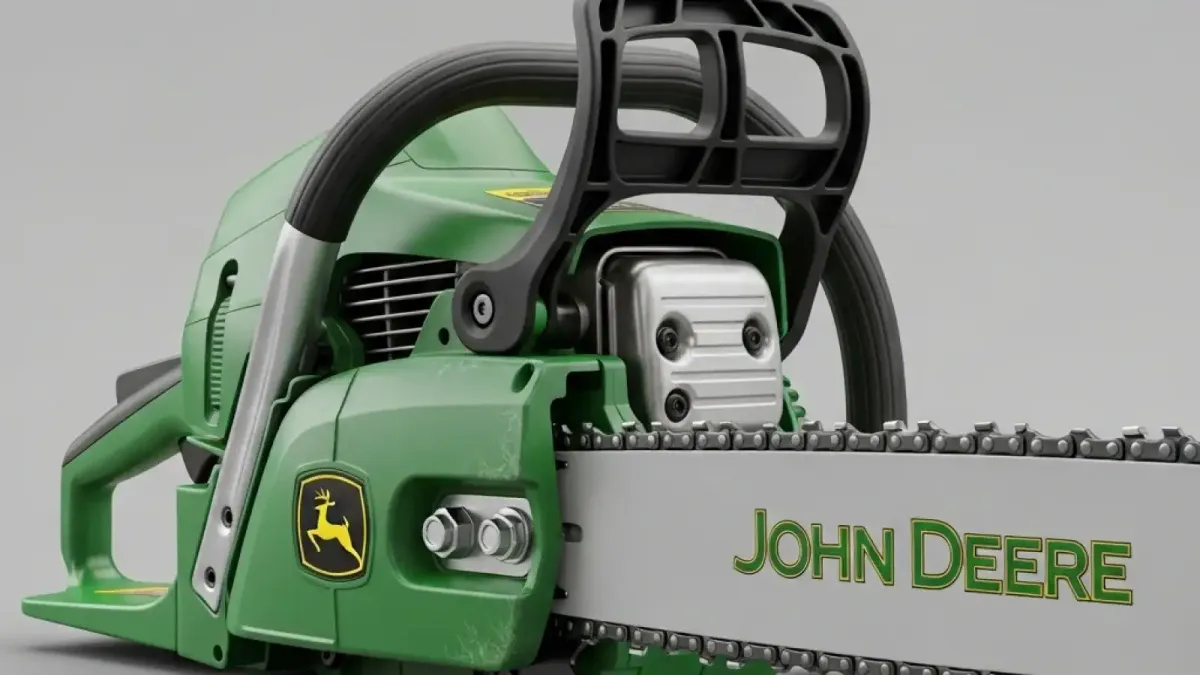
Quick answer: Spending around $300 on a well-maintained used John Deere chainsaw—such as the 46cc CS46 or 38cc CS38—delivers exceptional value because these units were built by commercial OEM manufacturer Efco. They feature professional-grade internal components, alloy crankcases, and standard bar mounts, making them dependable mid-duty saws for firewood cutting and land maintenance.
The History and OEM Origins Behind John Deere Chainsaws
To understand the quality of a John Deere chainsaw, you have to look past the badge to see who actually manufactured the powerhead. John Deere never set up an independent chainsaw production factory; instead, they partnered with leading power equipment engineers across two main eras. In the 1970s and 1980s, John Deere sourced their popular "V-series" models—such as the 50V, 60V, and 70V—directly from Kioritz Corporation, the parent company of Echo. These Japanese-built saws established a reputation for outstanding electronic ignition reliability, bulletproof carburetors, and exceptional longevity.
In the late 1990s through the mid-2000s, John Deere updated its lineup with the modern "CS" series, turning to Italian manufacturer Emak (producers of Efco and Oleo-Mac power tools). Saws like the CS36, CS46, CS52, and CS56 were essentially high-end Italian cutting tools dressed in John Deere green housings. Because Emak engineers saws for professional European loggers, these models brought commercial features to North American farm equipment dealerships, including vertical split magnesium crankcases, chrome-plated cylinder walls, double chain pegs, and top-access air filters.
Understanding this manufacturing heritage is crucial for modern owners. When sourcing replacement parts or evaluating a used saw for sale, knowing that a John Deere CS46 shares identical mechanical internals with an Efco 152 or Oleo-Mac 952 opens up access to thousands of inexpensive aftermarket components, carburetors, gaskets, and drive sprockets.
John Deere Chainsaw Model Comparison and Performance Reviews
Whether you need a compact saw for limbing storm debris or a mid-sized saw for felling hardwood trees, the John Deere CS line covered a complete spectrum of displacements and bar combinations. Below is an overview of the key specifications for the primary models encountered on the market today:
| Model | Displacement (cc) | Power Output (hp / kW) | Recommended Bar Length | Chain Pitch & Gauge | Target Application |
|---|---|---|---|---|---|
| John Deere CS38 | 38.0 cc | 2.3 hp / 1.7 kW | 14" – 16" | 3/8" Low Profile, .050" | Light pruning, storm cleanup, campfire wood |
| John Deere CS46 | 45.0 cc | 3.1 hp / 2.3 kW | 16" – 18" | .325", .050" / .058" | Firewood harvesting, medium tree felling, farm use |
| John Deere CS56 | 56.5 cc | 4.1 hp / 3.0 kW | 18" – 20" | 3/8" Standard, .050" / .058" | Heavy logging, clearing dense timber, bucking large logs |
| John Deere CS62 | 62.0 cc | 4.7 hp / 3.5 kW | 20" – 24" | 3/8" Standard, .050" / .058" | Professional felling, large hardwoods, land clearing |
John Deere CS38 Review
The CS38 was designed as an entry-level homeowner saw, offering a lightweight powerhead weighing under 10 lbs dry. Driven by a 38cc two-stroke engine, it pairs best with a 16-inch guide bar running 3/8-inch low profile chain. It features an primer bulb, inertia-activated chain brake, and an anti-vibration damping system using steel springs rather than soft rubber bushings. For small acreage management or orchard trimming, the CS38 offers smooth throttle response and easy cold starts.
John Deere CS46 Review
Widely considered the sweet spot of the lineup, the CS46 packs a 45cc engine producing over 3 horsepower. Sitting squarely in the $250 to $350 used price bracket, this saw is built to handle an 18-inch guide bar through solid oak, maple, and pine. It utilizes a .325-inch pitch chain that provides smooth, low-vibration cutting performance. The crankcase is fully magnesium alloy, allowing the saw to handle continuous high-rpm thermal expansion without leaking air around the crank seals—a common failure point in cheap plastic-clad homeowner saws.
John Deere CS56 Review
If you regularly cut several cords of firewood annually, the CS56 is a true workhorse. Boasting a 56.5cc displacement, it easily pulls a 20-inch bar using full 3/8-inch pitch chain. The CS56 features a side-access chain tensioner, an adjustable automatic oil pump that allows users to increase oil flow for sticky softwoods or extra-long bars, and a decomp valve for quick starting. Despite its robust output, it maintains a comfortable power-to-weight balance that limits user fatigue during long cutting sessions.
Essential Chainsaw Maintenance, Tuning, and Part Cross-Referencing
Maintaining a vintage or pre-owned John Deere chainsaw requires strict adherence to fuel quality, drive system upkeep, and proper sharpening habits. Like all high-rpm two-stroke outdoor power equipment, these engines depend on precise air-to-fuel ratios and continuous bar lubrication to survive high temperatures.
Pro tip: When setting chain tension on older CS-series saws, always lift the nose of the guide bar upward before tightening the bar nuts. Standard heat cycles cause newly installed chains to stretch rapidly within the first 10 to 15 minutes of cutting; check tension after your first tank of fuel to prevent the chain from throwing off the sprocket or galling the bar rails.
- Fuel Mix Ratio: Use a strict 50:1 fuel-to-oil mix ratio (2.6 oz of high-grade 2-stroke air-cooled engine oil per 1 gallon of 89+ octane ethanol-free gasoline). Avoid gasoline with more than 10% ethanol (E10), as ethanol degrades rubber fuel lines and attracts moisture inside small diaphragm carburetors.
- Air Filter Cleaning: Clean the fleece or mesh air filter after every 5 operating hours using warm soapy water. A clogged filter restricts air intake, causing the engine to run excessively rich and build carbon on the spark plug.
- Bar and Chain Care: Clean the guide bar groove with a putty knife or specialized groove cleaner, and verify that the oil inlet holes are free of packed sawdust. File the depth gauges (rakers) to .025 inches every three to four chain sharpenings to maintain smooth chip clearance.
- Spark Plug Maintenance: Check the spark plug gap (typically set to .020 to .024 inches) every season. Replace fouled plugs with proper resistor-type NGK or Champion equivalents.
When searching for John Deere chainsaw parts, search both by the official John Deere part number and the corresponding Efco/Oleo-Mac model number. For example, carburetors manufactured by Walbro or Zama for the Efco 152 fit directly onto the John Deere CS46 without modification. Standard wear items such as rims, sprockets, guide bars, and saw chains use universal Oregon or Carlton mount patterns (such as K095 or A041 motor mounts), making bar and chain replacements simple and inexpensive at any saw shop.
Buying Guide: Is a $300 John Deere Chainsaw Worth Purchasing Today?
When evaluating a pre-owned John Deere chainsaw listed for $300 online or at a local power equipment dealer, always perform a thorough physical and mechanical inspection. Unlike modern cheap plastic saws found in big-box retail stores, a $300 Italian-built John Deere offers commercial-grade construction that can easily last decades when serviced correctly.
- Compression Check: Pull the starter rope slowly with the engine cold. You should feel firm resistance. Ideally, test the engine with a mechanical compression gauge; healthy 2-stroke engines should read between 130 PSI and 160 PSI.
- Inspect Piston and Cylinder Walls: Remove the muffler cover or look through the exhaust port with a small flashlight to verify that the piston skirt is smooth and free of vertical scoring or heat seize marks.
- Verify Chain Brake Function: Engage the front hand guard manually. The chain brake mechanism must trip instantly and lock the clutch drum in place to prevent kickback injuries.
- Check the Oil Delivery: Start the saw, let it warm up, and rev the throttle while pointing the bar tip toward a piece of light cardboard or a clean stump. A fine mist of bar oil should sling off the chain tip onto the surface.
If the saw passes these inspections, a $300 price tag for a clean CS46 or CS56 represents a smart buy for any landowner. You receive commercial-grade alloy crankcases, high-efficiency cooling fins, and smooth anti-vibration rubber or spring isolation at the price of a flimsy modern entry-level saw. Always equip yourself with proper Personal Protective Equipment (PPE)—including chainsaw chaps, leather gloves, eye protection with a mesh face shield, and ANSI-approved hearing protection—before operating any chainsaw.
Final Recommendation
For most homeowners and rural property owners looking for an affordable, durable workhorse, a mid-sized John Deere CS46 fitted with an 18-inch bar provides the ultimate blend of balance, cutting speed, and reliability around the $300 price mark. Make sure to run fresh 50:1 ethanol-free fuel, keep your chain properly tensioned and razor-sharp, and cross-reference parts through local Efco or Echo distributors whenever maintenance is required.
Frequently Asked Questions
Are John Deere chainsaws still being manufactured?
No, John Deere discontinued its line of gas-powered chainsaws in the mid-2000s. However, replacement parts, bars, chains, and service manuals remain widely available through online suppliers and power equipment dealers that service Efco, Oleo-Mac, and Echo machinery.
Who manufactured chainsaws for John Deere?
John Deere partnered with major outdoor power equipment manufacturers for its chainsaw lines. The early V-series saws (50V, 60V, 70V) were manufactured by Kioritz (Echo) in Japan, while the later CS series (CS38, CS46, CS56, CS62) were built by Emak (Efco / Oleo-Mac) in Italy.
What is the correct gas-to-oil fuel ratio for a John Deere chainsaw?
John Deere two-stroke chainsaws require a 50:1 gas-to-oil mix ratio. Mix 2.6 fluid ounces of high-quality two-stroke air-cooled engine oil with one gallon of premium 89+ octane gasoline (preferably ethanol-free).
Where can I find replacement parts for my John Deere CS46 or CS56?
Replacement wear items like bars, chains, and drive sprockets use standard universal mount fittings available from brands like Oregon or Stens. Engine and carburetor components can be purchased using original John Deere part numbers or by searching for equivalent Efco part numbers (such as the Efco 152 for CS46 saws or Efco 156 for CS56 saws).