

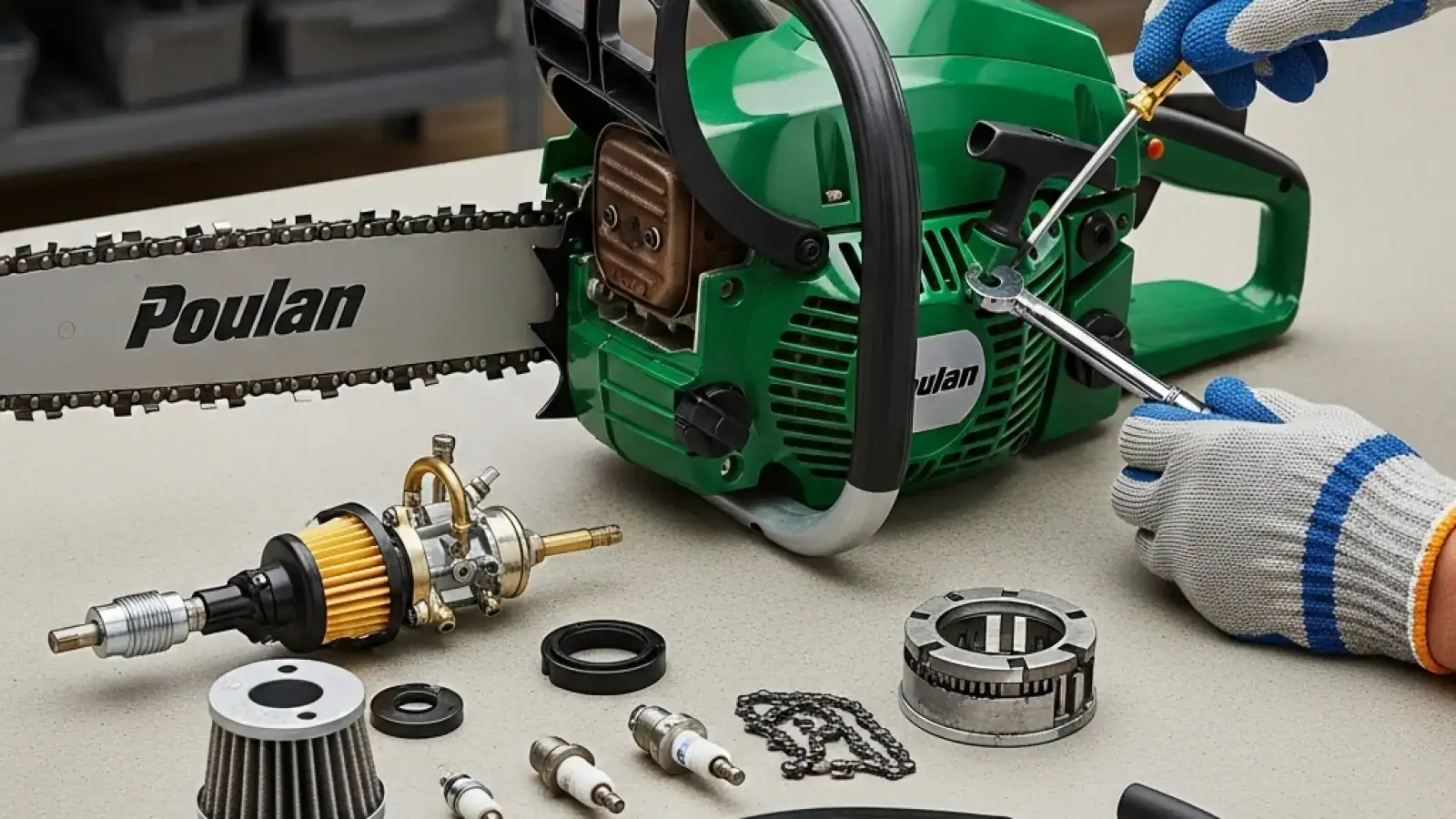

As a seasoned arborist and outdoor power equipment specialist, I’ve seen my share of chainsaws, from the smallest electric models to the most powerful professional beasts. Among them, Poulan chainsaws hold a special place for many homeowners and DIY users. They’re reliable workhorses when properly maintained, but like any hardworking tool, they occasionally need a little TLC – and sometimes, a repair or two.
Table Of Content
- Why DIY Poulan Chainsaw Repair Matters & What You’ll Need
- The Value of Understanding Your Saw
- Essential Tools and Safety Gear
- The Indispensable Manual and Diagrams
- Common Poulan Chainsaw Issues and Their Fixes
- Engine Not Starting or Running Poorly
- Spark Plug
- Air Filter
- Fuel System (Carburetor & Fuel Filter)
- Chain Performance Problems
- Dull Chain
- Loose or Overtightened Chain
- Bar Wear
- Step-by-Step Repair Guides for Key Poulan Components
- Replacing the Spark Plug (Poulan P3816 Example)
- Cleaning/Adjusting the Carburetor (Poulan P3416 Example)
- Guide Bar and Chain Maintenance
- General Maintenance Practices to Prevent Future Repairs
- Fuel and Oil Management
- Regular Cleaning and Inspection
- Storage Tips
Ever been in the middle of a big yard project, only for your Poulan to sputter and die? It’s frustrating, to say the least. But here’s the good news: many common Poulan chainsaw issues are surprisingly straightforward to diagnose and fix yourself. Understanding
how can repair Poulan chainsaw parts
isn’t just about saving money on shop fees; it’s about empowering yourself to keep your equipment running safely and efficiently, extending its life, and truly getting to know your tool.
This guide is designed to be your trusted advisor, walking you through the essential knowledge and practical steps for repairing your Poulan. We’ll cover everything from simple maintenance like spark plug replacements to more involved tasks such as carburetor adjustments, using specific examples from popular models like the Poulan P3416, P3314, and P3816. Let’s get your Poulan purring like new again!
Why DIY Poulan Chainsaw Repair Matters & What You’ll Need
Taking ownership of your chainsaw’s maintenance and minor repairs is one of the most rewarding aspects of being a homeowner or landowner. It’s not just about the immediate fix; it’s about building confidence, understanding your equipment intimately, and ensuring its longevity. Think of it this way: when you know how to fix a basic issue, you’re less likely to be stranded mid-project, and you’re certainly saving a few bucks.
The Value of Understanding Your Saw
For starters, repairing your Poulan yourself can lead to significant cost savings. A trip to the repair shop for a simple spark plug or fuel filter replacement can quickly add up, often costing more in labor than the part itself. Beyond the financial aspect, there’s the invaluable experience. Each repair teaches you more about how your chainsaw operates, making you better equipped to spot potential problems before they become major breakdowns.
Furthermore, self-repair allows for immediate action. When your saw acts up, you don’t have to wait for a service appointment; you can often diagnose and fix the issue on the spot, getting back to work without delay. This proactive approach not only keeps your projects on schedule but also instills a deeper appreciation for the mechanics of your Poulan chainsaw, transforming you from a mere operator into a knowledgeable craftsman.
Essential Tools and Safety Gear
Before you dive into any repair, gathering the right tools is crucial. You don’t need a professional workshop, but a few basics will go a long way. Here’s what I recommend for your DIY Poulan repair kit:
- Screwdrivers: Flathead and Phillips, various sizes.
- Spark Plug Wrench/Socket Wrench: Specifically sized for your Poulan’s spark plug (often a 13mm or 19mm socket).
- Torx Wrenches or Hex Keys: Depending on your model, some fasteners might require these.
- Pliers: Needle-nose for small components.
- Carburetor Adjustment Tool: If your Poulan has non-standard D-shaped or pac-man adjustment screws (many newer models do for EPA compliance), you’ll need a specific tool.
- Wire Brush: For cleaning carbon buildup.
- Feeler Gauge: For checking spark plug gap and electrode clearance.
- Clean Rags: For wiping up fuel or oil spills.
- Safety Glasses: Non-negotiable for eye protection.
- Work Gloves: Protect your hands from grime and sharp edges.
- Hearing Protection: Even when not running, some tasks can be noisy.
- Chainsaw File Kit: For sharpening, which is preventative maintenance but often goes hand-in-hand with repairs.
The Indispensable Manual and Diagrams
I cannot stress this enough: your Poulan chainsaw’s owner’s manual is your absolute best friend. Seriously, it’s not just a collection of boring instructions; it’s a treasure trove of model-specific information. It provides detailed safety guidelines, maintenance schedules, and most importantly for repairs,
how can repair Poulan chainsaw parts manual
and exploded view diagrams.
For models like the Poulan P3416, P3314, or P3816, the manual will specify the correct spark plug size, fuel-to-oil mixture, and detailed steps for routine maintenance tasks. The
how can repair Poulan chainsaw parts diagram
is equally vital, offering a visual roadmap of your saw’s internal components. This visual aid, often found in the back of your manual or online, helps you identify specific parts like the Poulan P3416 carburetor, understand their relationships, and ensures you reassemble everything correctly. Never start a repair without first consulting these resources.
Common Poulan Chainsaw Issues and Their Fixes
Most chainsaw problems fall into a few predictable categories: issues with the engine’s ability to start or run smoothly, or problems related to the cutting mechanism (the chain and bar). Let’s break down the most common culprits and how to tackle them with your Poulan.
Engine Not Starting or Running Poorly
This is arguably the most common and frustrating problem. A chainsaw that won’t start or bogs down under load is practically useless. Often, the issue is simpler than you might think.
Spark Plug
The spark plug is the ignition system’s workhorse, providing the spark that ignites the fuel-air mixture. If your Poulan isn’t starting, or is running rough, the spark plug is one of the first things to check. It can become fouled with carbon deposits, oil, or fuel, or the electrode gap can be incorrect. For a Poulan P3314, for instance, knowing the correct
Poulan P3314 spark plug size
and gap is critical for reliable ignition. Typically, this is around 0.025 inches (0.63 mm), but always confirm in your manual.
A dirty or incorrectly gapped spark plug can lead to misfires, reduced power, and difficulty starting. If the plug looks severely worn, cracked, or has heavy deposits, it’s time for a replacement. Remember, using the wrong size or type of spark plug can cause engine damage or poor performance. Always opt for a quality replacement recommended by Poulan.
Air Filter
Your chainsaw’s engine needs a clean supply of air to mix with fuel for proper combustion. A clogged air filter, packed with sawdust and debris, chokes the engine, leading to reduced power, increased fuel consumption, and difficulty starting. It’s like trying to run a marathon while breathing through a pillow!
Regularly inspect your air filter, especially after dusty jobs. Most Poulan models feature a relatively easy-to-access air filter. You can often clean foam or nylon filters with warm, soapy water, rinse thoroughly, and let them air dry completely before reinstalling. Paper filters usually need replacement if heavily soiled. A clean air filter ensures your engine breathes freely, delivering optimal performance.
Fuel System (Carburetor & Fuel Filter)
The fuel system is often the source of many engine woes, especially with modern ethanol-blended fuels. Old, stale fuel (anything over 30 days old without stabilizer) can gum up the carburetor, corrode fuel lines, and clog the fuel filter. The carburetor’s job is to precisely mix air and fuel; if it’s dirty or out of adjustment, your saw will run poorly or not at all.
A common issue with the
Poulan P3416 carburetor
, like many small engine carburetors, is clogging of the tiny fuel passages. This often manifests as the saw starting but quickly dying, or running fine at idle but bogging down under throttle. Before tackling a full carburetor rebuild, check the fuel filter (a small filter usually found inside the fuel tank, attached to the fuel line). If it’s dirty, replace it. If the carburetor is suspected, a thorough cleaning with carburetor cleaner can often resolve minor issues. For more complex problems, careful adjustment of the high and low-speed screws (if accessible) may be necessary, or even a carburetor rebuild kit.
Chain Performance Problems
Even if your engine is running perfectly, a poorly performing chain can make cutting a miserable, inefficient, and dangerous experience.
Dull Chain
A dull chain is not just an inconvenience; it’s a safety hazard. It forces you to push harder, increasing kickback risk and putting unnecessary strain on both you and the saw. A sharp chain, on the other hand, pulls itself into the wood effortlessly, creating clean, consistent chips. If your saw is producing fine sawdust instead of chips, or requires excessive force to cut, your chain is dull.
Sharpening involves filing each cutter link to a precise angle (typically 30-35 degrees, check your manual) and maintaining the correct depth gauge setting. A good file guide can make this job much easier. Regular, light sharpening is far better than letting the chain get completely dull. I always keep a file on hand when cutting.
Loose or Overtightened Chain
The chain tension is critical for both safety and cutting efficiency. A loose chain can derail from the guide bar, potentially causing injury or damage to the saw. An overtightened chain, conversely, puts excessive strain on the engine, guide bar, and clutch, leading to premature wear and overheating. The proper tension allows the chain to be pulled freely around the bar by hand but leaves no sag on the underside of the bar.
Always check chain tension before each use and adjust as needed. Most Poulan chainsaws have a side-mounted tensioning screw, often adjusted with a flathead screwdriver while loosening the bar nuts slightly. Always ensure the chain brake is disengaged when checking tension, and re-tighten the bar nuts securely after adjustment.
Bar Wear
The guide bar, often overlooked, is just as important as the chain. Over time, the bar rails can wear unevenly, burrs can form, and the oil passages can become clogged. Uneven wear can cause the chain to track incorrectly, leading to poor cuts and accelerated chain wear. Burrs on the edges of the bar can impede chain movement.
Regularly inspect your guide bar. Clean the groove with a bar groove cleaner and ensure the oil holes are clear. Use a flat file to remove any burrs from the bar rails. Flipping the bar periodically (e.g., every time you replace the chain) helps to ensure even wear on both sides, significantly extending its life. A well-maintained guide bar ensures smooth chain travel and optimal cutting performance.
Step-by-Step Repair Guides for Key Poulan Components
Now that we’ve covered the common issues, let’s get down to the practical steps of fixing some of the most frequent problems. Remember, safety first! Always ensure your chainsaw is off, the spark plug boot is disconnected, and the engine is cool before attempting any repair.
Replacing the Spark Plug (Poulan P3816 Example)
A fresh spark plug can solve a multitude of starting and running issues. Here’s how to perform a
Poulan P3816 spark plug replacement
, a task that’s very similar across most Poulan models:
- Ensure Safety: Turn off the chainsaw. Allow the engine to cool completely if it has been running. Engage the chain brake.
- Locate and Access: The spark plug is usually found under a plastic cover, often near the starter housing. Remove any screws or clips holding the cover in place and gently lift it off.
- Disconnect the Boot: Firmly pull the rubber spark plug boot straight off the top of the spark plug. Avoid pulling on the wire itself.
- Remove the Old Plug: Use your spark plug wrench or socket wrench to carefully unscrew the old spark plug counter-clockwise. It might be tight initially.
- Inspect the Old Plug: Examine the tip of the old plug. Is it black and sooty (rich mixture), white and blistered (lean mixture/overheating), or oily (burning oil)? This can give clues to other engine problems.
- Prepare the New Plug: Take your new spark plug (ensure it’s the correct type and heat range for your Poulan P3816 or specific model). Check the electrode gap with a feeler gauge. Adjust it if necessary by gently bending the ground electrode. Your manual will specify the correct gap, typically around 0.025 inches.
- Install the New Plug: Hand-thread the new spark plug into the cylinder head clockwise. Be careful not to cross-thread it. Once it’s finger-tight, use the spark plug wrench to tighten it an additional 1/2 to 3/4 turn. Do not overtighten, as this can damage the cylinder head.
- Reconnect and Test: Push the spark plug boot firmly back onto the new spark plug until it clicks into place. Reattach any covers. Now, you can attempt to start your chainsaw.
Cleaning/Adjusting the Carburetor (Poulan P3416 Example)
Carburetor issues can be tricky, but a good cleaning can often bring your
Poulan P3416 carburetor
back to life. Adjustments, however, can be complex, and for severe issues, professional help might be best.
- Safety First: As always, ensure the saw is off, cool, and the spark plug boot is disconnected. Drain the fuel tank into an approved container.
- Access the Carburetor: This usually involves removing the top cover, air filter housing, and possibly the rear handle assembly. Take photos with your phone as you disassemble to aid reassembly. Disconnect fuel lines and linkage rods carefully.
- Disassemble and Clean: Remove the carburetor from the engine. With small flathead screwdrivers, carefully remove the diaphragm cover, gaskets, and diaphragms. Use carburetor cleaner to spray all small passages and jets. Pay close attention to the small screens and check valves. A fine wire can help clear stubborn clogs, but be gentle.
- Inspect and Replace: Examine the diaphragms for stiffness, tears, or warping. If they are compromised, a carburetor rebuild kit for your specific Poulan P3416 model is highly recommended. These kits contain all necessary gaskets and diaphragms.
- Reassemble the Carburetor: Reassemble the carburetor with new gaskets and diaphragms from the kit, if used, following your diagram precisely. Ensure everything is seated correctly.
- Reinstall and Reconnect: Mount the carburetor back onto the engine. Reconnect all fuel lines, throttle linkage, and choke rod. Make sure no lines are kinked.
- Basic Adjustment (Caution!): For Poulan chainsaws with adjustable high (H) and low (L) speed screws (often requiring special tools), start by gently turning them clockwise until they lightly seat, then back them out 1 to 1.5 turns. The idle (T) screw sets the engine idle speed. This is a starting point. Fine-tuning often requires running the saw and listening carefully to the engine’s response under load, which can be dangerous for inexperienced users. If you’re unsure, or the saw still runs poorly, consider professional tuning.
Guide Bar and Chain Maintenance
Maintaining the cutting components is vital for safety and performance.
- Remove and Clean: With the chain brake engaged and engine off, remove the side cover and carefully take off the chain and guide bar.
- Clean the Bar Groove: Use a bar groove cleaner (or a thin, stiff piece of metal) to scrape out packed sawdust and debris from the guide bar groove. Ensure the oil holes are clear.
- Remove Burrs: Use a flat file to gently file off any raised burrs from the top and bottom rails of the guide bar. This helps the chain run smoothly.
- Inspect Sprocket Tip: If your bar has a sprocket nose, check if it spins freely. Apply a small amount of grease to the sprocket tip via the lubrication hole, if present.
- Inspect Chain for Wear: Check for damaged or stretched links. Sharpen the chain using a round file and file guide, ensuring the correct angle and depth gauge setting for each cutter.
- Reinstall and Tension: Place the chain back on the bar, ensuring the cutters are facing the correct direction. Mount the bar and chain onto the saw, then adjust the chain tension. It should be snug, with no sag on the underside, but still allow the chain to be pulled freely by hand. Tighten the bar nuts securely.
General Maintenance Practices to Prevent Future Repairs
An ounce of prevention is worth a pound of cure, especially with chainsaws. Regular, diligent maintenance is the single best way to avoid unexpected breakdowns and expensive repairs. It ensures your Poulan is always ready for action and operates safely.
Fuel and Oil Management
This is perhaps the most critical aspect of preventative maintenance for any 2-stroke chainsaw. Always use fresh, high-quality gasoline mixed with the correct ratio of 2-stroke engine oil, as specified in your Poulan manual (typically 50:1 for newer models, meaning 2.6 oz of oil per gallon of gas). Never use straight gas! Ethanol-free gasoline is always preferred if available, as ethanol can degrade fuel lines and carburetor components. For fuel that will sit for more than a few weeks, use a reputable fuel stabilizer. Always drain the fuel tank if storing the saw for more than a month or two.
Equally important is chain oil. Use only purpose-made bar and chain oil. It’s designed to stick to the chain and lubricate the bar and chain assembly, reducing friction and heat. Never use old motor oil, as it’s too thin and lacks the necessary tackiness. Keeping the chain oiled significantly reduces wear on both the chain and guide bar.
Regular Cleaning and Inspection
After every cutting session, even a short one, take a few minutes to clean your Poulan. This simple habit can prevent many problems. Remove the side cover, guide bar, and chain. Use a brush or compressed air to clear away sawdust, wood chips, and debris from the clutch area, around the sprocket, and from the air filter housing. Clean the cooling fins on the engine to prevent overheating.
While cleaning, conduct a quick visual inspection. Check for loose bolts, damaged components, or unusual wear patterns. Look at the exhaust for excessive carbon buildup. This proactive approach helps you catch small issues before they escalate into major repairs. For example, a small crack in a fuel line caught early is a simple fix; left unattended, it could lead to engine damage from a lean fuel mixture.
Storage Tips
Proper storage is essential for maintaining your chainsaw during off-seasons. For short-term storage (a few weeks), ensure the fuel is stabilized. For long-term storage (several months or more), completely drain the fuel tank and run the engine until it dies to clear the carburetor of any remaining fuel. This prevents gumming and corrosion.
Clean the entire saw thoroughly, lubricate the chain and bar with fresh bar oil, and apply a light coat of oil to any exposed metal parts to prevent rust. Remove the spark plug and put a teaspoon of clean 2-stroke oil into the cylinder, then slowly pull the starter cord a few times to distribute the oil. Replace the spark plug. Store your Poulan in a clean, dry place, away from extreme temperatures and direct sunlight. These steps might seem minor, but they significantly extend the life and reliability of your chainsaw.
Repairing your Poulan chainsaw parts might seem daunting at first, but with a little patience, the right tools, and this guide, you’ll be surprised at what you can accomplish. From tackling a Poulan P3816 spark plug replacement to understanding the nuances of your Poulan P3416 carburetor, you’re not just fixing a machine; you’re becoming a more self-reliant and knowledgeable chainsaw owner. Regular maintenance, coupled with the confidence to address common issues, ensures your Poulan remains a dependable tool for years to come. Remember, a well-maintained chainsaw is a safer, more efficient chainsaw. Happy cutting!