Quick answer: A Coocheer chainsaw offers exceptional engine power per dollar, making the 58cc (5800) and 62cc models great budget options for clearing storm damage and cutting firewood. They perform reliably when tuned properly, though they require routine user maintenance, immediate chain upgrades, and proper 25:1 or 40:1 gas-to-oil fuel mixing to ensure long engine life.
Understanding the Coocheer Chainsaw Lineup and Specs
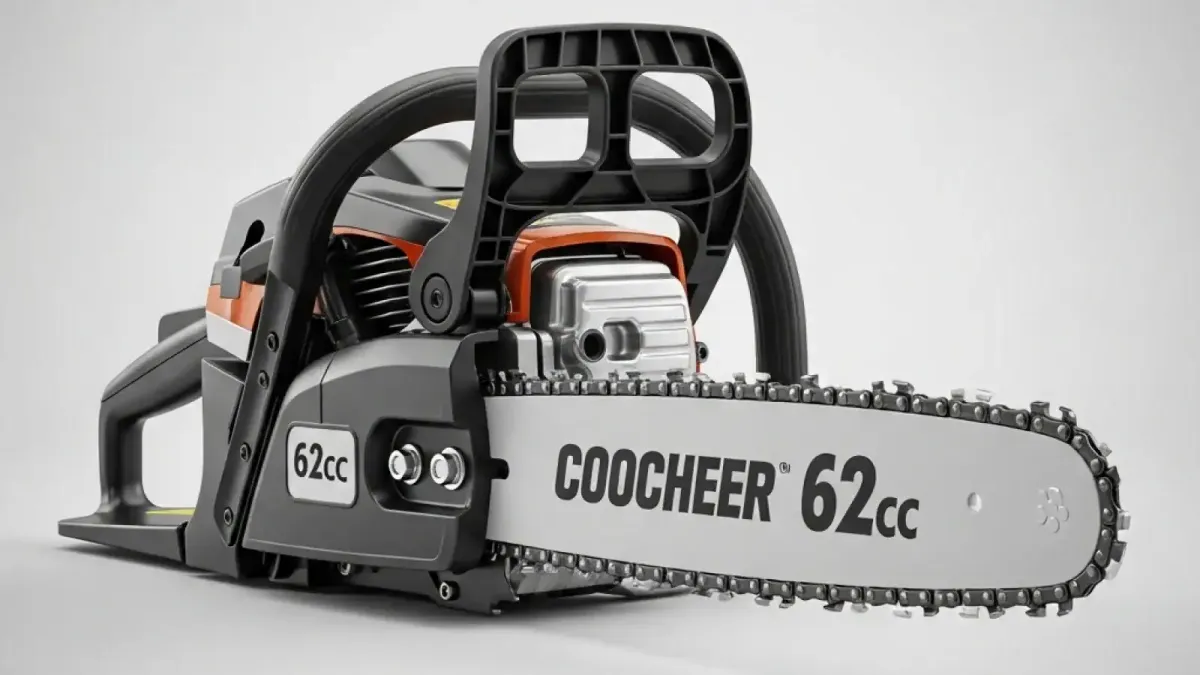
The core lineup of Coocheer gas chainsaws revolves around two main engine platforms: the popular 5800 series (58cc) and the heavier-duty 62cc model. These machines utilize air-cooled, single-cylinder two-stroke engines that rev up to 8,500–10,000 RPM under load, delivering impressive torque for cutting through oak, maple, and pine. Most units come out of the box equipped with a 20-inch guide bar, paired with a standard .325-inch pitch or 3/8-inch pitch saw chain having a .058-inch gauge. While heavy compared to top-tier commercial saws, their power-to-weight balance easily handles logs up to 18 inches in diameter without stalling out.
Engineering-wise, these saws utilize die-cast aluminum crankcases paired with durable plastic outer shrouds, standard centrifugal clutches, and direct-drive automatic oil pump mechanisms. The starter system features an assisted recoil mechanism, often marketed as an "easy-start" system, which uses a secondary spring inside the pull pulley to cut down on the physical effort required to turn over the high-compression engine. Vibration damping is managed by standard rubber buffers and steel coil springs strategically positioned between the handles and the powerhead chassis.
When selecting between the common models, matching the engine displacement to your actual workload is critical for long-term satisfaction. The 58cc model delivers roughly 3.5 horsepower, which is more than sufficient for general farm clearing, firewood bucking, and backyard limbing. The larger 62cc engine pumps out closer to 4.0 horsepower, providing that extra grunt needed when pulling a fully buried 20-inch bar through dense, frozen green timber or hard oak trunks.
| Feature / Specification | Coocheer 5800 (58cc) | Coocheer Heavy Duty (62cc) |
|---|---|---|
| Engine Output Power | ~2.6 kW / 3.5 HP | ~2.9 kW / 4.0 HP |
| Recommended Bar Lengths | 18" to 20" | 20" to 24" |
| Standard chain pitch & Gauge | .325" pitch, .058" gauge | 3/8" pitch, .058" gauge |
| Fuel Mix Ratio | 25:1 (Break-in) / 40:1 (Synthetic) | 25:1 (Break-in) / 40:1 (Synthetic) |
| Dry Powerhead Weight | 13.8 lbs (6.25 kg) | 14.5 lbs (6.58 kg) |
Performance and Hands-On Coocheer Chainsaw Review
Putting a Coocheer chainsaw to work on real-world cutting jobs reveals both its strengths and its limitations. On the positive side, the engine torque is undeniable for a saw in this price bracket. Throttle response is snappy once the carburetor is set correctly, and the saw pulls smoothly through hard logs without forcing the operator to constantly ease off the pressure. However, these machines are noticeably heavier than mid-range brand-name equivalents, meaning operator fatigue sets in faster during prolonged overhead limbing or all-day felling operations.
Pro tip: Out of the box, inexpensive factory chains stretch aggressively during their first two tanks of fuel. Check your chain tension every 10-15 minutes of cutting: switch off the engine, loosen the bar nuts, lift the nose of the guide bar, and tighten the tension screw until the drive links fit snug against the bottom of the bar rail without sagging. Upgrading immediately to a quality Oregon or Husqvarna chain dramatically cuts down on stretching and vastly improves cutting performance.
The standard safety equipment integrated into these saws includes a functional inertia-activated chain brake, a throttle trigger interlock to prevent accidental acceleration, a rear hand guard, and a metal chain catcher pin. While these features meet essential safety guidelines, users should always operate with full personal protective equipment (PPE), including ASTM-approved chainsaw chaps, heavy leather work gloves, eye protection with side shields, and ear protection rated for at least 105 dB. Never run these high-decibel two-stroke motors without adequate hearing conservation gear.
| Feature | Coocheer chainsaw 62cc | COOCHEER Chainsaw 5800 |
|---|---|---|
| Engine displacement | 62cc | 58cc |
| Power level | Higher, heavy-duty | Moderate, versatile |
| Best use case | Professional-grade tasks | Home and light forestry |
| Weight | Slightly heavier | More manageable |
| Parts availability | Moderate | Widely available |
Selecting Coocheer Chainsaw Parts and Maintenance Essentials
Keeping a Coocheer chainsaw operating smoothly over several seasons requires a proactive approach to routine maintenance and parts sourcing. Because many off-brand import saws share generalized platform designs (such as the widespread 4500, 5200, and 5800 designs), tracking down compatible replacement components is relatively easy once you know what to look for. Essential replacement parts that every owner should keep on hand include spare air filters, spark plugs, bar nuts, starter rope assemblies, and extra drive sprockets.
- Guide Bars & Cutting Chains: Standard replacement bars feature a common K095 or A074 tail mount style. Upgrading to a quality 20-inch bar with a matching .325" or 3/8" chain upgrades cutting speeds instantly.
- Carburetors & Fuel Lines: Most models use a standard Walbro-clone diaphragm carburetor (often labeled standard HUAYI or similar). Keeping a carburetor adjustment tool (21-teeth splined or Pac-Man driver) is vital for fine-tuning fuel mixtures based on elevation and ambient temperature.
- Ignition & Spark Plugs: Factory spark plugs should be swapped early for high-grade equivalents such as an NGK BPMR7A or Torch L7T, gapped to roughly 0.025 inches (0.63 mm) to ensure reliable cold starting.
- Air Filters: The stock dual-element mesh air filters require cleaning after every 4 hours of heavy cutting. Wash them in warm soapy water, air dry completely, and inspect for fine dust bypassing into the choke throat.
Proper engine lubrication is the single most critical factor for longevity. Always mix fresh 87+ octane unleaded gasoline with a high-grade ISO-L-EGD or JASO FD certified two-stroke engine oil. While the manual frequently recommends a standard 25:1 mix ratio during the initial 10-hour break-in period, switching to a high-quality fully synthetic two-stroke oil at a 40:1 ratio afterwards reduces excessive exhaust smoke, prevents carbon buildup on the piston top, and keeps the exhaust spark arrestor screen from clogging up prematurely.
Navigating the Coocheer 5800 Chainsaw Manual and Setup Guide
Proper setup before pulling the starter cord prevents premature engine damage and frustrating cold-start scenarios. The factory Coocheer 5800 chainsaw manual outlines a strict step-by-step assembly process that includes mounting the guide bar, setting the saw chain in the correct direction of rotation (cutters on top pointing forward toward the bar nose), and adjusting the side-access chain tensioner before fully torquing the dual bar nuts.
Starting a cold Coocheer chainsaw follows a repeatable, time-tested sequence. Turn the master ignition switch to the "ON" position, pull the choke lever all the way out, and press the primer bulb (if equipped) 5 to 7 times until fuel fills the purge bulb. Hold the rear handle firmly on the ground with your right boot inserted into the handle loop, grip the front handlebar with your left hand, and pull the starter cord firmly until the engine "pops" or fires briefly (usually within 3 to 5 pulls). Once you hear that initial pop, push the choke lever fully back in, pull the cord again, and the engine will start right up on high idle. Squeeze the throttle trigger once to release the fast-idle latch and drop the saw into normal idle speed.
Troubleshooting starting failures usually comes down to three main culprits: flooding, stale fuel mix, or improper carburetor tuning. If the engine drowns in fuel due to excessive pulls with the choke engaged, remove the spark plug, turn the saw upside down, and pull the starter rope 10 times to clear the flooded cylinder. Dry off the spark plug electrode, reinstall it, and attempt to start with the choke completely open. Adjusting the carburetor's Low (L) and High (H) needle screws by 1/8th turn increments can also resolve rough idling or bogging under load.
Who Should Buy a Coocheer Chainsaw?
If you need a high-power, budget-friendly machine for occasional heavy yard clearing, cutting up storm debris, or processing 3 to 5 cords of firewood annually, buying a 58cc or 62cc Coocheer chainsaw is a practical and cost-effective choice. While it demands a bit more hands-on maintenance awareness than a commercial saw costing five times as much, its raw cutting performance and widely available cheap replacement parts make it a solid investment for self-reliant homeowners.
Frequently Asked Questions
What gas-to-oil mix ratio does a Coocheer chainsaw require?
During the first few tanks (break-in phase), use a 25:1 gas-to-oil ratio with standard 2-stroke oil. After the break-in period, running a high-quality synthetic 2-stroke oil at a 40:1 ratio provides superior engine protection with cleaner burning and less exhaust smoke.
Can I install an Oregon bar and chain on a Coocheer chainsaw?
Yes. As long as you match the motor's drive sprocket pitch (typically .325" or 3/8") and match the bar mount tail pattern (standard K095/A074 small-mount pattern), high-quality Oregon bars and chains fit perfectly and greatly enhance cutting speed.
Why does my Coocheer chainsaw die when I hit the throttle?
This issue usually points to a lean fuel mixture on the carburetor's Low-speed (L) needle screw, a clogged fuel filter inside the tank, or an air leak in the fuel lines. Slightly opening the L screw counter-clockwise (about 1/8 turn) often resolves throttle bogging.
Where can I find replacement parts for the Coocheer 5800 model?
Because the Coocheer 5800 shares its internal engine and body architecture with standard generic 58cc Chinese two-stroke chainsaw platforms, parts like carburetors, recoil starters, ignition coils, and air filters are widely available across major online tool stores and hardware marketplaces.
Sources
- ANSI B175.1 Safety Requirements for Gasoline Chainsaws
- OSHA Standard 1910.266 - Logging Operations and Chainsaw Safety
- Wikipedia - Chainsaw Design and Two-Stroke Engine Mechanics