Disclosure: As an Amazon Associate, we earn from qualifying purchases.
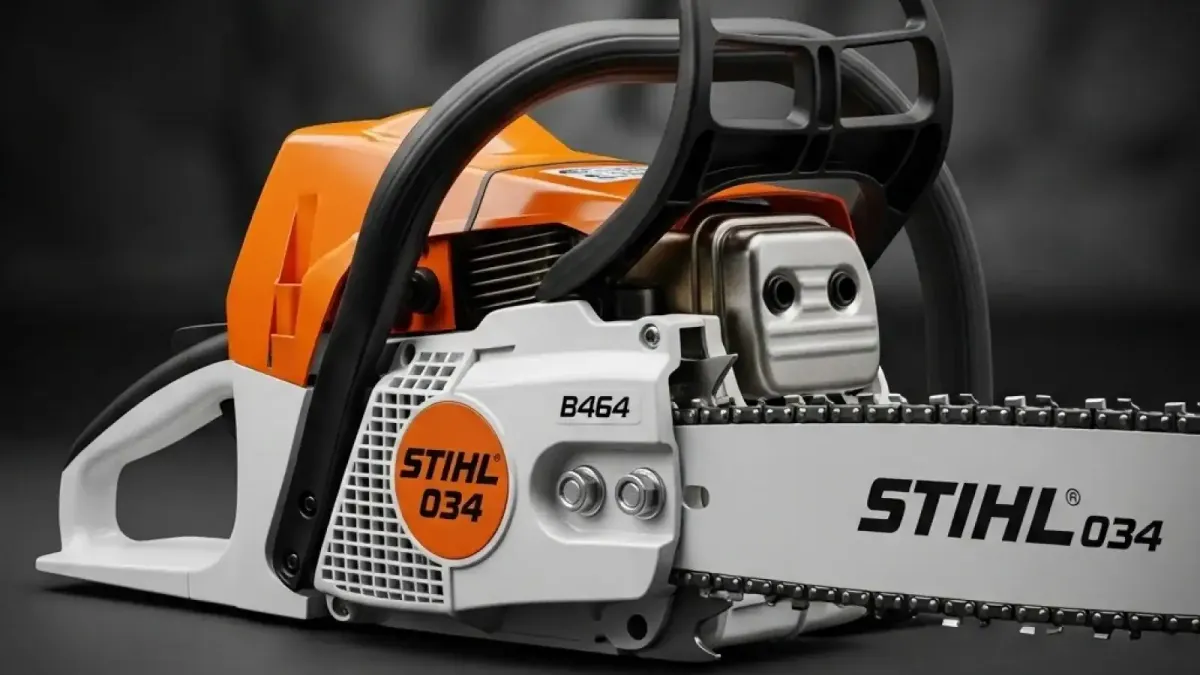
When Stihl introduced the 1125 chassis series in the mid-1980s, timber fallers and rural landowners gained access to one of the most well-engineered mid-sized powerheads ever produced. Designed as a direct replacement for the popular but heavy Stihl 031 and 032 lines, the Stihl 034 AV hit the market with an impressive balance of raw cutting force and manageable handling. Built around a rugged die-cast magnesium crankcase, this saw set a new benchmark for what a general-purpose mid-range saw could accomplish on farmsteads, woodlots, and professional job sites.
Quick answer: Engineered around a 56.4 cc engine delivering 4.1 horsepower (3.0 kW) at 9,500 RPM, the original Stihl 034 weighs roughly 11.9 pounds dry and handles 16-inch to 20-inch guide bars running 3/8-inch pitch chain with exceptional mid-range torque. The upgraded 034 Super increases engine displacement to 61.5 cc and boosts power to 4.4 horsepower, making both variants among the most versatile mid-class saws ever manufactured.
The Engineering Legacy of the Stihl 1125 Chassis
The success of the Stihl 034 lies within its innovative 1125 series chassis, which represented a massive leap forward in ergonomics and structural strength compared to older two-stroke powerheads. Stihl engineers integrated a lightweight yet rigid magnesium crankcase that safely housed high-grade ball bearings capable of handling sustained maximum speeds up to 12,500 RPM. By shifting weight away from non-essential housing components while strengthening the internal drive geometry, Stihl achieved a dry powerhead weight under 12 pounds without compromising durability.
Vibration isolation was another major engineering focus during the design of the 034 AVEQ series. Stihl implemented a tuned rubber anti-vibration buffer system that decoupled the front and rear handles from the engine crankcase and cutting attachments. This design significantly reduced high-frequency motor vibrations transmitted to the operator's hands, making full-day firewood bucking or storm cleanup far less exhausting. The layout also made basic service accessible, allowing mechanics to access the air filter, spark plug, and carburetor under a single top cover shroud.
Fuel delivery on the 034 was managed through heavy-duty dual-jet carburetors, predominantly manufactured by Tillotson (HK series) or Zama (C3A series). These carburetors feature high- and low-speed adjustment screws alongside an adjustable idle speed control, giving owners precise control over air-fuel mixtures across varying elevations and ambient temperatures. Combined with a chrome-plated aluminum cylinder bore and an efficient piston-ported intake design, the 034 delivers consistent throttle response and rapid acceleration under heavy loads.
Technical Specifications and Model Variations
Understanding the Stihl 034 requires recognizing the key differences between the standard 034 AV, the performance-oriented 034 Super, and its late-1990s successor, the Stihl 036. While all three models share identical crankcase mounting points, handle geometries, starter recoils, and side clutch covers, their internal displacement and top-end cylinder designs differ substantially. The standard 034 features a 46 mm cylinder bore with a 34 mm stroke length, generating 4.1 hp from a 56.4 cc displacement.
The 034 Super elevated cutting capability by expanding the cylinder bore diameter to 48 mm while retaining the same 34 mm stroke. This bump created a total engine capacity of 61.5 cc, pushing maximum output up to 4.4 hp (3.3 kW). When Stihl eventually transitioned the model line into the 036 Pro series, they retained the 48 mm bore and 61.5 cc displacement but added a manual decompression valve on top of the cylinder head to reduce pulling resistance when starting the higher-compression motor.
Because the 1125 chassis platform is modular, cross-model compatibility remains one of its greatest strengths. Mechanics and DIY enthusiasts frequently rebuild worn 56.4 cc base 034 engines using 48 mm cylinder and piston kits intended for the 034 Super or 036. This bolt-on upgrade immediately elevates top-end power output without requiring custom machining, providing an economical way to breathe new life into a classic saw platform.
| Specification Parameter | Standard Stihl 034 AV | Stihl 034 AV Super | Stihl 036 Pro |
|---|---|---|---|
| Engine Displacement | 56.4 cc (3.44 cu. in.) | 61.5 cc (3.75 cu. in.) | 61.5 cc (3.75 cu. in.) |
| Power Output | 4.1 hp (3.0 kW) | 4.4 hp (3.3 kW) | 4.5 hp (3.4 kW) |
| Cylinder Bore x Stroke | 46 mm x 34 mm | 48 mm x 34 mm | 48 mm x 34 mm |
| Dry Powerhead Weight | 11.9 lbs (5.4 kg) | 12.1 lbs (5.5 kg) | 12.3 lbs (5.6 kg) |
| Maximum Operating Speed | 12,500 RPM | 13,000 RPM | 13,500 RPM |
| Fuel Mix Ratio | 50:1 (Premix) | 50:1 (Premix) | 50:1 (Premix) |
| Decompression Valve | No | Rare late production | Yes (Standard) |
Bar Selection, Chain Setup, and Practical Operation
Getting the most productivity out of a Stihl 034 depends heavily on choosing an appropriate bar and chain setup tailored to the density of the wood being harvested. The standard 034 engine delivers its sweet spot in power when paired with an 18-inch or 20-inch guide bar running 3/8-inch pitch chain with a .050-inch or .063-inch gauge. While a 16-inch bar turns the powerhead into a lightning-fast limbing saw, a 20-inch bar provides an ideal reach for felling mature hardwoods without overburdening the powerhead.
Running the correct chain profile directly impacts both cutting speed and operator safety. Full-chisel cutter tooth profiles offer fast self-feeding performance in clean softwoods and green hardwoods like red oak or ash. However, if you regularly cut dirty logs near ground level, frozen timber, or abrasive species like shagbark hickory, a semi-chisel chain retains its sharp cutting edge significantly longer. Regardless of cutter shape, keeping your depth gauges (rakers) filed strictly to .025 inches prevents aggressive grabbing and minimizes severe kickback risks during plunge cuts.
Pro tip: On older farm saws like the 034, chain tension often drifts rapidly during the first ten minutes of heavy cutting as friction heats up the guide bar. Always re-check chain tension after warming up the bar on your first log—a loose 3/8-inch chain on a high-rpm saw can derail, chewing up the chain catcher and damaging drive links instantly.
Proper lubrication is critical for protecting high-speed cutting gear during continuous bucking sessions. The Stihl 034 utilizes an automatic, gear-driven oil pump that feeds bar lube proportionally based on engine shaft RPM. Turning the oil adjustment screw on the underside of the crankcase allows operators to increase oil flow when stepping up to a 20-inch bar or when cutting absorbent, dry hardwoods. Always check that the oil discharge port behind the side plate remains clear of packed sawdust and resin buildup before mounting a fresh chain.
Safety First: Never Fire Up Your Saw Without This
No matter how experienced you are with a powerful chainsaw, safety is completely non-negotiable. Before you make your next cut, ensure you have a professional-grade Forestry Safety Helmet System. Getting a helmet with a built-in steel mesh face shield and heavy-duty earmuffs is the single most important investment you can make to protect your hearing and your face from kickback.

Maintenance Schedules, Troubleshooting, and Fuel Protocols
To keep a vintage two-stroke engine running at peak efficiency, maintaining clean air intake and proper fuel chemistry is mandatory. The original nylon mesh air filter on the 034 filters out coarse wood chips, but fine wood dust can pass through if the filter element becomes damaged or unseated. Cleaning the filter with warm soapy water every few tanks of fuel prevents fine grit from reaching the carburetor venturi and scouring the cylinder wall coating.
Modern ethanol-blended gasolines represent a major hazard for legacy chainsaws like the 034. Gasoline containing more than 10 percent ethanol (E10) degrades rubber fuel lines, hardens internal carburetor diaphragms, and attracts moisture, leading to lean fuel mixtures and severe engine overheating. Running 91+ octane ethanol-free gasoline mixed at a strict 50:1 ratio with high-grade synthetic two-stroke oil ensures proper lubrication of crankshaft main bearings and keeps exhaust ports free of heavy carbon deposits.
- Daily Operating Checks: Inspect chain brake engagement, verify oiler discharge pattern against a clean log, clean air filter box, and tighten bar nuts.
- Monthly Maintenance Tasks: Inspect spark plug gap (0.020 in / 0.51 mm), clean cylinder cooling fins with compressed air, flip the guide bar to ensure even rail wear, and clean bar grooves.
- Seasonal Overhaul: Replace internal fuel tank filter pickup, inspect anti-vibration rubber mounts for cracks, grease clutch needle bearings, and perform a crankcase pressure/vacuum test if idle becomes erratic.
Frequently Asked Questions
What is the correct spark plug gap for a Stihl 034?
The correct spark plug gap for the Stihl 034 chainsaw is 0.020 inches (0.51 mm). Standard recommended replacement spark plugs include the Bosch WSR6F, NGK BPMR7A, or Champion RCJ7Y calibrated for two-stroke ignition systems.
Can I install an 036 cylinder kit directly onto a standard Stihl 034 crankcase?
Yes, because both models share Stihl's 1125 series chassis, a 48 mm cylinder and piston kit for an 034 Super or 036 will bolt directly onto a standard 034 crankcase without modification, upgrading engine displacement from 56.4 cc to 61.5 cc.
What guide bar length works best on a Stihl 034?
An 18-inch or 20-inch guide bar provides the best balance of leverage, cutting speed, and engine load for the Stihl 034. Running bars longer than 20 inches is not recommended for sustained cutting as it can strain the 4.1 hp motor and oiling system.
Why does my Stihl 034 start easily but die when I press the throttle?
This symptom typically indicates a hardened high-speed carburetor diaphragm, a clogged fuel pickup filter, or an air leak along the intake boot or impulse hose. Replacing the internal carburetor diaphragm kit and checking the rubber intake boot usually restores smooth throttle transition.
If you are looking for a reliable, hard-hitting mid-range saw on the secondary market or rebuilding an existing unit, the Stihl 034 remains an outstanding choice. Equipping this 56.4 cc powerhead with an 18-inch bar, 3/8-inch semi-chisel chain, and fresh ethanol-free 50:1 pre-mix fuel gives landowners and firewood gatherers professional-grade cutting performance at a fraction of the cost of a modern professional saw.
Sources
- STIHL Official Global Website
- Wikipedia: Chainsaw Specifications and History
- OSHA 1910.266: Logging Operations Safety Standards
| Specification | Detail (Standard Stihl 034) |
| Engine Displacement (Stihl 034 cc) | $approx 57.0 text{ cc} (3.45 text{ cu. in.})$ |
| Horsepower (Stihl 034 hp) | Typically cited around $3.4 text{ hp}$ to $4.1 text{ hp}$ |
| Powerhead Weight | $approx 11.6 text{ lbs}$ (without bar/chain/fuel) |
| Construction | Polymer and Die-Cast Magnesium |
| Standard Chain Pitch | $3/8 text{ inch}$ |
| Standard Chain Gauge | $0.050 text{ inch}$ |
| Recommended Bar Lengths | $16 text{ inches to } 20 text{ inches}$ |