Disclosure: As an Amazon Associate, we earn from qualifying purchases.
When clearing storm debris, processing firewood, or maintaining woodland property, high-priced commercial chainsaws aren't always necessary for every landowner. Proyama has carved out a distinct position in the outdoor power equipment market by manufacturing heavy-duty gas chainsaws that offer impressive raw displacement at a fraction of the cost of premium European brands. Designed primarily for budget-conscious homeowners, DIYers, and semi-professional users, these saws promise high torque and large bar capacities without demanding a four-figure investment.Quick answer: Proyama chainsaws offer exceptional power-per-dollar value, particularly in the 58cc and 68cc classes paired with 20 to 24-inch guide bars. While their plastic housing fit and finish are simpler than premium STIHL or Husqvarna models, their robust two-stroke engines deliver reliable cutting power for firewood cutting and land clearing when properly tuned and maintained.
Engine Performance and Technical Architecture
The core appealing factor of a Proyama saw lies in its traditional air-cooled two-stroke engine design. Ranging from nimble 25.4cc top-handle units to muscular 62cc and 68cc powerheads, these engines utilize standard porting and a diaphragm carburetor setup that is straightforward to adjust and service. On the larger 68cc models, the engine produces roughly 3.5 to 4.0 horsepower, providing sufficient torque to pull a full-chisel 3/8-inch pitch chain through dense hardwoods like oak, maple, and hickory.
Fuel delivery depends on a proper 2-stroke mix. Proyama specifies a 40:1 or 50:1 gas-to-oil ratio depending on the exact engine family and oil quality grade. Utilizing a high-quality JASO-FD rated synthetic two-stroke oil mixed with 89-octane ethanol-free gasoline ensures proper upper-cylinder lubrication and prevents premature crank bearing wear. The saw utilizes an adjustable automatic oil pump, allowing operators to increase chain lubrication flow when running longer 22-inch or 24-inch guide bars through dry timber.
Pro tip: Budget high-displacement saws like Proyama frequently experience chain-tension drift and minor bar-nut loosening during their first 2 to 3 tanks of fuel. Always re-tension the chain after 10 minutes of initial cutting and check bar nut torque repeatedly while the drive clutch housing breaks in.
Build Quality, Component Ergonomics, and Construction
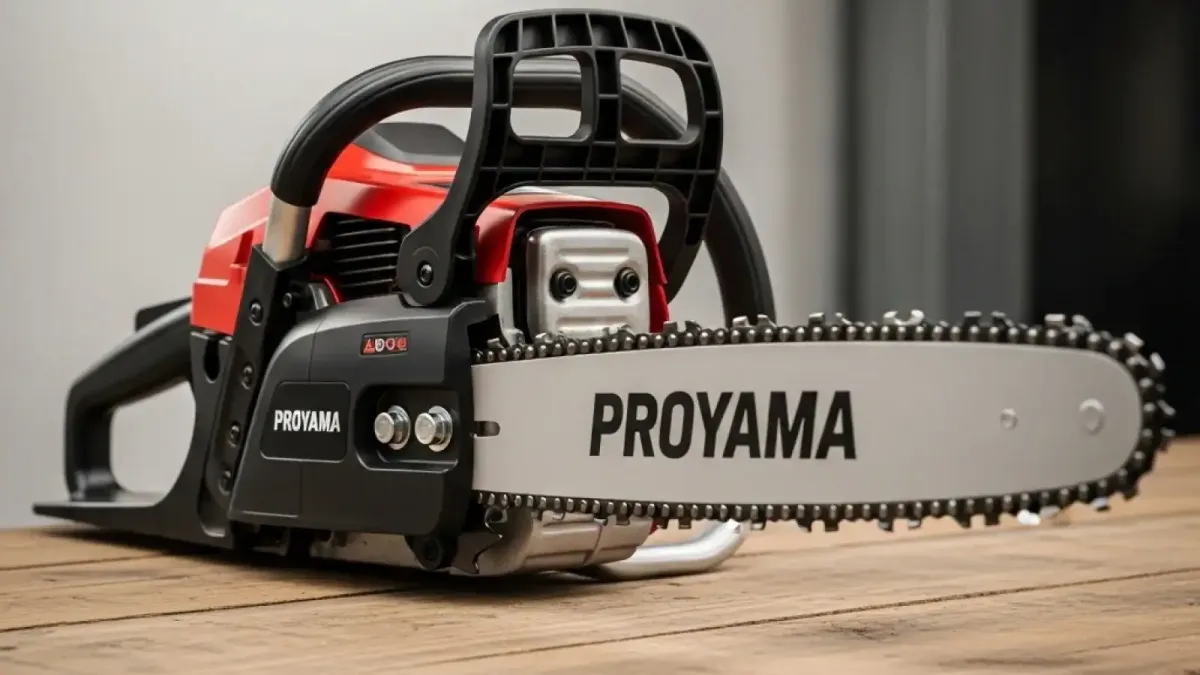
Evaluating the build quality of a Proyama chainsaw requires an understanding of where cost-savings occur. The powerhead chassis uses an aluminum-magnesium alloy crankcase mated to impact-resistant polymer body panels. While the plastics lack the ultra-refined finish of commercial-tier saws, the internal mechanical assemblies—including the forged crankshaft, dual-ring piston, and centrifugal clutch assembly—are robust enough to handle sustained load cycles.
Ergonomically, Proyama equips its mid-range and large-frame saws with a multi-point anti-vibration damping system using steel coil springs and rubber mounts. This isolation layout significantly reduces feedback to the operator's hands and forearms during long woodpiles sessions. The front wrap handlebar provides solid grip angles for felling cuts and bucking operations, though the side-access chain tensioner hardware requires careful tool engagement to prevent rounding off the tensioning screw.
Model Range Comparison: Top Handle vs. Heavy-Duty Saws
Choosing the right Proyama chainsaw depends on the specific work environment, wood diameter, and physical demands of the job. The line spans lightweight pruning units to large-displacement log bucking saws, each configured with specific bar lengths, drive link gauges, and weight profiles.
Maximum Value for Money: PROYAMA 58cc 2-in-1 Chainsaw Kit

| Model Category | Displacement | Bar Length | Chain Pitch / Gauge | Primary Application |
|---|---|---|---|---|
| Top Handle Pruner | 25.4 cc | 12" - 14" | 3/8" LP / .050" | In-tree pruning, light orchard work |
| All-Round Mid-Size | 51.2 cc - 58 cc | 18" - 20" | .325" / .058" | Storm cleanup, medium firewood, limbing |
| Heavy-Duty Bucker | 62 cc - 68 cc | 22" - 24" | 3/8" / .058" or .063" | Large tree felling, heavy log bucking |
For high-altitude limb work or operating within tight tree canopies, the compact 25.4cc top-handle model allows single-handed control (for qualified operators) and precise maneuvering. Conversely, the 68cc heavy-duty model paired with a 24-inch bar shines when bucking thick trunk sections on the ground, utilizing its low-end torque to pull through wide cuts without bogging down under reasonable feed pressure.
| Model | Key Feature | Best Use Case |
|---|---|---|
| Proyama chainsaw top handle | Compact & lightweight | Arborists, pruning, trimming |
| Proyama chainsaw 68cc | Powerful engine | Heavy-duty cutting tasks |
| Proyama chainsaw 24 Inch | Long bar length | Forestry & large logs |
Proyama Chainsaw vs. STIHL: A Practical Reality Check
Comparing Proyama to industry benchmarks like STIHL highlights clear operational differences. A pro-grade STIHL MS 362 or MS 462 offers sophisticated engine management (such as electronic carburetor tuning), superior power-to-weight ratios, and an extensive dealer support network. However, those saws carry price tags between three to five times higher than a comparable displacement Proyama.
Proyama wins squarely on raw torque per dollar. For a landowner who burns two cords of firewood every winter or clears storm blowdowns twice a year, a 68cc Proyama provides more than enough cutting power without tying up heavy capital. While STIHL components demonstrate superior long-term resistance to heavy daily abuse, Proyama delivers actionable capability for users willing to perform basic routine maintenance themselves.
Essential Safety Gear and Operator Best Practices
Regardless of brand, operating a gas chainsaw requires non-negotiable personal protective equipment (PPE) complying with OSHA standards and ANSI safety practices. High-displacement saws operating at chain speeds exceeding 4,000 feet per minute demand maximum protection against accidental contact and flying debris.
- Chainsaw Chaps: Wear UL-classified chaps containing high-tenacity Kevlar or Aramid fibers designed to jam the drive sprocket immediately upon contact.
- Head and Face Shielding: Utilize an integrated logging helmet featuring a wire mesh visor and built-in noise reduction earmuffs rated for at least 24 dB NRR.
- Hand and Foot Protection: Heavy cut-resistant leather gloves with anti-vibration palm padding and steel-toe or composite-toe work boots with high ankle support.
- Chain Safety Maintenance: Regularly verify that the inertia chain brake functions instantly upon manual push or sudden upward kickback motion.
Frequently Asked Questions
The $10 Upgrades That Make PROYAMA Run Like a Stihl

Who makes Proyama chainsaws and where are they manufactured?
Proyama chainsaws are manufactured by specialized outdoor power equipment production facilities located in China. The brand manages design specifications, quality control, and direct distribution to global online markets and retailers.
What oil and gas ratio should I use in my Proyama chainsaw?
Most Proyama two-stroke engines run efficiently on a 40:1 or 50:1 fuel-to-oil mix ratio. Use mid-grade 89+ octane ethanol-free gasoline blended with high-grade synthetic two-stroke air-cooled engine oil.
Can I install an Oregon bar and chain on a Proyama powerhead?
Yes, Proyama saws use standard bar mount patterns (commonly K095 or D009 depending on displacement). Upgrading to an Oregon bar and a sharp, high-quality Oregon 3/8" full-chisel chain significantly enhances cutting speed and edge retention.
Is the Proyama 68cc suitable for milling lumber?
While the 68cc engine possesses enough displacement for light chainsaw milling on softwoods, continuous heavy ripping cuts generate extreme heat. For regular chainsaw milling, a dedicated 80cc+ chainsaw is recommended to prevent thermal overload.
If you need a high-power gas saw to manage firewood cutting, land clearance, or large storm cleanup on a tight budget, select the Proyama 58cc or 68cc model equipped with a 20-inch or 24-inch bar. Your immediate first step upon delivery should be inspecting all factory fasteners, filling the oil reservoir with premium bar oil, and properly tuning the carburetor high/low needle screws for your local altitude.
Sources
- OSHA Logging Safety Guidelines
- Wikipedia: Chainsaw Mechanics and Safety
- ANSI B175.1 Gasoline-Powered Chain Saws Safety Requirements